



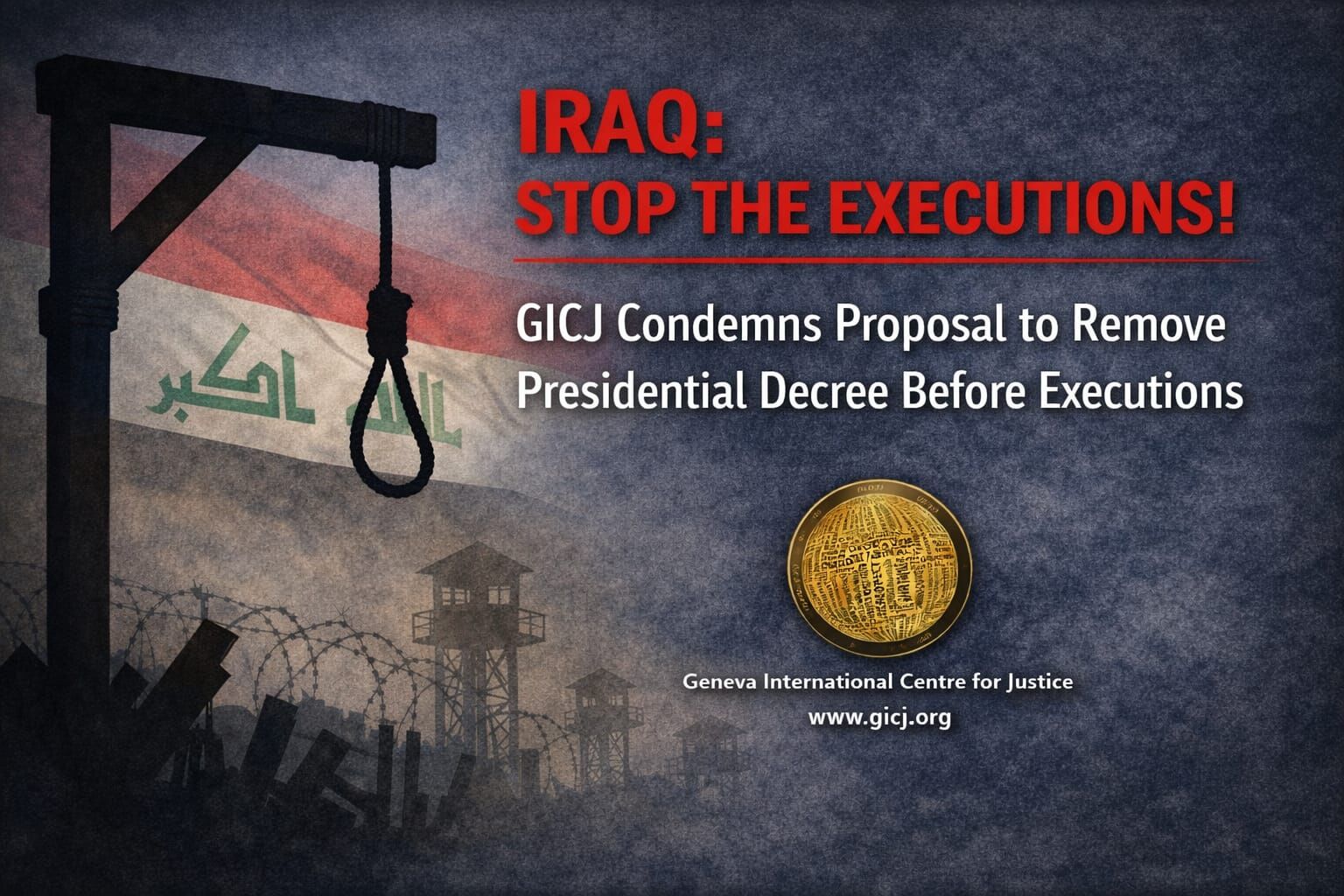
Iraq Must Not Make Execution Easier
GICJ statement condemning the proposal to remove the final safeguard before carrying out death sentences
Key message: In a system already marked by torture allegations, coerced confessions, overbroad terrorism charges, and unfair trials, reducing safeguards before execution increases the risk of irreversible injustice.
Geneva International Centre for Justice (GICJ) strongly condemns the proposal submitted by Iraqi MP Zahraa Fadel Al-Hajjami to amend Articles 285-289 of the Iraqi Code of Criminal Procedure (no. 23 of 1971)so as to remove the requirement of a presidential decree before a death sentence may be carried out. This is not a neutral procedural amendment. It is a measure aimed at accelerating executions by eliminating one of the last remaining institutional restraints between conviction and the irreversible deprivation of life.
This move coincides with the increased of executions in Iraq for a number of person who were deprived from fair trials. Many others died in custody after being subjected to severe torture.
A Legislator Should Strengthen Justice, Not Speed up Executions
At a time when Iraq should be strengthening judicial guarantees, improving the integrity of investigations, and preventing miscarriages of justice, this proposal moves in the opposite direction. A member of parliament should be working to reinforce the justice system, protect the right to a fair trial, and save lives. Instead, this initiative would make it easier for the State to execute people in a system long criticized for torture-tainted confessions, deficient legal representation, and serious due process failures. Where the criminal process itself is under sustained human rights scrutiny, removing a final safeguard before execution is not reform; it is regression.
Iraq's International Obligations are Clear
This proposal must be assessed against Iraq's binding obligations under international human rights law. Iraq is a State party to the International Covenant on Civil and Political Rights (ICCPR). Under article 6, the right to life is protected, and in countries that have not abolished the death penalty, capital punishment may be imposed only in the most exceptional circumstances and subject to the strictest safeguards. The Human Rights Committee has made clear that the death penalty must be limited to the most serious crimes, understood as crimes involving intentional killing, and that it cannot lawfully be carried out after proceedings that fail to meet the guarantees of a fair trial under article 14. Article 6(4) further protects the right of every person sentenced to death to seek pardon or commutation. Removing the presidential decree requirement narrows one of the last practical opportunities for that protection to be meaningfully exercised.
UN Standards Point Toward Restraint and Abolition
United Nations mechanisms have for years urged Iraq to move in the opposite direction: toward restraint, review, commutation, and abolition. The UN High Commissioner for Human Rights has called on Iraq to establish a moratorium on executions with a view to abolition and to ratify the Second Optional Protocol to the ICCPR. The Committee against Torture has urged Iraq to commute death sentences, review the application of counter-terrorism legislation and other laws leading to capital punishment, strengthen due process guarantees at every stage, and ensure that families are notified before executions are carried out.
The Iraqi Context Makes This Proposal Especially Dangerous
The danger of this amendment cannot be separated from the realities of Iraq's justice system. UNAMI and OHCHR have documented the imposition of death sentences for offences that do not meet the international threshold of the most serious crimes, including cases framed around mere membership in a terrorist organization. They have also reported persistent reliance on confession evidence, including where defendants alleged torture or ill-treatment, and noted cases in which no lawyer was present during interrogation by police or other security forces. UNAMI warned that death sentences imposed after proceedings marked by defects in fair trial guarantees may violate articles 6 and 14 of the ICCPR and, if carried out, amount to arbitrary deprivation of life.
The Risk of Sectarian Abuse Cannot Be Ignored
This proposal is even more alarming in light of longstanding allegations surrounding the use of Iraq's Anti-Terrorism Law No. 13 of 2005. For years, serious concerns have been raised that terrorism charges and death sentences were used in a manner that disproportionately targeted Sunni detainees and Sunni communities. In such a context, any proposal designed to speed up executions raises an even graver risk of irreversible injustice on a sectarian basis. Where a legal framework is already accused of discriminatory application, the answer cannot be to facilitate faster executions, but to strengthen safeguards, review convictions, and prevent wrongful death sentences from being implemented.
Removing the Final Check Increases the Risk of Irreversible Harm
Removing the final executive step narrows the time in which wrongful convictions, torture-tainted confessions, fabricated or unreliable evidence, and procedural defects may still be identified before an irreversible punishment is carried out. It also weakens the practical possibility of pardon or commutation. In any justice system, this would be dangerous. In a justice system facing repeated and credible criticism over fair trial violations, it is reckless.
What Parliament Should Be Doing Instead
The duty of lawmakers is not to streamline executions. It is to repair the justice system. Iraqi legislators should be addressing torture, coerced confessions, denial of access to legal counsel, overbroad counter-terrorism charges, and the continuing failure to guarantee fair trials. They should be reducing the risk of wrongful execution, not removing safeguards that may still save a life at the final stage.

GICJ Calls for Rejection of the Proposal
GICJ therefore calls on the Iraqi Parliament to reject this proposal in full. Iraq should instead immediately establish a moratorium on executions, ensure full compliance with fair trial guarantees under the ICCPR, exclude evidence obtained through torture or ill-treatment, guarantee timely access to legal counsel at all stages, protect the right to seek pardon or commutation, and move toward ratification of the Second Optional Protocol to the ICCPR. Any legal reform that makes executions easier in the current Iraqi context is incompatible with the protection of human life, inconsistent with Iraq's international obligations, and dangerously indifferent to the risk of executing people after unfair trials.
International legal basis referenced
- International Covenant on Civil and Political Rights (ICCPR), especially articles 6 and 14.
- ICCPR article 6(4) on the right to seek pardon or commutation.
- Second Optional Protocol to the ICCPR, aiming at the abolition of the death penalty.
- Recommendations of the UN High Commissioner for Human Rights, the Committee against Torture, and reporting by UNAMI/OHCHR on Iraq.
Conclusion
Any amendment to the laws that makes carrying out executions easier in the current Iraqi context would be inconsistent with protecting the right to life, contrary to Iraq’s international obligations, and reflective of a dangerous disregard for the risk of executing people following unfair trials.