



Niger’s Fourth UPR Cycle: Persistent Challenges in Rights, Justice and Protection
By Clara Choucair / GICJ
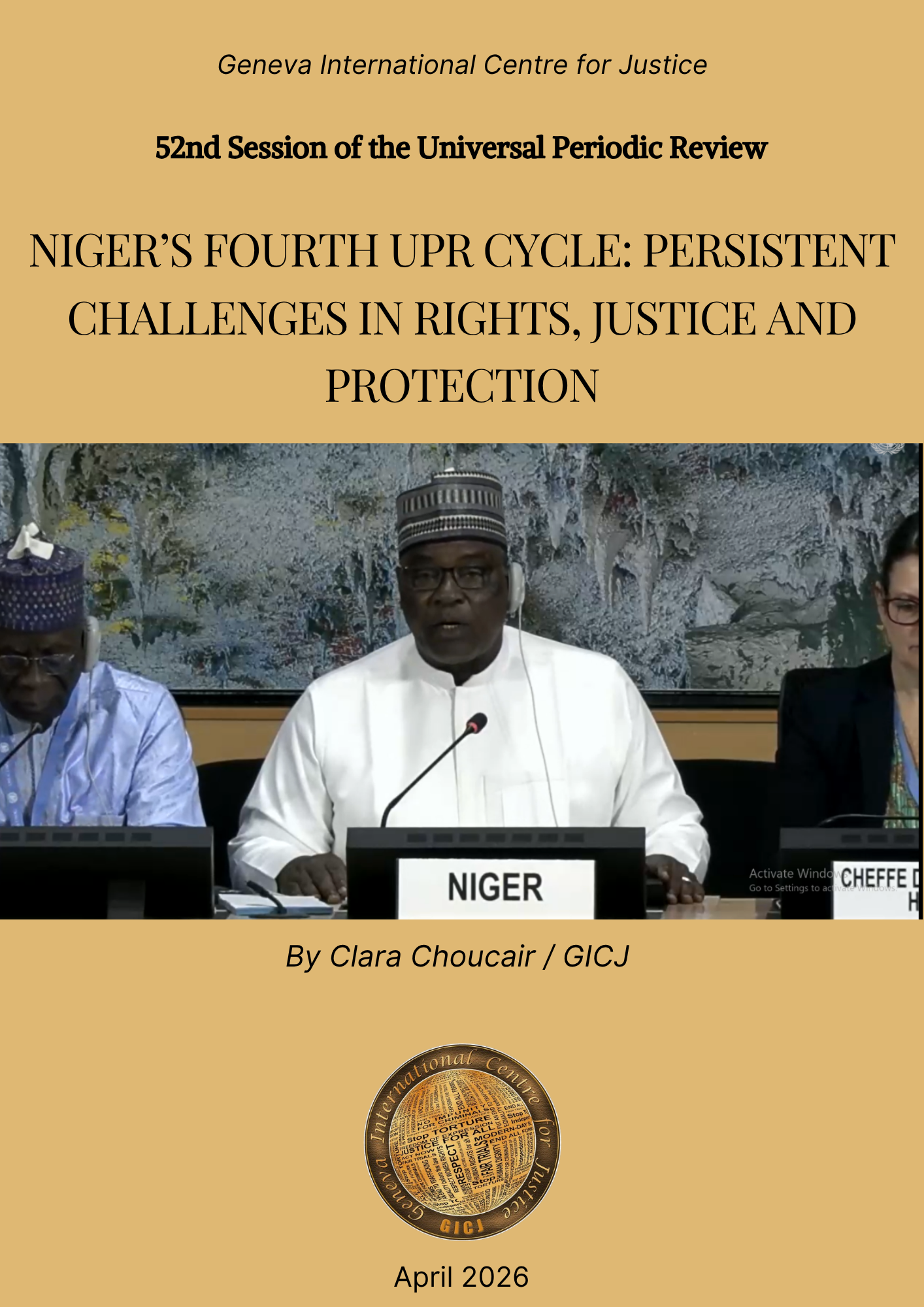
On 4 May 2026, the Human Rights Council convened a meeting under the Universal Periodic Review (UPR) process to examine the human rights record of Niger as part of the fourth cycle of this mechanism. In preparation for this review, the State submitted its national report on 27 March 2026, while the Office of the High Commissioner for Human Rights (OHCHR) and other stakeholders compiled additional reports based on United Nations sources and civil society contributions. The delegation of Niger, led by Alio Daouda, Minister of Justice and Human Rights, presented the State’s position and engaged with recommendations from Member States. The review took place in a context marked by significant political transformation following the military takeover of 26 July 2023, which led to the suspension of the Constitution and the establishment of a transitional framework under the Conseil National pour la Sauvegarde de la Patrie (CNSP). During the interactive dialogue, delegations addressed key concerns, notably calling for the criminalisation of child marriage and the establishment of 18 years as the legal minimum age of marriage, alongside broader efforts to strengthen the rights of the child. Recommendations also focused on combating discrimination against vulnerable groups, advancing gender equality, and addressing violence against women and girls, particularly in rural areas. States further urged Niger to intensify efforts to eradicate slavery and human trafficking, strengthen institutional frameworks, cooperate with international human rights mechanisms, and promote economic and social development, including food security and healthcare. Civil and political rights were also highlighted, with calls to ensure freedom of expression and to release individuals arbitrarily detained, including former President Mohamed Bazoum and his wife. In response, the delegation indicated that most recommendations could likely be accepted, while noting that the abolition of the death penalty would require further internal consultations. The representative also emphasised that national armed forces do not recruit children, attributing such practices to terrorist groups. He further affirmed the State’s respect for the work of NGOs while expressing concern that certain organisations may contribute, directly or indirectly, to insecurity by facilitating or exacerbating terrorist activities, stressing that such actions would not be tolerated. Moreover, the delegation highlighted existing anti-trafficking measures, ongoing efforts to combat malnutrition, and confirmed that compulsory education has been extended to the age of 16. While the State emphasised progress in strengthening legal and institutional frameworks, including the adoption of new legislation and policies in areas such as justice, social protection, and gender equality, United Nations mechanisms and stakeholders continued to underline persistent structural challenges and institutional weaknesses. In particular, concerns were raised regarding the absence of a fully functioning independent national human rights institution following institutional changes introduced after the 2023 political transition.
Many additional issues were discussed and addressed during the dialogue, reflecting the broad scope of the review. Niger continues to face significant human rights challenges shaped by a complex combination of security, political, and socio-economic factors. The country has been deeply affected by armed conflict and terrorism, particularly in regions such as Tillabéri, Diffa, and Maradi, as well as areas bordering Mali, Burkina Faso, and Nigeria. These conditions have contributed to widespread insecurity, civilian casualties, internal displacement, increasing humanitarian needs, and limited access to basic services, with millions of people requiring assistance. Reports further highlight serious violations committed by both non-State armed groups and security forces, including extrajudicial killings and enforced disappearances, raising concerns regarding accountability and compliance with international human rights and humanitarian law. These conditions have exacerbated existing vulnerabilities, especially among women and children, who remain disproportionately affected by poverty, child marriage, limited access to education, and gender-based violence. Despite legislative efforts and some progress reported by the State, including measures aimed at reducing gender-based violence and improving access to education and healthcare, practices such as early and forced marriage, slavery-like practices, and forms of modern slavery persist, often rooted in longstanding cultural norms, discriminatory systems, and insufficient enforcement of the law. Structural challenges, including weak institutional capacity, limited resources, corruption, governance constraints, climate change, economic instability, and recurring humanitarian crises, continue to hinder the effective implementation of human rights protections. Food insecurity and malnutrition also remain critical concerns throughout the country. Furthermore, significant concerns have been raised regarding the deterioration of fundamental freedoms, including restrictions on freedom of expression, peaceful assembly, and civic space. Reports indicate cases of arbitrary detention, harassment of journalists and human rights defenders, and increasing pressure on opposition actors, particularly following the 2023 political transition. Concerns regarding the use of torture and the weakening of institutional oversight mechanisms have also been highlighted by stakeholders and international observers. Overall, the fourth UPR cycle of Niger highlights a persistent gap between the State's formal commitments and their effective implementation. While Niger continues to engage with international human rights mechanisms and has expressed openness to many recommendations, the current political transition, ongoing insecurity, and institutional instability raise serious concerns regarding the sustainability of reforms and the State's capacity to address deeply rooted human rights challenges.
Read the full report by clicking on the image below: