



Enforced Disappearances in Iraq: Seeking Truth and Justice amid Governmental Denial
The 30th session of the Committee On Enforced Disappearances
Geneva 9-19 March 2026
By Ginestra Faeta and Lila Exhertier / GICJ
Introduction
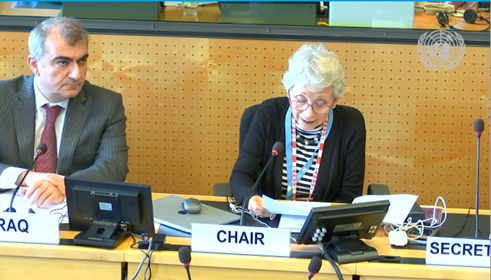
On 11 March, the United Nations Committee on Enforced Disappearances in Geneva held a Dialogue on Iraq. This review represented a crucial moment, not only in uncovering the scale of this ongoing crime, but also in bringing it to the forefront of international attention after years of denial and impunity. The case of enforced disappearances in Iraq is one of the most dangerous cases of violations, as we estimate almost a million people have disappeared since the invasion of 2003 by the United States of America, and this crime has continued by armed groups and militias pro-authorities or operating under their control. Despite the scale of this tragedy, Iraqi authorities are still unable or unwilling to take serious steps to reveal the fate of the missing, hold those responsible accountable, and provide justice for the victims and their families.
Having reviewed the additional information submitted by Iraq under article 29(4) of the Convention, dated 30 October 2024, as well as the observations provided by the State Party on 2 August 2023 regarding the Committee’s report on its visit conducted under article 33 of the Convention, the Committee has decided to focus this dialogue with Iraq on the priority themes and related issues. Therefore, during the session, the Iraqi Minister of Justice, Khaled Shuwani cleared the list of issues addressed by the Special Rapporteurs.
- Harmonization of legislation with the Convention, and institutional framework
The first priority theme asks Iraq how it is aligning its laws and institutions with the Convention on Enforced Disappearance, including adopting a law criminalizing the offence, ensuring accountability, and providing reparations for victims. It also raises concerns about institutional independence, investigations, data on cases, and the impact of the closure of UN investigative mechanisms.
As stated in Article 2 of the International Convention for the Protection of All Persons from Enforced Disappearance (2006), "enforced disappearance" is considered to be the arrest, detention, abduction or any other form of deprivation of liberty by agents of the State or by persons or groups of persons acting with the authorization, support or acquiescence of the State, followed by a refusal to acknowledge the deprivation of liberty or by concealment of the fate or whereabouts of the disappeared person, which place such a person outside the protection of the law.
On the other hand, the Iraqi government stated they have not registered any case of enforced disappearances as per the definition of the Convention, and especially rejects allegations that enforced disappearances still occur within the territory after 2021. While this denial will surprise all those who are well aware about the situation in Iraq, Mr. Shuwani claimed that “this is not a denial but a reflection of the strong legal institutions of Iraq and a source of pride for all of them”. However, the Committee observed that there has not been any progress in the implementation of the recommendation of 2023 and 2024 related to enforced disappearances in Iraq since 2003, and that accountability processes need to be deployed as enforced disappearances remain an ongoing violation due to the absence of its criminalization as an autonomous criminal offense and to entrenched impunity in the Iraqi judiciary system.
Throughout the response, the authorities repeatedly emphasised the existence of domestic legal provisions criminalizing unlawful detention and safeguarding due process. However, these references to the legal framework contrast with persistent concerns raised by international observers about the limited enforcement of these protections in practice. The government also acknowledged that a dedicated Draft Law on enforced disappearances supposed to criminalize enforced disappearance as a separate offence, remains under consideration but has yet to be adopted after several years of discussion. The prolonged delay in approving this legislation continues to draw scrutiny, as the absence of a specific legal framework and effective implementation mechanisms complicates efforts to address allegations, ensure accountability, and provide remedies for victims and their families.
Besides, they also insisted on the creation of a National Committee on Missing Persons in 2024 which aims to coordinate national efforts to determine the fate of missing persons and centralize information across institutions. However, this committee does not seem to be efficient, and only a few meetings have taken place since its creation.
The Iraqi authorities claim their commitment to human rights and international cooperation, they also emphasised their devotion to protecting every form of liberty, starting with the freedom of speech and of opinion. They state that Iraqi laws have criminalized any form of privation of liberty, as a duty to enhance individuals’ freedoms. When it comes to complainers and whistleblowers from the civil society, the Iraqi government affirmed their tolerance and respect for their work. But in reality, the civil society actors who are raising their voices against enforced disappearances and human rights violations are facing real threat and intimidation by the authorities. We have documented that many of them are threatened and suffer from repression, unable to bring cases of enforced disappearances to the attention of the international community, as they face an unwilling government and the fear of disappearing themselves.
- Search, investigation, prosecution and prevention of enforced disappearances
During the Committee session, one of the main issues at stake was the condition of State prisons and the presence of illegal structures of detention. Iraq restated the total control of the Ministry of Justice over State prisons, of which an online database has been published. They also denied the existence of secret prisons, whereas it is well known that there exist many of these facilities under the control of the militias and other bodies affiliated to the government. They also highlighted the adequate treatment of inmates, whereas concerns about non-compliance with international human rights law in Iraqi prisons persist, with prisoners being tortured, starved or unjustly treated in overcrowded cells, as it has been shared in previous reports.
On the same line, the issue of mass graves has been brought up by the special rapporteurs. Law 13 of 2015 was said not to cover all mass graves. Yet, Mr. Shuwani highlighted that the law is absolute and, as absolute laws cover all cases, it covers all mass graves in Iraq, and that a standardized registry has been made. Furthermore, the reports on exhumation are opened to the public and international organizations can take part in the exhumation. He said that all graves are dealt with on an equal footing and that the Iraqi State also guarantees the presence of a committee set by the Ministry of Justice to organize the data in a facilitative manner, in order for users to find data about exhumation and excavation. Notwithstanding these insurances, the special rapporteurs remain concerned about which steps have been taken to fulfil the recommendations previously issued by the Committee. This insurance is far from the reality that mass graves are not efficiently handled by the authorities, but sometimes left under the control of armed groups. Contrary to the recommendations, the victims, families and the civil society organizations are prevented from any type of involvement in the opening procedures of the mass graves.
- Rights of victims of enforced disappearance
With regard to the third theme, the Committee asked Iraq what measures they took to ensure that the legal definition of “victim” complies with the Convention, and guarantees victims’ rights to truth, justice, reparation and participation in investigations. The Committee also addresses measures to remove the death certificate requirement, prevent intimidation and reprisals, implement protection programmes, and safeguard the data, privacy and security of complainants and families of disappeared persons.
In their response, the Iraqi delegation said they “do their best to compensate the families”. They follow-up on this folder from a humanitarian and social perspective, as they reaffirmed their commitment to the international humanitarian framework. As usual, the Iraqi government cited multiple domestic laws that allow for reparation for victims, as well as laws for victims of military errors and terrorist attacks. They added that the families of the victims apparently receive wages as compensation. For example, when Yazidi women were abducted, they provided their families with reparation. In reality, since 2003, compensations in Iraq have been offered to people affiliated with the ruling Parties regardless of being victims or affected by any violations. Therefore, those victims who are not affiliated with the Parties, are suffering from a lot of obstacles to receive any type of compensation or rehabilitation support.
The Iraqi authorities claim their commitment to human rights and international cooperation, they also emphasised their devotion to protecting every form of liberty, starting with the freedom of speech and of opinion. They state that Iraqi laws have criminalized any form of privation of liberty, as a duty to enhance individuals’ freedoms. The reality is different: the freedom of speech has been under severe threat in Iraq since 2003, and it increased sharply in the last three years, especially under the current Prime Minister, who brings journalists and activists to the court in order to bring them to silence.
When it comes to complainers and whistleblowers from the civil society, the Iraqi government affirmed their tolerance and respect for their work. But in reality, the situation of civil organizations reporting in Iraq has been declining: many members operating on the field were forced to leave due to threats and government intimidation, Special Rapporteur Barbara Lochbihler states. She emphasized the necessity for the Iraqi government to give a response and stand up on the stiff increase in violence against civil society members such as journalists, activists or NGO members that work on enforced disappearances. Mr. Shuwani’s response guarantees that the Supreme Council has made a committee “specialized in matters related to mass media, that is able to address issues related to journalists” and that there has been “no cases of journalists arrested without a specific order” as there are competent and specialized Human Rights experts that look into any action that might be contradicting the law.
Finally, the Iraqi government claimed that there are great improvements on the administrative side to answer the Special Rapporteurs. Indeed, they highlighted the creation of a unified database for body identification, thanks to which human bodies or remains were examined with DNA tests. They also attested the existence of a declaration of absence to enable the regularisation of the legal situation of disappeared persons and their relatives, without requiring a death certificate. In reality, the families are still required to provide a death certificate for schools and other administrative structures, even though they are still waiting, hopeful that their loved one will be back. They are forced to accept the administrative death, without getting any answers. According to recent information, the death certificate is still needed, and the situation is deterioring for families.
- State Party’s cooperation with the Committee
This fourth theme questions measures taken to ensure that statistical and analytical data on urgent actions are made public and shared with parliament and the High Commission for Human Rights, how lessons learned from urgent action cases have informed broader reforms in search processes, detention safeguards, victim protection and interinstitutional coordination, including between federal and Kurdistan authorities.
The Minister of Justice suggested the Committee keep him informed about any case of enforced disappearances of their knowledge, in order for them to provide the Committee with the relevant information within the course of the investigation. He further went on stating that Iraq has ratified the Convention on Enforced Disappearances, which entered into force in 2010. This has brought the government to cooperate with the United Nations and to be part of the international community. As for impunity allegations, the response was that the government will review them in the following months, even though “it is considered an important law that requires deep consultation by the competent authorities”.
The Iraqi government repeats the same allegations from the previous years, that they are working to amend the criminal code in Iraq of 1969, to include a dedicated definition of enforced disappearances, to hold people accountable for these crimes when they do occur. Iraq respects Human Rights, including the international convention on enforced disappearances, and it’s one of the first countries to enforce the convention. This, according to the Iraqi delegation, shows compliance with the Human Rights framework.
Conclusion
Iraqi authorities remain largely unwilling to take meaningful and sustained action to uncover the fate of the thousands of individuals who have been forcibly disappeared over the past decades. The scale of this tragedy is staggering: thousands of men, women, and children have vanished since 2003.. These enforced disappearances constitute not only a profound violation of fundamental human rights, including the right to life, liberty, and security, but also represent crimes against humanity under international law, given their systematic and widespread nature.
Families of the disappeared continue to live in a state of unbearable uncertainty and grief, deprived of closure or recognition of their loved ones’ suffering. Despite repeated calls from human rights organizations and international bodies, there has been little progress in investigating these crimes, holding perpetrators accountable, or providing justice and reparations to the victims and their families. The impunity that surrounds these enforced disappearances perpetuates a climate of fear, undermines the rule of law, and erodes public trust in state institutions. Without concrete measures to confront this dark chapter of Iraq’s history, the cycle of human rights violations and denial of justice for victims remains tragically unbroken.
Position of the Geneva International Centre for Justice (GICJ)
The Geneva International Centre for Justice (GICJ) strongly condemns the continued use of enforced disappearances in Iraq. This practice violates fundamental norms of international law and, in certain circumstances, may amount to a crime against humanity. GICJ calls on the Committee to take immediate and decisive recommendations for Iraq. First, legal frameworks must be strengthened and enforced disappearances must be recognized as a distinct crime in national legislation. Second, institutional mechanisms must be reinforced by ensuring independent investigations and full cooperation with international monitoring bodies. Finally, Iraq must guarantee the protection and active participation of victims’ families, while also providing reparations and adequate psychosocial support to survivors and affected relatives.