



Will the Rwanda-DRC Peace deal end decades of Conflict?
By Mildred Asiimwe / GICJ
Executive Summary
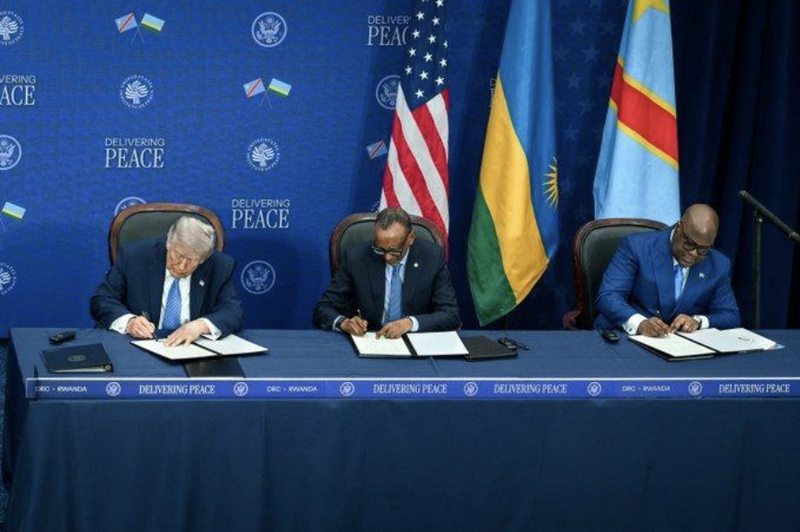
On December 5 2025, Presidents Felix Tshisekedi of the Democratic Republic of Congo and Paul Kagame of Rwanda signed a peace deal aimed at ending the long-running conflict. In a summit hosted by US President Donald Trump in Washington, the two leaders signed what many see as an endorsement of an agreement that was reached in June, which has failed to end the fighting.
Other African Leaders in Attendance were the Presidents of Kenya (William Ruto), Angola (João Lourenço), and Burundi (Évariste Ndayishimiye), the Prime Minister of Togo (Faure Gnassingbé), and the Vice President of Uganda (Jessica Alupo) also witnessed the signing ceremony in support of a regional peace initiative.
Background of the Conflict
The DRC-Rwanda conflict is partially a result of the 1994 genocide in Rwanda, in which an estimated 800,000 Tutsis were killed by Hutus. In the aftermath, Hutu extremists fled to eastern DRC, regrouped and continued fighting the Rwandan government and threatened the Tusti (called Banyamulenge) in Congo. Rwanda pursued the extremists, resulting in wars that have lasted for three decades, instability, ethnic tensions and the creation of several armed groups, one of which is the M23 that currently controls parts of the mineral-rich Kivu province in DRC. Other factors that have exacerbated the conflict include minerals; Eastern DRC is mineral-rich, which has led to the rise of various armed groups all fighting for resource control and fueling the conflict. The current conflict began in 2022, after going largely quiet since 2013. Early in 2025, M23 captured territories in Goma and Bukavu, the capital cities of the North and South of the province of Kivu. The conflict has drawn in neighbouring countries like Uganda and Burundi, with Presidents Kagame and Tshisekedi accusing their neighbours of taking sides.
There have been several attempts to end the conflict, including the mediation talks by Kenya and Angola, which did not yield lasting solutions. In March 2025, Presidents Kagame and Tshisekedi met in Doha, Qatar, and both called for a ceasefire, which the M23 rejected. Following this meeting, the US and Qatar worked closely to bring about further negotiations, resulting in the signing of the peace deal in Washington.
The Washington Peace Deal
The East African Community (EAC), of which both Rwanda and DRC are members, hailed the agreement as a significant historic moment and is optimistic that tensions between Kigali and Kinshasa will finally come to an end. Other members are hopeful that the peace deal will improve security and, hopefully, give the bloc credibility as one of the platforms for resolving disputes within the region.
The peace deal was generally received with enthusiasm from political leaders and citizens. Both Presidents welcomed the peace deal with President Kagame saying the deal contained “everything needed to end the conflict once and for all”, while President Tshisekedi called it a historic turning point and a symbol of “irreversible commitment” to ending the conflict once and for all.
President William Ruto of Kenya welcomed the agreement as a "decisive act to end a devastating conflict," emphasising its transformative and historic nature.
The African Union Commission (AUC) Chairperson, H.E. Mahmoud Ali Youssouf, welcomed the agreement as a “significant milestone” for lasting peace, security, and stability. He acknowledged the efforts of African mediators like Togo and Angola; support from the US and Qatar and commended the Presidents Kagame and Tshisekedi for recognising the importance of the peace deal.
Bishop Samuel, a Communications Expert in the Ministry of East African Community Affairs, Uganda wrote, “My prayer is that this agreement does not remain a ceremonial document but becomes a living testament to the power of African resolve” [1].
There was criticism from some African leaders, notably Ibrahim Traoré of Burkina Faso (quoted in social media discussions), who criticised the agreement for being signed in the United States, framing it as African leaders “crossing the oceans to cede their minerals” and questioning the compromise of African sovereignty for foreign favour.
Burundi's Foreign Minister Edouard Bizimana accused Rwanda of continuing “destabilising activities” on the border, warning Burundian troops would not withdraw until their mission was accomplished.
Concern about Ongoing Violence: Even as the deal was signed in Washington, fighting on the ground in Eastern DRC surged. Local media reported that ongoing hostilities were causing civilian deaths and displacement, questioning the relevance of the peace deal.
Aftermath of the Peace Deal
Just days after the signing of the peace deal, China Global Television Network (CGTN) Kenya reported that Rwanda launched attacks in Eastern DRC, killing several people and destroying property in parts of Kivu province. Gunfire was exchanged between the M23 rebels and the DRC government forces. President Tshisekedi accused Rwanda of violating the terms of the peace deal, and sources in the DRC accused Rwanda of bombing schools, health centres and homes [2].
As of December 10, 2025, there were reports of fresh fighting in Eastern DRC resulting in 74 deaths and more than 200,000 civilians fleeing into Rwanda, following fighting between M23 and a joint force of Burundian and Congolese soldiers [3].
Position of Geneva International Centre for Justice
Geneva International Centre for Justice (GICJ) is supportive of all efforts to bring peace to the Democratic Republic of Congo and calls upon Rwanda and the DRC to continue working towards ending the conflict. GICJ is especially concerned about human rights violations, especially in the aftermath of the peace deal in Washington. GICJ calls upon armed groups to cease fire in order to prevent more deaths and the displacement of civilians. GICJ further commends the DRC and Rwanda’s neighbours who have played mediation roles and encourages them to continue all efforts to prevent further human rights violations.
References:
[1]https://www.monitor.co.ug/uganda/oped/commentary/rwanda-dr-congo-peace-deal-turning-point-for-eac--5292436#goog_rewarded
[2] https://www.facebook.com/watch/?v=824516317226854
[3]https://www.theeastafrican.co.ke/tea/news/east-africa/200-000-flee-new-advance-of-rwanda-backed-rebels-in-congo-5292074