



Promises on Paper, Stagnation on the Ground: An Analysis of Nepal’s Fourth UPR Cycle
By Melissa Fuhrer/ GICJ
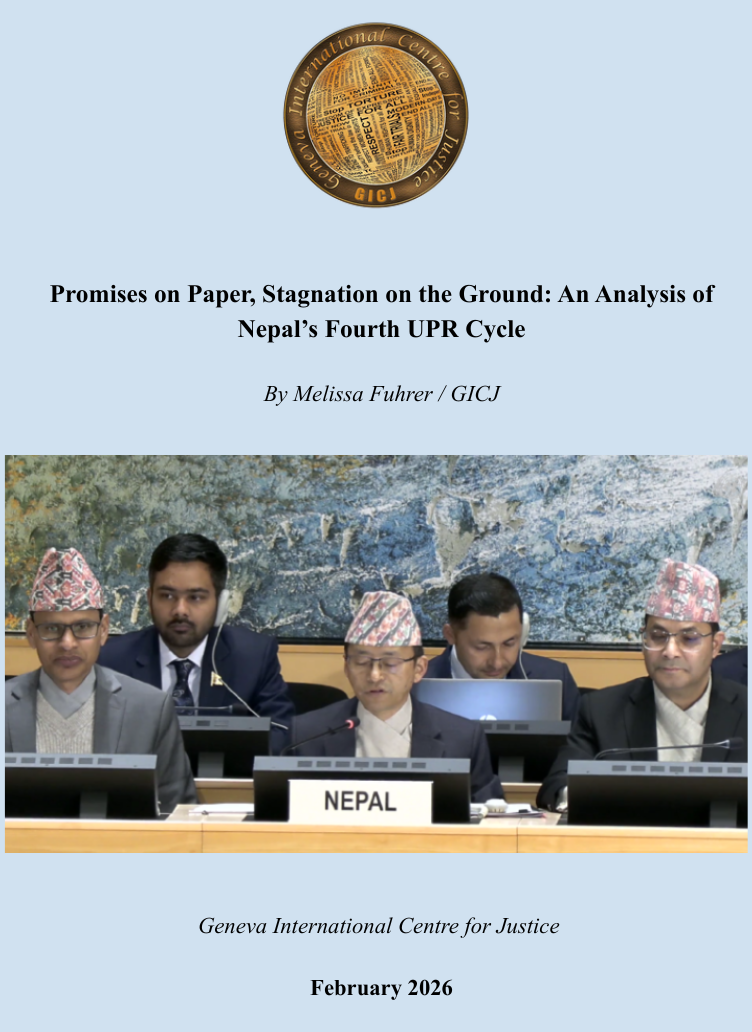
On 21 January 2026, the Universal Periodic Review (UPR) Working Group of the UN Human Rights Council conducted its fourth periodic review of the human rights situation in Nepal. The State submitted its report dated on 17 July 2025. Other documents related to the review were the report submitted by human rights bodies and other stakeholders.
After briefly reviewing Nepal’s current domestic political situation and its participation in the 37th UPR session of the Working Group, this report notes the recommendations made by 101 countries during this 51st UPR session, where Nepal is currently partaking in its fourth review.
This report provides a brief analysis of the recommendations made during the current UPR cycle in comparison with Nepal’s previous review. The recommendations from various countries reflected distinct geopolitical priorities, economic conditions, and national areas of expertise. For example, countries in the Global North focused more heavily on the rule of law, transitional justice, and individual liberties. Conversely, countries of the Global South prioritised poverty alleviation, food security, and the rights of labourers.
Regarding national areas of expertise, countries known for their progressive marriage laws (Iceland, the Netherlands, and Uruguay) recommended that Nepal redefine marriage in gender-neutral terms and ban conversion therapy. Nations with strong domestic protections for reproductive autonomy, such as France and Iceland, pushed for the decriminalisation and legalisation of abortion in all circumstances.
Geneva International Centre for Justice (GICJ) acknowledges Nepal’s constitutional recognition of a broad range of civil, political, economic, social, and cultural rights, as well as the State’s continued engagement with the Universal Periodic Review process. However, GICJ remains concerned by the persistent gap between formal commitments and their effective implementation. Despite Nepal’s consistent acceptance of recommendations across successive UPR cycles, progress on the ground - particularly regarding transitional justice, caste-based discrimination, accountability for past human rights violations, and institutional independence - has remained limited. The lack of enforcement mechanisms and delayed reforms risks reducing compliance to a performative exercise rather than a genuine effort toward structural change.
GICJ is particularly alarmed by recent developments surrounding restrictions on freedom of expression, including the 2025 social media ban, and the use of force during protests. These measures raise serious concerns regarding Nepal’s adherence to its international obligations under instruments. GICJ stresses the urgent need for independent, transparent investigations into protest-related violence, the strengthening of safeguards for peaceful assembly, and the revision of media and cybersecurity legislation to ensure full compliance with international human rights standards. Furthermore, GICJ supports recommendations calling for the ratification of key international treaties, including the Rome Statute of the International Criminal Court and the Convention against Enforced Disappearance, as essential steps toward combating impunity and restoring public trust.
Read the full report by clicking on the image below.