



From the Bazar to the Streets: Iran’s Protests and the Escalating Repression
By Delfina Fiammenghi / GICJ
Introduction
Since 28 December 2025, Iran has been gripped by a rapidly growing wave of protests. Demonstrations have expanded far beyond Tehran, spreading across cities nationwide.
Geneva International Centre for Justice (GICJ) is deeply alarmed by the escalating reports of violent repression, unlawful detention, and serious human rights violations committed against demonstrators exercising their rights to freedom of expression and peaceful assembly in Iran.
Escalating Repression and the Information Siege
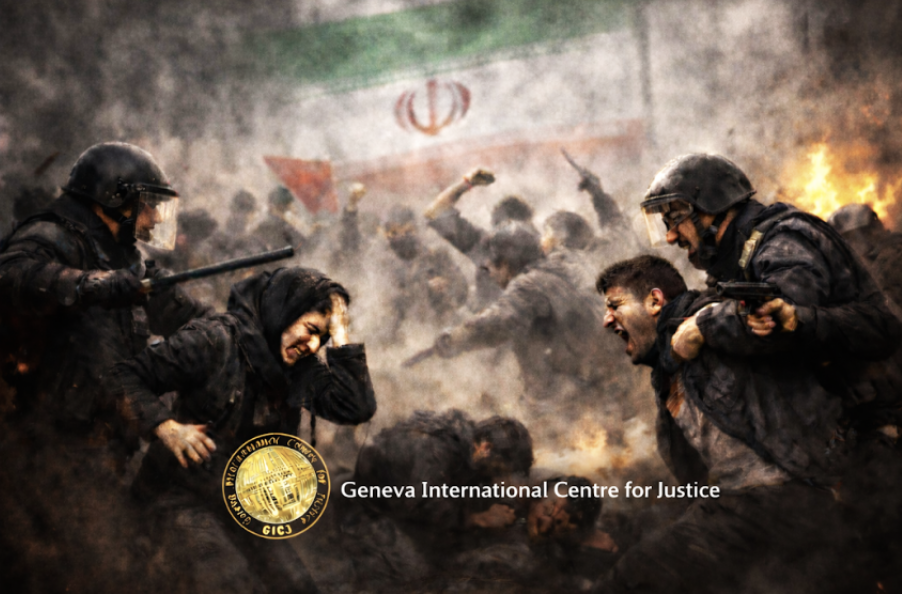
What has intensified the alarm in recent days is not only the scale of the unrest, but the pattern of alleged violations accompanying the authorities’ response: lethal force against protesters, mass arrests, intimidation in hospitals and public institutions. Furthermore, an escalating “information siege” has taken the form of a near-total shutdown of internet and mobile connectivity, designed to sever Iranians from one another and from the outside world at precisely the moment independent scrutiny is most needed. Despite the blackout, human rights monitors have documented a mounting toll of casualties, including hundreds of people reported to have been killed and thousands detained. The very fact that figures remain so difficult to verify underlines the danger of the blackout itself: when communications collapse, accountability collapses with them.
We are gravely concerned by the credible reports documenting the use of excessive force against peaceful protesters, widespread arbitrary arrests, interference with communications and access to information, and the apparent denial of fundamental civil and political rights. These actions not only violate Iran’s international legal obligations under treaties to which it is a party, but also undermine essential norms of international human rights law. We condemn in the strongest terms:
- The disproportionate and lethal use of force against demonstrators, including live ammunition and crowd-control tactics that have led to deaths, injuries, and ongoing fear among civilians;
- Mass arbitrary detentions of individuals engaged in peaceful protest activities;
- Restrictions on access to the internet and other platforms, which impede the right to free expression and transparency. The ability to seek help, share information, and document violations is not a luxury, it is part of the architecture of human rights protection;
- Judicial and security practices that appear to lack due process, including tactics aimed at intimidating human rights defenders, lawyers, journalists, and protest participants.
We call on the international community to pressure the authorities in Iran to:
- Cease all unlawful use of force against peaceful demonstrators and respect the rights to freedom of expression and assembly.
- Immediately release all individuals unlawfully detained for participating in or supporting peaceful protests.
- Ensure independent, transparent investigations into all reported cases of unlawful violence, killing, and abuse, and hold those responsible to account under international law.
- Facilitate unfettered access for independent international human rights monitors to document and report on the situation.
- Protect the rights of human rights defenders, lawyers, journalists, and civil society activists who face harassment or persecution for their role in defending fundamental freedoms.
UN Warning and the Demand for Restrain
Against this backdrop, the United Nations has issued unusually direct warnings. In a statement delivered by the Secretary-General’s spokesperson, António Guterres emphasised that all Iranians must be able to express their grievances peacefully and without fear, calling for the rights to expression, association, and peaceful assembly to be respected, urging authorities to exercise maximum restraint, and explicitly calling for steps to restore communications and access to information.
Equally significant are the warnings attributed to the UN-mandated Independent International Fact-Finding Mission on Iran, which said it was alarmed that security forces had been ordered to carry out a “decisive” crackdown “without restraint,” and urged the unconditional release of those arbitrarily detained for exercising protected rights.
These developments should be read through the lens of international law, which is not optional rhetoric but binding obligation. The Universal Declaration of Human Rights affirms that everyone has the right to freedom of peaceful assembly and association. The International Covenant on Civil and Political Rights, to which Iran is a State party, recognises the right of peaceful assembly and permits restrictions only under strict, necessity-based conditions. Even where public order is invoked, the baseline does not change: restraint, proportionality, and accountability are not discretionary.
Blaming Foreign Hands: Tehran’s “Terrorist Agents” Narrative
As protests spread and the state’s response hardened, Iranian authorities have moved quickly to frame the unrest not as a domestic uprising but as a coordinated security threat driven from abroad. In official statements and state-linked coverage, demonstrators have been portrayed as foreign agents and even terrorist elements, with Foreign Minister Abbas Araghchi describing during a press conference the street mobilization as a “terrorist war” against the country. Tehran has also said its security services seized weapons and explosives from “militants,” and officials have claimed they possess audio and other evidence showing orders being issued from outside Iran, an argument the government is using to justify sweeping communications restrictions, including major internet cutoffs. This narrative aims to shift attention away from the grievances animating the streets and toward an external enemy; yet the speed and breadth of the mobilization point to pressures that are largely internal. To understand why the protests caught fire so quickly, and why the bazaar became such a powerful catalyst, it is necessary to look beyond the government’s foreign-infiltration claims to the country’s deepening economic crisis and the daily reality of misgovernance, repression, and declining living standards.
Why the Protests Spread so quickly: the Bazar as a Catalyst
To understand why the protests spread so quickly, it is important to know where they began: the bazar. On 28 December, shopkeepers in Tehran’s main commercial districts closed their businesses after a sudden spike in the exchange rate, and what started as market paralysis spilled into the streets. The demonstrations, which began in Tehran’s bazar and quickly spread to numerous cities across the country, have been driven above all by those social groups hit hardest by the rising cost of living and inflation, while the central authorities appear increasingly unable to govern the instability. The bazar indeed is not only an economic space; it is also a dense social infrastructure that can translate collective livelihood pressure into collective action. When the bazar moves, it often signals that economic instability has reached well beyond the margins. The tensions manifested in the present had been mounting for years, sparked by economic hardship and prolonged misgovernance.
This is the moment when economics stops being just economics. A collapsing currency becomes a political event not because people suddenly turn ideological, but because the breakdown of the rial destroys the basic conditions of everyday life. Years of structural fragility and recurring economic crisis have converged with an extreme phase of currency depreciation and inflation widely cited above 40%. In this context, the protests are not an anomaly; they are an eruption from a long buildup of livelihood insecurity and institutional paralysis.
Beyond the 2022 Lens
Global coverage is often framing the current unrest through the lens of the 2022 uprising. However, the present wave is not simply a replay: it is shaped by a different mix of pressures and should be assessed in its own context. In 2022, female students were among the earliest and most visible actors. As mobilisation grew, the nature of the protests broadened: the initial demand for accountability expanded into wider denunciations of authoritarian rule, with slogans moving from “Woman, Life, Freedom” to explicitly anti-regime, and often anti–Supreme Leader, messages. Back then, women’s rights remained at the centre inside Iran and across unusually large diaspora mobilisations.
The current protests, by contrast, appear to be driven by a different impulse. The struggle for personal freedoms and gender equality remains part of the movement’s political memory, but the immediate grievance today is more clearly tied to widespread economic distress and a sense of collapsing livelihoods. This distinction matters. In 2022, the gender-equality core of the uprising galvanised many, especially younger Iranians. However, it also faced structural limits in reaching more conservative parts of society where acute economic insecurity can constrain participation and where daily survival concerns tend to dominate political mobilisation. This time, the movement seems to cut more quickly across social and geographic lines, suggesting a greater capacity to penetrate beyond a single demographic or symbolic register.
Geneva International Centre for Justice (GICJ) calls for an immediate end to the use of lethal and unlawful force against demonstrators and for independent investigations into killings and injuries; an end to arbitrary detention, enforced disappearances, coerced confessions, and intimidation of families; and full restoration of internet and mobile connectivity.