



From International Women’s Day to HRC61:
Reaffirming Women’s Rights as Universal Human Rights
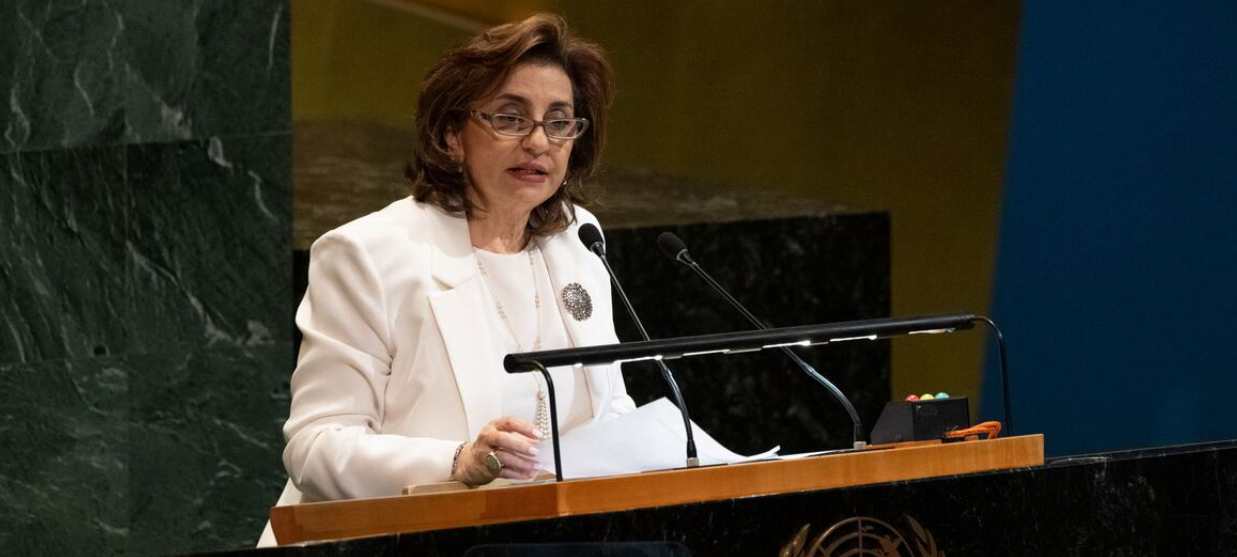
UN Photo/Evan Schneider Sima Sami Bahous, Executive Director of UN Women, addresses the opening of 70th Session of the Commission on the Status of Women.
Delfina Fiammenghi / GICJ
Just a few days after International Women’s Day was marked on 8 March 2026 under the UN theme “Rights. Justice. Action. For All Women and Girls,” the 70th session of the Commission on the Status of Women opened in New York from 9 to 19 March 2026 around a clear priority theme: ensuring and strengthening access to justice for all women and girls. At the same time, in Geneva, the Human Rights Council’s 61st session has been taking place, from 23 February to 31 March 2026, including the interactive dialogue with the Special Rapporteur on the right to privacy, Ana Brian Nougrères, and her report on international collection and processing of personal data, compiled after her country visit in Nepal. That overlap should have created a moment of institutional clarity. Instead, it exposed a troubling gap: while one UN space speaks of justice for women and girls, another still struggles to confront how deeply that justice is being undermined in digital spaces. The lack of intersectionality is one of the causes of the weakening of the effectiveness of women’s rights revindications and, as GICJ, we here take the opportunity to highlight the importance of filling this gap.
The digital revolution has not merely transferred existing forms of gender-based violence onto new platforms. It has intensified them, accelerated them, and globalised them. Sexual harassment, stalking, hate speech, misinformation, and defamation now circulate through data systems, social media platforms, and digital infrastructures at a scale that was previously impossible. At the same time, technology has generated new forms of abuse: hacking, doxing, cyberbullying, online grooming, and image- and video-based abuse, including deepfakes. For millions of women and girls, the digital sphere is not a neutral environment but a space of surveillance, intimidation, humiliation, and control.
The scale of the problem is impossible to dismiss. UN Women notes that global studies place the prevalence of technology-facilitated violence against women between 16 and 58 per cent. Regional data confirms that this is not a local anomaly but a global pattern: 60 per cent of women internet users in the Arab States have experienced online violence; research across 12 countries in Eastern Europe and Central Asia found that more than 50 per cent of women over 18 had experienced some form of technology-facilitated abuse in their lifetime; a study across five countries in sub-Saharan Africa found that 28 per cent of women had experienced online violence; and a survey across Europe, New Zealand, and the United States found that 23 per cent of women reported at least one experience of online abuse or harassment.
These figures are not abstract. They reflect daily realities. Sexual harassment and stalking remain among the most commonly reported forms of technology-facilitated violence against women and girls. Perpetrators use unwanted messages, abusive posts, phone calls, and the non-consensual sharing of intimate images. Women are harassed in comment sections, flooded with sexually explicit or threatening messages, tracked through GPS-enabled applications, blackmailed with intimate images, and targeted through coordinated campaigns intended to shame, isolate, or silence them. Then, what begins online rarely remains there, with digital abuses spilling into workplaces, schools, streets and homes.
That is precisely why the UN Secretary-General’s report for CSW70, Ensuring and strengthening access to justice for all women and girls, including by promoting inclusive and equitable legal systems, eliminating discriminatory laws, policies and practices, and addressing structural barriers, is so important. The report makes clear that legal equality remains out of reach for the majority of the world’s women and girls, who enjoy only 64 per cent of the legal rights of men. It also notes that 54 per cent of countries still lack consent-based legal definitions of rape. These are not marginal shortcomings. They reveal a structural crisis, that becomes even more acute when violence and discrimination are reproduced through digital means.
For that reason, the international fora should produce a stronger and more explicit institutional response and commitments. During HRC61, the Special Rapporteur on the right to privacy raised essential principles: that protection must travel with the data, that legal frameworks must be updated for an interconnected world, and that technology must serve humanity. Yet the broader debate has still not sufficiently centered the specific ways in which women and girls are harmed by online abuses, internet-enabled impunity, and weak cross-border accountability. A discussion on privacy that does not directly confront gendered digital violence remains incomplete. This silence matters because privacy violations are not gender-neutral. Surveillance, doxing, impersonation, non-consensual image-sharing, and the exposure of personal data disproportionately affect women and girls, when they are politically visible or professionally exposed, as well as when marginalised. Harm travels quickly across jurisdictions, while protection remains slow, fragmented, and uneven. Platforms are global; remedies are not. This is why the connection between UN meetings, and the lived reality of women cannot remain rhetorical. If CSW70 identifies justice as a central issue for women and girls, then HRC61 cannot treat the digital dimension of that injustice as secondary, or even non-existent.
The problem extends beyond online abuse alone. The increasing digitisation of legal and administrative systems can itself reproduce discrimination. Artificial intelligence tools used in bail decisions, sentencing recommendations, risk assessments, and case management are often presented as efficient and objective. In reality, when built on biased data or deployed without adequate safeguards, they can replicate existing inequalities on the basis of gender, race, and class. Digital injustice is therefore not separate from legal inequality; it is one of its newest and most sophisticated expressions. That is why access to justice for women and girls must include scrutiny of the technologies now shaping legal outcomes and any serious critical assessment of the human rights impact of new technologies must also examine how digitisation affects women.
The international community cannot claim that it lacks the necessary tools. The Beijing Declaration and Platform for Action, the 2030 Agenda for Sustainable Development, and the Convention on the Elimination of All Forms of Discrimination against Women already provide a normative framework. Member States have committed themselves to equal access to justice and to legal systems that promote, enforce, and monitor equality and non-discrimination. Yet implementation remains stalled. UN reporting highlighted for CSW70 shows that no reporting country has fully closed legal gaps across the areas measured under Sustainable Development Goal indicator 5.1.1.
As Geneva International Centre for Justice, we ask that formal equality on paper does not continue to coexist with substantive injustice in practice. This matters, especially in a time where different overlapping emergencies share a common denominator: today's ecological, economic, social, or political crisis, all reveal violence as a non-incidental element of political systems. National-populist regimes are often marked by masculinity and the normalisation of domination as a governing style. To oppose patriarchy and to pretend equal rights for women, is therefore not only to demand protection from a gender based harm; it is to reject a model of power built on force and exclusion, and to insist instead on a constructive, inclusive, and democratic form of power, one rooted in the capacity of all people to act and to shape their own future. Too often, public discourse speaks only about what women ask for and what women are given, but not about what women offer to institutions, to democracy, and to the evolution of rights. That omission undermines how feminism has been one of the most powerful forces for rethinking social and political life. From universal suffrage to divorce, from bodily autonomy to labour struggles, from the critique of authoritarianism to the rebellion against every form of exclusion, women’s struggles for equal rights have, across the centuries and protests, been the lifeblood of emerging democracies around the world. Today, they are the bones that allow our democracies to stand, preventing what remains of the international order from collapsing. Feminism, as the last international utopia. In this sense, the struggle against gender inequality is not a sectoral issue, but a resource for a broader democratic contestation against violence. This evidence was also acknowledged by UN Secretary-General António Guterres, who, speaking at the CSW70 Town Hall Meeting with Women Civil Society Leaders on 10 March 2026, praised those actors as “foundation-shakers” who advance “justice, dignity and equality for communities across the globe.”
Geneva International Centre for Justice (GICJ) recommends to the international community to move beyond general declarations and place technology-facilitated violence against women and girls at the centre of international human rights, privacy, and justice agendas. This means strengthening legal frameworks in line with Sustainable Development Goal indicator 5.1.1; eliminating discriminatory laws and closing legislative gaps on gender-based violence and ensuring that women’s rights organisations and feminist movements are directly involved in shaping both legal reform and technological governance. Moreover, and most importantly, we call on the international community to adopt an intersectional approach across all international fora, to ensure women’s rights are not isolated, but integrated into every discussion that shapes equality, accountability, and democracy. The UN already has the language, the commitments, and the evidence. What is still missing is coherence: the urgency invoked on 8 March, the findings of the UN Secretary-General’s report for CSW70, and the debates at HRC61 must finally speak to one another.
Bibliography
UN News, ‘Women’s rights are regressing worldwide, warns UN gender equality chief’ (4 March 2026); link: https://news.un.org/en/story/2026/03/1167081
UN Women, International Women’s Day 2026 & the 70th Session of the Commission on the Status of Women, Media Advisory, 25 February 2026; link: https://www.unwomen.org/en/news-stories/media-advisory/2026/02/iwd2026-and-csw70
UN Women, CSW70 (2026), Commission on the Status of Women, 9–19 March 2026; https://www.unwomen.org/en/how-we-work/commission-on-the-status-of-women/csw70-2026
United Nations, Ensuring and strengthening access to justice for all women and girls, including by promoting inclusive and equitable legal systems, eliminating discriminatory laws, policies and practices, and addressing structural barriers, Report of the Secretary-General, E/CN.6/2026/5, 22 December 2025.
UN Women, FAQs: Digital abuse, trolling, stalking, and other forms of technology-facilitated violence against women, 13 November 2025; https://www.unwomen.org/en/articles/faqs/digital-abuse-trolling-stalking-and-other-forms-of-technology-facilitated-violence-against-women