



International Day of Zero Tolerance for Female Genital Mutilation (6 February 2026)
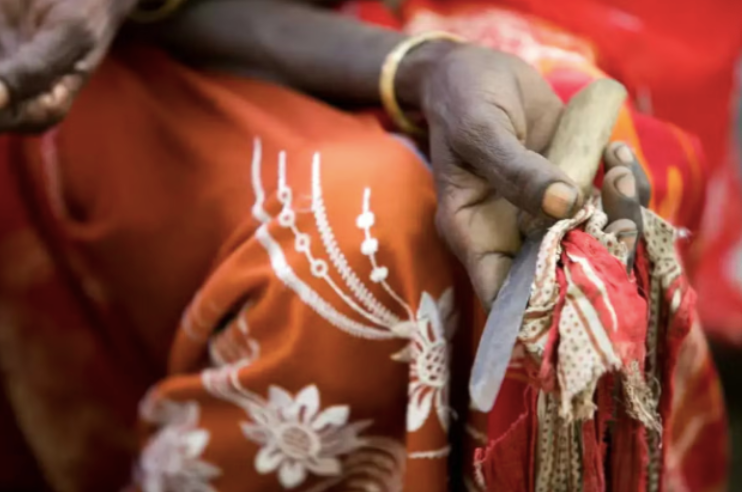
Boko Mohammed, a former excisor (a practitioner who performs female genital mutilation) holds the tool she used to perform the procedure at a community meeting in Kabele Village, in Amibara District, Afar Region (Ethiopia). Photo: UNICEF/ Kate Holt
By Tamira Gibbs Chumillas / GICJ
Introduction
The International Day of Zero Tolerance for Female Genital Mutilation takes place on 6 February with the aim of raising awareness of a practice that constitutes a severe human rights violation against the autonomy of women and girls. FGM was officially recognised as a violation of human rights by the UN in 1993. Over 230 million girls worldwide have been subjected to female genital mutilation (FGM), a non-medical procedure that consists in the “partial or total removal of the female external genitalia.”[1] FGM can cause lifelong physical impediments, including infertility and chronic pain, along with profound mental health issues. Although a decrease in FGM cases has been observed over the last three decades, rapid population growth in countries where FGM persists threatens to undermine progress made.[2]
Reasons Behind FGM
FGM is performed in many countries, particularly in Africa and the Middle East. FGM is practiced for a variety of different reasons, including as a means of social acceptance within the community, for religious reasons or as a rite-of-passage into adulthood. FGM is also linked to misogynistic conceptions of “purity” and “cleanliness,” wherein the act of altering female genitalia is presented as a method of “preserving” a woman’s virginity until marriage. In many communities, virginity is seen as a priceless commodity that reflects the moral integrity and worth of girls and women.
Consequences of FGM
There are no hygienic advantages or health benefits to FGM. On the contrary, women who have undergone FGM often suffer from short-term risks and later develop lifelong health complications. Often times, FGM is carried out in appallingly unhygienic conditions where the instrument of incision is used on several girls or women consecutively without being disinfected. Short-term health risks include haemorrhaging, infections and genital tissue swelling. In some cases, women have died as a direct result of FGM due to tetanus and excessive bleeding.
Long-term health risks can occur at any time during a FGM victim’s life. This includes chronic pain due to tissue damage and improper scarring, genital infections, reproductive tract infections, urinary tract infections, vaginal problems (including bacterial vaginosis) and menstrual problems (especially for women with Type III FGM). Furthermore, women who have been subjected to FGM suffer from sexual complications, including painful sexual intercourse, difficulty during penetration and decreased sexual desire. FGM is also associated with infertility and increased complications during childbirth, frequently leading women to resort to caesarean sections, which are often carried out in unsafe circumstances without the proper medical equipment and appropiate hygiene standards.[3]
UN Stance
In 2012, the UN General Assembly unanimously passed a resolution banning the practice of FGM. Furthermore, General Recommendation No. 14 on the subject of “Female Circumcision,” the Convention on the Elimination of All Forms of Discrimination Against Women (CEDAW), recommends that states that are party to the convention take effective measures in order to eradicate FGM. These include: supporting women’s organisations at a national and local level, encouraging politicians, professionals, religious and community leaders to cooperate in influencing attitudes towards eliminating FGM, as well as introducing appropiate education and training programmes based on research findings about the problems arising from this harmful practice.[6]
The Special Rapporteur on the Rights of Women in Africa (SRRWA), Hon. Janet Ramatoulie Sallah-Njie, reiterates that the prohibition of FGM is enshrined in the Protocol to the African Charter in Human and People’s Rights on the Rights of Women in Africa (the Maputo Protocol).[7] This protocol, which has been ratified by 44 African states as of 2024, calls on State Parties to enact and enforce laws prohibiting any form of FGM. Although the Special Rapporteur acknowledges the commendable progress carried out by many African States in implementing laws that criminalise FGM, she voices concern about the threat of setbacks to this progress that have arisen in recent years. As of early 2026, The Gambia has seen concerted efforts to overturn the decriminalisation of FGM.[8] Supporters of FGM claim that the criminalisation of FGM constitutes a “violation” of Gambians’ constitutional rights to cultural and religious freedoms. The UN strongly rejects this argument, stating that “though we honour cultural traditions, alternative rites of passage must be embraced - ones that celebrate girls without subjecting them to violence.”[9]
Case Study
Omnia Ibrahim, a blogger from Egypt, recounts her experience of being subjected to FGM at only 11 years old. On her blog, she writes “I knew that day that my right to be a complete human being had gone.”[10] To her, FGM is performed simply for the “crime of being a woman.” She felt like a stranger in her own body, unable to nurture her sexuality and ultimately leading her to renounce any sexual intimacy as a result of shame and a sense of estrangement from all that had to do with love. For Ms. Ibrahim, the mere fact that her body had known such mutilation meant that any sexual intimacy would constitute “another act of violence,” which would only serve to remind her of what she had suffered. [11]
Conclusion
FGM is an attempt to not only control women’s sexuality, but to completely eradicate it. Women’s bodies are seen as being inherently unclean - both physically and figuratively. To be born a woman is to be born imperfect. Normal human desires, such as libido, are deemed unnatural when manifested in women. Men, on the other hand, do not face the same type of discrimination with regard to their sexual desire, as evidenced by the fact that certain FGM procedures (especially FGM Type III) are positively promoted as providing more pleasure for the man during sexual intercourse.[12] The continuation of FGM is the perpetuation of the myth of the inherent uncleanliness of women and the misogynistic notion that a woman needs to have her sexuality controlled or eradicated to be considered an acceptable member of a community.
Geneva International Centre for Justice (GICJ) adamantly condemns the practice of FGM which violates the rights of women and girls and subjects them to unnecessary short-term and long-term risks, including reproductive complications and mental trauma. GICJ calls on the international community to keep raising awareness on this practice and calls on states with high prevalence of FGM to put the necessary enforcement mechanisms in place to ban this practice, including community-centred approaches that address the sociocultural reasons behind FGM.
References
[1] https://www.unicef.org/media/106831/file/FGM-State-of-Evidence.pdf
[2] https://data.unicef.org/topic/child-protection/female-genital-mutilation/
[3] https://www.unicef.org/media/106831/file/FGM-State-of-Evidence.pdf
[4]https://www.who.int/teams/sexual-and-reproductive-health-and-research-(srh)/areas-of-work/female-genital-mutilation/health-risks-of-female-genital-mutilation
[5]https://www.unwomen.org/en/news-stories/statement/2025/02/female-genital-mutilation-is-violence-against-women-and-girls
[6] https://www.refworld.org/legal/general/cedaw/1990/en/27729
[7]https://achpr.au.int/index.php/en/news/press-releases/2025-02-06/international-day-zero-tolerance-female-genital-mutilation
[8]https://www.theguardian.com/global-development/2026/jan/09/the-gambia-female-genital-mutilation-fgm-supreme-court-case-overturn-ban
[9]https://www.unwomen.org/en/news-stories/statement/2025/02/female-genital-mutilation-is-violence-against-women-and-girls
[10,11] https://omnia-says.com/?p=3519