



International Day of Commemoration in Memory of the Victims of the Holocaust – 27th January
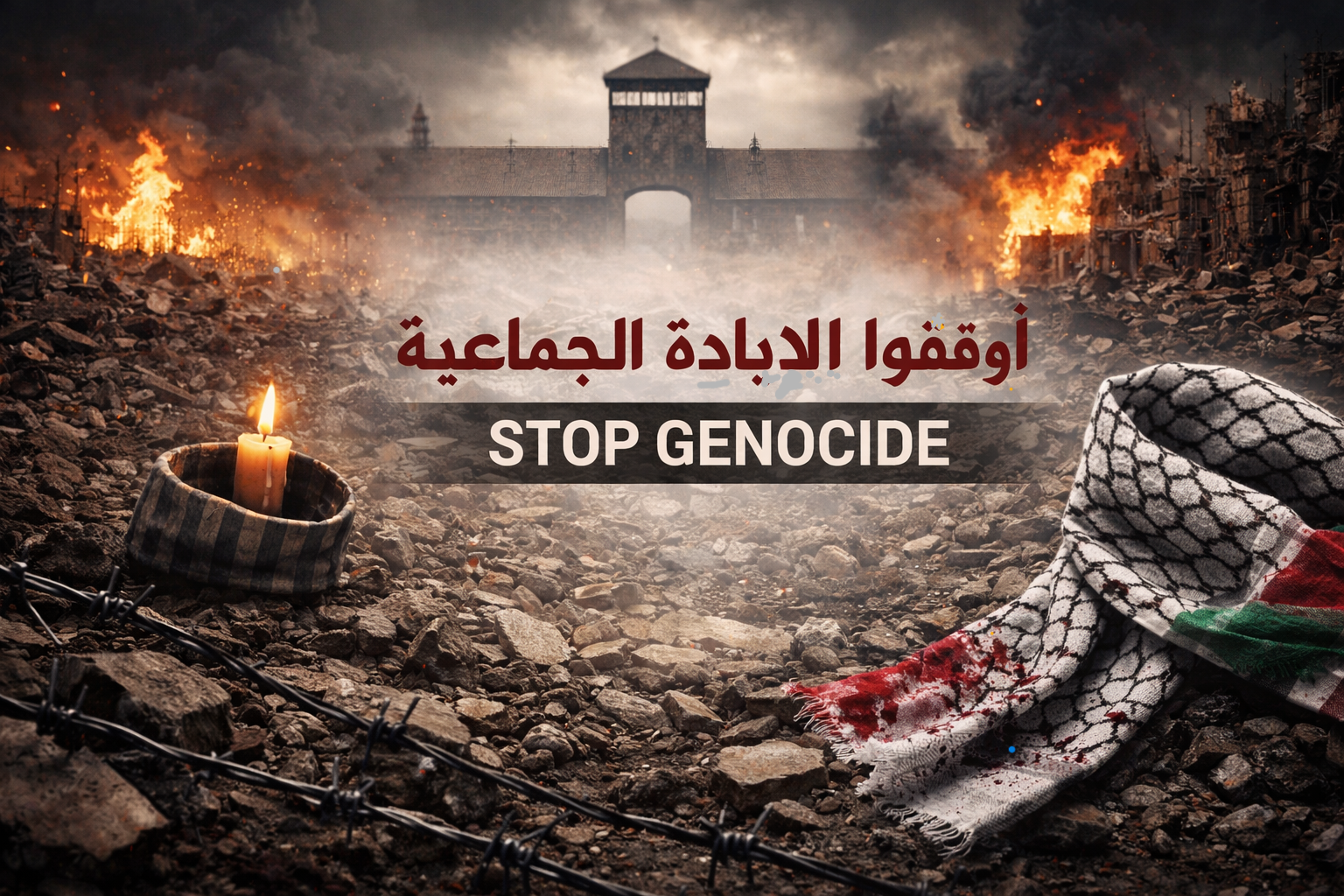
Edgar Kaiser/ GICJ
“Everything can be taken from a man but one thing; the last of human freedoms – the ability to choose one’s attitude in any given set of circumstances, to choose one’s own way”, said Victor Frankl, one of the remarkable survivors of the Holocaust.
Today marks the 81st anniversary of the International Memorial Day for the Victims of the Holocaust, created by the adoption of the United Nations General Assembly Resolution A/RES/60/7 to commemorate the sufferings of one of the darkest episodes of human history. 27th January 1945 was the day when one of the last concentration camps of the Holocaust led by Nazi leader Adolf Hitler, was liberated. It is particularly horrendous for the extermination of 6 million Jews, including other vulnerable communities such as the Roma, disabled persons, homosexuals, political dissidents, people of colour, ethnic Poles and other Slavic groups, Soviet citizens, prisoners of war, Jehovah’s Witnesses and others. What makes this event more egregious is the systematic cleansing of those communities, the brutal methods of torture used and the genocidal intent behind these actions. Since 2005, the United Nations has commemorated this day to pay homage to all the victims and survivors of this horrific event. But how relevant is this commemoration day today? As Viktor Frankl noted, the more compelling question today, after almost a century, is what ‘attitude’ we as an international community have adopted with the lessons we learnt.
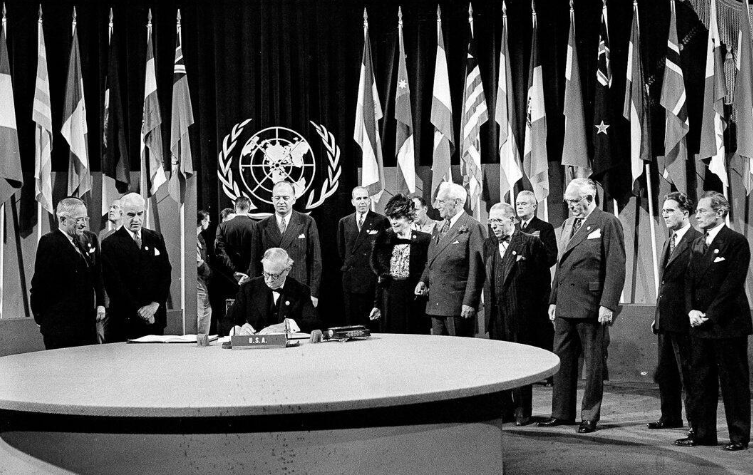
The signing of the United Nations Charter June 26, 1945
The immediate effects of the Holocaust
Shaken by the immense devastation of the Holocaust, the international community realised the need for a robust mechanism to prevent such a catastrophic event from recurring, the culmination of which is the United Nations. Unlike the League of Nations, the international community this time sought a firm global system to maintain peace and tranquillity among and within nation-states, guided by a set of well-defined principles. The Holocaust was also a major impetus for the drafting of the Universal Declaration of Human Rights (1948) and many other international covenants and conventions that followed later. More specifically, the Genocide Convention (1948), followed by the Rome Statute (1998), and currently, the drafting of the Convention on Crimes against Humanity (2019). We have different mechanisms in place to protect different vulnerable communities, which function according to their own mandate. While all these efforts are commendable, what we are witnessing today in the world does not actually reflect the lessons that were purportedly learnt.
Never-ending wars and their remnant effect on the Holocaust
Since the Holocaust, the world has been witnessing numerous conflicts, including civil wars (often labelled as non-international armed conflicts in legal parlance), and international armed conflicts. Uppsala Conflict Data Program (UCDP) has announced that the number of armed conflicts in the world will reach a historic high in 2024. It recorded 61 active conflicts involving at least one state in 2024, up from 59 the previous year and the highest number since statistics began in 1946. Since the end of the Holocaust in 1945, it is estimated that 55 million civilians have perished in more than 89 major genocides around the world. Astonishingly, UN member states committed an average of 51% of all 181 incidents of genocide counted by contemporary scholars. What we have seen in Gaza since October 7 2023, is an ongoing genocide which the world powers have chosen to take a back seat and witness and a few others being complicit. In principle, all these international actors would be liable under Article 16 of the Draft Articles on Responsibility of States for Internationally Wrongful Acts adopted by the International Law Commission for “aiding or assisting the commission of an internationally wrongful act”. Complicity in genocide is also a well-recognized international law violation under Article 3(e) of the Genocide Convention.
Democratic backsliding and sheer disrespect for International Law
In the last few decades, we have been witnessing growing autocratic tendencies, oppressive regimes and democratic backsliding around the world. The world’s largest democracy, India, is at its epitome of a populist regime, where there is no say for minorities, and where there is dwindling civic space and genocidal rhetoric by the ruling powers. What about the world’s largest democracy? The United States of America is setting new standards by committing a flagrant violation of the UN Charter clause 2(2) by using force against a sovereign nation, Venezuela, and threatening their territorial integrity. It has also exited from many UN Bodies and stopped its funding, which has considerably affected the UN’s humanitarian work. True respect for the survivors of the Holocaust can only be complete if the very institutions that were built to prevent such an event in the future are given the due respect they deserve, both in theory and in practice. The United Nations sums all of this in a single quote: “Over eighty years after the Holocaust, we witness daily assaults on our fellow global citizens.”
Hope amidst Despair
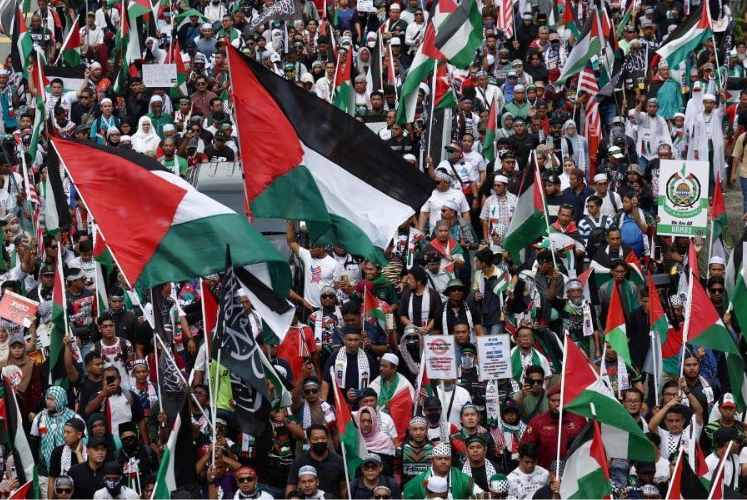
Despite this shimmering reality, what GICJ wishes to remind us is that we still do have a system and humanity that can bring peace and justice to this world as envisioned after the Holocaust. Since the unfolding of the horrific events in Gaza, tens of thousands of people from almost all major cities across the world have come to the streets to remind their leaders to wake up, break their silence and call out this horrific moment in history. This is a clear sign that there is still some hope in this international ecosystem and that it is possible to do true justice to our promise made 81 years ago. The International Criminal Court (ICC) has issued an arrest warrant against several leaders responsible for these atrocities, including Benjamin Netanyahu and Yoav Gallant. The ICJ’s Advisory Opinion on Palestine, the ongoing hearings for the genocide in Myanmar and various UN reports calling for accountability are positive signs. However, this t will only work if the international community stands together in solidarity and calls upon states to do what international law obliges them to do.
The United Nations theme for this day in 2026 is “Holocaust Remembrance for Dignity and Human Rights”. This year, the UNr is holding several events for this day, a couple of which very much resonate with the idea delivered here. This includes an exhibition on the right to truth and a panel discussion on the living responsibility of Holocaust remembrance. It aptly reflects GICJ’s position of calling the international community to stand up and raise a voice for the truth and for the dignity and human rights of all. This is made clear by the UN in its own words to commemorate this day: “In remembering the victims of the Holocaust, we affirm our shared humanity and pledge to defend the dignity and human rights of all.”
Geneva International Centre for Justice (GICJ) stands in solidarity with the millions of victims of the Holocaust, the survivors and the descendant families who are still alive and who are witnessing the unfolding events. GICJ calls upon the international community to pay homage and respect to the Holocaust victims, not merely through symbolic rhetoric, but through tangible actions that promote international accountability, peace and security. The holocaust serves as a definitive warning against dehumanisation, leading to the UN's founding vow "Never Again." GICJ asserts this mandate must be applied to the critical situation in Gaza to prevent further mass artocities and to bring the ongoing genocide to an end. We call upon the international community to exhaust all diplomatic and legal efforts to uphold international law and address the current humanitarian crisis. True remembrance requires the rigorous enforcement of provisional measures and legal accountability to protect all civilian populations. On this international day, the GICJ also call upon the states to internalise the international human rights protection against genocide and mass atrocities through domestic laws, good practices in order to ultimately protect human rights and to stay committed to the founding values of the United Nations, in memory of the Holocaust victims.