




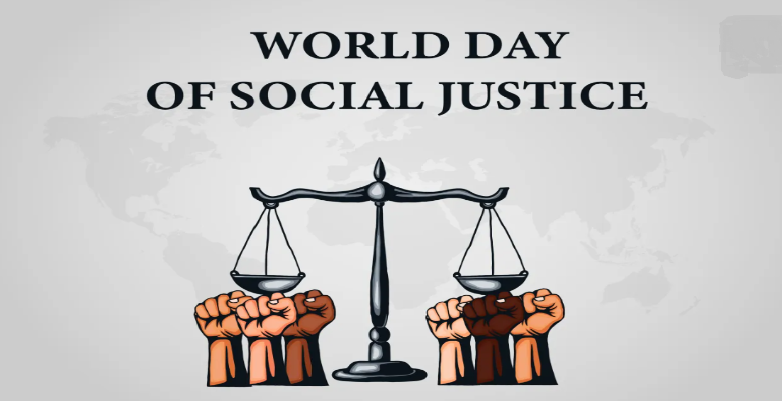
World Day of Social Justice - 20 February
By Apoorva Mishra/ GICJ
Introduction
Social justice is not merely an ideal but a commitment that ensures peaceful, inclusive and sustainable societies. It is celebrated annually on 20 th February worldwide, and is focused on the importance of fairness, equality and solidarity in tackling global challenges such as unemployment, poverty, non- discrimination and exclusion. The United Nations General Assembly (“UNGA”) declared the observance of world day on social justice on 26 th November 2007 through resolution A/RES/62/10. It recognised social development and social justice as indispensable components for the attainment and maintenance of world peace and inter- nation security. Further, the resolution also affirmed that these goals cannot be achieved in isolation, without respecting human rights and fundamental freedoms.
The World Day on social justice was first celebrated in 2009 to support international efforts towards poverty eradication, promotion of full employment, gender equality and access to social wellbeing for all. In today’s times, the pursuit of social justice has become more important than ever; globalisation has not only given boost to the economic development of the world but has also created and widened global inequalities, and social injustices.
Renewed commitment to social development and social justice
The theme for world day on social justice, 2026 is based on “Empowering Inclusion: Bridging gaps for social justice.” The three-fold focus areas are marginalised inclusion, economic equity and systemic solutions. This theme emphasizes on the need for inclusive policies, digital equality, and social protections to reduce poverty and inequality, provide decent work opportunities and strengthen social protection systems. Further, it calls for translating political commitments into tangible actions that improve the lives of vulnerable populations. At its core, renewed commitment recognizes that economic growth alone does not guarantee fairness. In fact, efforts should be made to achieve coordinated policies and multilateral cooperation so that the developmental benefits of all sections of society are ensured. The commemorative meetings associated with this day reflects progress since the 1995 Copenhagen World Summit for Social Development and to explore pathways to achieve accelerated completion of Sustainable Development Goals.
Why social justice matters today
Social justice is based on the principle of peaceful and prosperous coexistence among the nations and also within them. It can usually be upheld through promoting measures such as gender equality, protection of rights of marginalised groups, removing barriers related to age, ethnicity, religion, disability, or cultural background.
However, despite all the efforts, grave injustices persist worldwide. Issues such as labour insecurity, increasing inequality and deepening class divide. It not only threatens development gains but also makes all the past achievements redundant. What is therefore, needed is reinforcement of strengthening institutions that prioritize fairness. Serious challenges including financial crises, poverty, exclusion and inequality can be overcome through opportunities in trade, investment and technological advancement that have opened owing to globalisation, according to the United Nations.
Ultimately, social justice is inseparable from human dignity. Ensuring access to education, healthcare, employment, and legal protections foster stable and resilient societies, whereas entrenched inequality risks fuelling social unrest and undermining long-term peace.
Social justice in a transforming global economy
It is everybody’s responsibility to ensure that economic transformational benefits everyone equally. The United Nations highlights the importance of decent work which is also incorporated as goal 8 of the sustainable development goal, that promotes sustained economic growth along with full and productive employment. ILO Declaration on social justice for a fair globalization, adopted in 2008 is a major step in the direction. It institutionalises decent work and puts it in focus, with an aim to achieve fair outcomes in an increasingly interconnected world.
The UN Declaration also reflects a broad consensus towards the need for a strong social commitment to globalization, emphasizing employment, social protection and ensuring the right to work as a key driver of social justice. Priority is given to sustainable enterprises and inclusive labour markets. The objective is to achieve greater employment and income opportunities, at the same time ensuring that economic progress translates into improved living standards for all.
UN action toward advancing social justice
The United Nations system continues to play a central role in advancing social justice through dialogue, partnerships, and policy development. Events are organised on this day to ensure cooperation of all stakeholders ranging from governments, international organisations and civil society actors. Need is to ensure commitments into concrete actions to leave no one behind.
There is an increased attention towards the idea that social justice should guide national and international policy agendas, enable governments to function more cohesively and to prioritize fairness. However, caution should be made towards increasing inequality and labour insecurity which is further aggravated by global crises.
Persistent barriers to equality and towards a more inclusive future
While globalization has contributed to economic expansion, it has also revealed structural disparities in access to resources and opportunities. The UN General Assembly acknowledges that insecurity, poverty, exclusion, and inequality continue to hinder integration into the global economy. Data further illustrates these challenges. Global employment growth has struggled to keep pace with labour force expansion, while youth unemployment remains significantly high. Informal work and working poverty have returned to pre-pandemic levels, with low-income countries facing the greatest difficulties in creating decent jobs.
These realities underscore a critical message; social justice must extend beyond rhetoric and become a part of national and international frameworks. Advancing social justice requires sustained political will, international cooperation, and innovative policy responses. Observances such as this international day reinforce the importance of solidarity, equality, and opportunity in building peaceful societies. From expanding social protection systems to promoting equitable labour markets, the path forward demands collaborative action across governments, private sectors, and civil society. Equally vital is public awareness. International days serve as reminders that building fair societies is a collective responsibility; one that requires accountability, empathy, and long-term commitment.
GICJ Position
Geneva International Centre for Justice (GICJ) affirms that social justice is fundamentally intertwined with the protection and promotion of human rights. Persistent inequalities, economic, social, and political undermine human dignity and threaten global stability. GICJ calls upon states to adopt inclusive policies that prioritize marginalized communities, ensure equitable access to resources, and strengthen social protection mechanisms. Achieving social justice requires measurable action, accountability, and adherence to international human rights obligations. A just society is one in which every individual can live with dignity, participate fully in public life, and access equal opportunities. Only through sustained global commitment can the international community build a peaceful, inclusive, and sustainable future for all.