



By Adnan Nasir Khan / GICJ
A Day to Say That Poverty Is Not Inevitable
No one is born to be poor, and no society is too rich to end it. Every 17 October, the International Day for the Eradication of Poverty asks the world to look at people whose statistics too often hide, and to treat their situation as a failure of rights rather than a misfortune.
On 17 October 1987, more than 100,000 people assembled at the Trocadéro in Paris, (the square where the Universal Declaration of Human Rights was proclaimed in 1948). They came to honour the victims of extreme poverty, violence and hunger, and declared that poverty is a violation of human rights. A commemorative stone unveiled that day has since been replicated across the world.1 On 22 December 1992, the United Nations General Assembly gave the gathering a global status through resolution 47/196, which designated 17 October as the International Day for the Eradication of Poverty and invited States to hold activities promoting the eradication of poverty and destitution.2
More than three decades later, the promise is still unmet. According to the United Nations, about 808 million people, or 9.9 per cent of the world's population, lived in extreme poverty in 2025, and around 3.8 billion people had no social protection of any kind in 2023. At the current pace, the world will not reach the target of ending extreme poverty by 2030.3
This Year's Focus: "Safe Homes for All"
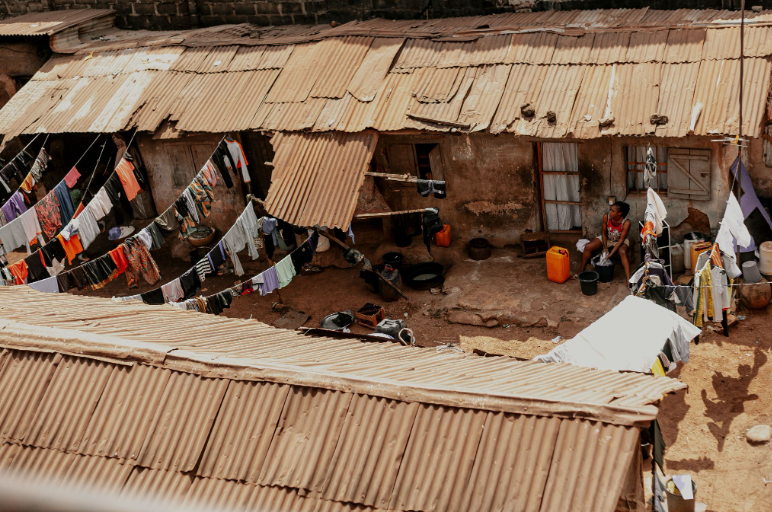
The United Nations has set a three-year theme for 2026 to 2028, "United for Peace and Human Rights". For 2026 it asks the world to concentrate on one concrete question: "Safe Homes for All". The UN presents adequate housing as the foundation for security, participation and a life of dignity, and it reports that more than 2.8 billion people worldwide face some form of housing inadequacy. Those already living in poverty and exclusion bear the heaviest burden.4
A home is more than a roof. It is where a child studies, where a patient recovers, where a worker rests, and where a family is protected from the weather, from violence and from fear. Without a secure address, people struggle to register for school, claim social benefits, find work or seek justice. Secretary-General António Guterres has called on States to mobilize the political will and the investment needed so that everyone has a safe home and can live in dignity, free from poverty.5
The focus also connects the Day to the wider theme of peace. Where families are evicted, displaced by conflict or driven into precarious settlements by disaster, tensions grow and trust in institutions erodes. Secure housing is therefore both a human right and a quiet foundation of social peace.
Poverty and Housing as Human Rights Questions
International law does not treat poverty as a private failing. The Universal Declaration of Human Rights recognises the right to an adequate standard of living, including housing, and the International Covenant on Economic, Social and Cultural Rights obliges States to take steps, to the maximum of their available resources, to realise it progressively.6 The UN human rights system describes the right to adequate housing as more than shelter. It includes seven elements: legal security of tenure with protection against forced eviction and harassment; affordability; habitability; availability of services such as safe water and sanitation; accessibility for disadvantaged groups; a location with access to work, health care and schools; and cultural adequacy.7 The Office of the High Commissioner for Human Rights notes that well over a billion people are not adequately housed.8
The UN has also built a specific mandate around the issue. The Special Rapporteur on extreme poverty and human rights was established by the Commission on Human Rights in 1998 and taken over by the Human Rights Council in 2006. Since March 2026 the mandate holder is Elena Carolina Díaz Galán, whose first report to the General Assembly examines cities and poverty, the link between urbanisation and deprivation.9 In 2012 the Human Rights Council adopted the Guiding Principles on Extreme Poverty and Human Rights, the first global policy guidelines on the rights of people living in poverty, intended as a practical tool for policymakers.10
The message of this framework is that people in poverty are rights-holders, not recipients of charity. They are entitled to participate in decisions affecting them, to equal protection, and to remedies when their rights are violated, including when they are evicted without notice, compensation or alternative shelter.
Case Study: When a Flood Takes the Home and the Margin
Pakistan's 2022 monsoon floods show how quickly a lack of safe housing turns a disaster into lasting poverty. According to the United Nations Development Programme, about 33 million people were affected and more than 1,730 died. The post-disaster assessment found that housing suffered the largest damage of any sector, at USD 5.6 billion, within total damages of more than USD 14.9 billion and total economic losses of about USD 15.2 billion. It estimated that the poverty rate could rise by 3.7 to 4.0 percentage points, potentially pushing 8.4 to 9.1 million more people below the poverty line. Rehabilitation and reconstruction needs were put at no less than USD 16.3 billion.11
The lesson is relevant to this year's focus. Families in fragile, low-cost homes lose everything when water arrives, and they have no savings, insurance or social protection to rebuild. Reconstruction that restores the same unsafe housing only resets the clock. A human rights approach asks that rebuilding be safe, affordable, secure in tenure and designed with the affected families, and that those who were already marginalised are not left to the end of the queue.
UN Action
The United Nations has placed poverty at the centre of its agenda. The first of the Sustainable Development Goals, adopted in the 2030 Agenda, commits States to end poverty in all its forms everywhere.12 The General Assembly has also proclaimed the Third United Nations Decade for the Eradication of Poverty, running from 2018 to 2027 under the theme "Accelerating global actions for a world without poverty", to coordinate action across the UN system.13 More recently, the General Assembly endorsed the Doha Political Declaration of the World Social Summit, the outcome of the Second World Summit for Social Development, renewing the pledge to put people and social inclusion first.14
Progress is real but uneven. UN data show that social protection coverage reached 52.4 per cent of the world's population in 2023, up from 42.8 per cent in 2015, yet coverage stands at only 9.7 per cent in low-income countries. Only one in five countries is on track to halve its national poverty rate by 2030.15 Each year the UN marks 17 October with a commemoration in New York, and in 2026 it takes place on 16 October at UN Headquarters, bringing together people with direct experience of poverty, States and civil society.16 Meanwhile the Human Rights Council's Special Rapporteur continues to hold States to account under the Guiding Principles.17
GICJ Position
As shown by the figures and the case above, poverty is not a natural condition but the result of choices about law, spending and priorities. GICJ holds that the right to an adequate standard of living, including a safe and secure home, is a legal entitlement and not an act of charity. It applies to every person in every country, regardless of income, status or nationality.
GICJ calls on States to guarantee security of tenure and to prohibit forced evictions without due process, notice, compensation and alternative housing. It urges them to extend social protection to everyone, to direct disaster reconstruction first to those with the least, and to involve people living in poverty in the decisions that affect them. It further calls on the international community to honour its commitments under the 2030 Agenda and the Doha Declaration and to support countries whose resources fall short, in line with their shared obligation of international cooperation. GICJ will continue to follow these questions in the work of the Human Rights Council and its mechanisms.
[1] https://www.un.org/en/observances/day-for-eradicating-poverty/background
[2] https://www.un.org/esa/socdev/poverty/documents/SG_Poverty_final.pdf
[3] https://www.un.org/en/observances/day-for-eradicating-poverty/background
[4] https://www.un.org/en/observances/day-for-eradicating-poverty
[5] https://www.un.org/en/observances/day-for-eradicating-poverty/background
[7] https://www.refworld.org/legal/general/cescr/1991/53157
[8] https://www.ohchr.org/en/housing
[9] https://www.ohchr.org/en/special-procedures/sr-poverty
[11] https://www.undp.org/pakistan/press-releases/pdna-pakistan-floods
[12] https://sdgs.un.org/2030agenda
[15] https://unstats.un.org/sdgs/report/2025/Goal-01/
[16] https://www.un.org/en/observances/day-for-eradicating-poverty/background