



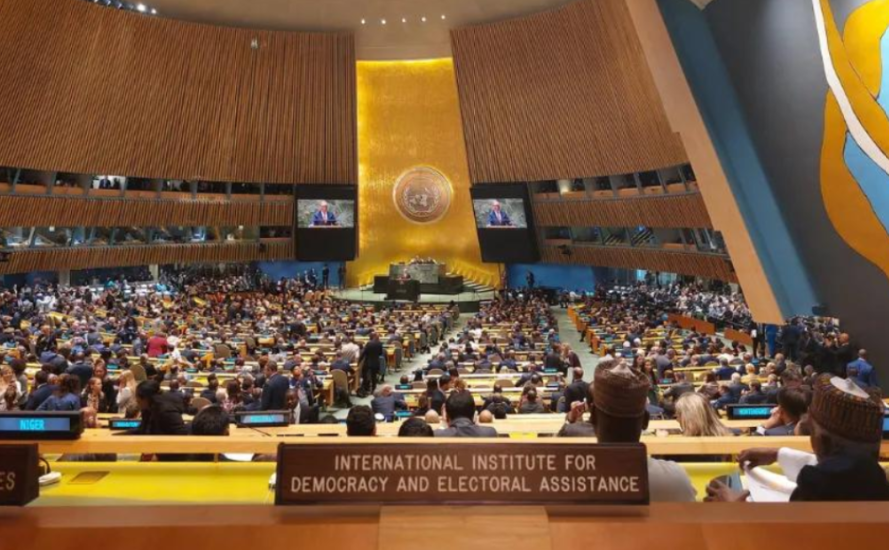
International Day of Democracy - From Gender Equality to Human Rights
By Itoe Francis Ebongue / GICJ
From Representation to the Right to Participate
International Day of Democracy 2026 arrives with a sharper question than the one asked a year ago: not simply who is represented in democratic institutions, but whether those represented can exercise their rights, influence decisions and hold power accountable. The Inter-Parliamentary Union (IPU) has chosen “Bring human rights into focus” as this year’s theme, following its 2025 theme, “Achieving gender equality, action by action.”
The progression is significant. In 2025, the international community was reminded that democracy cannot be representative while half of society remains under-represented. In 2026, the focus has moved towards the rights, freedoms and participation that give representation its meaning.
The 2025 campaign also marked 30 years since the Beijing Declaration and Platform for Action, reinforcing the connection between women’s political participation and wider democratic equality. There has been movement, although not enough to declare success. Women now occupy 27.5 per cent of seats in national parliaments worldwide in 2026, compared with 27.2 per cent in 2025. The increase is modest, but it demonstrates that sustained political and institutional action can produce measurable change.
What Changed Between 2025 and 2026?
The past year has therefore produced progress, but not parity. The central democratic challenge remains whether commitments made by governments, parliaments and international institutions translate into conditions in which women and other historically excluded groups can participate safely and meaningfully. Representation without protection, access without influence, or elections without accountability cannot by themselves deliver democratic government.
The experience of women in political leadership illustrates the problem. Nelly B. K. Mutti, Speaker of Zambia’s National Assembly, has consistently stressed the importance of gender parity, representative legislatures and political environments free from violence and harassment. Her position reflects a wider understanding emerging across democratic institutions: increasing the number of women in public office is necessary, but it is only one part of democratic reform. Women must also be able to speak, legislate, contest political decisions and exercise authority without intimidation.
Women in Leadership: More Than a Seat at the Table
Africa provides an important test of these commitments. The African Charter on Democracy, Elections and Governance connects democratic government with human rights, constitutional rule, accountable institutions, citizen participation and gender equality. The Maputo Protocol further establishes important commitments concerning women's participation in political and decision-making processes. These instruments provide a continental framework, but their real value is measured by implementation at national and community level.
Across the Americas, the Inter-American Democratic Charter similarly links representative democracy with human rights, citizen participation, development and social justice. Taken together, these regional commitments demonstrate that democracy is not defined solely by the conduct of elections. It includes the institutions, freedoms and social conditions that enable citizens to participate between elections and to challenge the exercise of public power.
The Global Foundation: Democracy and Human Rights
At the global level, the Universal Declaration of Human Rights remains one of democracy's clearest foundations. Its principles of equality, freedom of expression and participation in government establish rights that cannot be separated from legitimate democratic governance. The 2026 IPU theme therefore places human rights where they belong: at the centre of the democratic system rather than at its margins.
The United Nations has reinforced this message today. In his 15 September 2026 message for International Day of Democracy, Secretary-General António Guterres warned that the world is facing deepening division, multiplying conflicts, declining trust and a weakening social contract between citizens and governments. He stressed that “Democracy is more than elections”, describing it as a daily practice of protecting human rights, the rule of law and meaningful participation across civic and political life. He also highlighted deliberative democratic processes as a means of bringing people from different parts of society into decision-making, building trust and strengthening peaceful, inclusive and resilient societies.
His message provides an important bridge from the commitments of 2025 to the expectations of 2026. Democracy must not only provide citizens with the opportunity to vote; it must give them meaningful opportunities to be heard.
The 2026 Test: Can Representation Deliver Rights?
This is where the progress of the past year should be judged. Some commitments have produced measurable results: women's parliamentary representation has increased; gender equality remains firmly embedded in international and regional democratic frameworks; and the relationship between democracy, human rights and public participation has received renewed institutional attention. Yet the distance between formal commitments and lived experience remains considerable.
Political violence, discrimination, restrictions on civic space and unequal access to political institutions continue to prevent many citizens from exercising democratic rights on equal terms. For women in particular, harassment and intimidation can turn political participation into a personal risk. The democratic question is therefore no longer simply how many women occupy political office, but whether institutions protect their ability to exercise that office effectively.
Technology, Public Participation and New Democratic Risks
Technology adds another dimension to this debate. Digital platforms can broaden political participation, connect citizens with institutions and give marginalised voices greater visibility. They can also accelerate disinformation, manipulated content, online harassment and the misuse of artificial intelligence. These risks are particularly serious for women and public figures whose participation can attract coordinated abuse.
The democratic task for 2026 and beyond is to ensure that technology expands participation without weakening privacy, freedom of expression, equality or public trust. Digital innovation should strengthen democratic agency, not replace informed citizenship with manipulation.
What the International Community Has Delivered
The international community has therefore moved from broad declarations towards a more demanding conversation about implementation. The Beijing Platform for Action, the African Charter on Democracy, Elections and Governance, the Maputo Protocol, the Inter-American Democratic Charter, the Universal Declaration of Human Rights and the Inter-Parliamentary Union's continuing parliamentary work all provide standards against which governments and institutions can be judged.
The question is whether these commitments are reaching citizens. Democracy becomes credible when laws are applied fairly, institutions can be challenged, elections are trusted, journalists and civil society can operate safely, women can participate without intimidation, and citizens can see a connection between their voices and public decisions.
The Question Democracy Must Carry Into 2027
As the international community moves towards another year, one strategic question deserves to remain on the democratic agenda:
When the international community looks back next year, what promises made in 2025 and 2026 will it be able to demonstrate as fulfilled, and what evidence will show that democracy has improved the lives of the people it is meant to serve?
That question should shape the expectations for 2027. Progress should be visible in greater representation of women and historically excluded communities, stronger protection from political violence, wider civic participation, better access to justice, more accountable institutions and safer spaces for democratic expression.
International Day of Democracy should therefore be understood not merely as an annual celebration, but as an annual audit of democratic performance. The progression from gender equality in 2025 to human rights in 2026 provides a clear direction: representation must lead to participation; participation must be protected by rights; and rights must be supported by institutions capable of answering to the people.
That is the standard by which the promises of democracy should be measured, not by the number of declarations issued, but by the freedoms protected, the voices heard and the lives improved.
Geneva International Center for Justice (GICJ) maintains that democracy must extend beyond elections to include meaningful participation, human rights, the rule of law, accountable institutions and the protection of civic space.
GICJ therefore calls the attention of States, parliaments, international organisations and other stakeholders to the continuing barriers faced by women, youth, marginalised communities, journalists and human rights defenders, including discrimination, harassment, restrictions on civic freedoms and the misuse of technology to undermine public participation.
GICJ urges States and stakeholders to strengthen democratic institutions and ensure that everyone can express themselves, assemble peacefully, participate in public affairs and hold authorities accountable without fear, discrimination or reprisal.