




International Day of the Victims of Enforced Disappearances - 30 August
No Charge. No Trial. No Answer. Just Disappearance.
By Javaria Qadir /GICJ
Introduction
Some people choose conscience over silence. They question what others accept, speak when silence is safer, and look where society is told to look away. Too often, under the sweeping language of national security, counter-terrorism, or political necessity, individuals are taken beyond the protection of the law. No charge. No trial. No answer. They simply disappear.
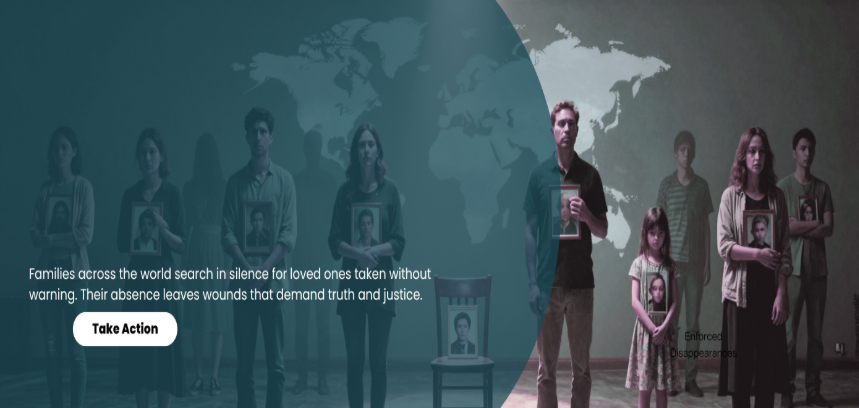
But an enforced disappearance does not take one person alone. It leaves mothers waiting, children growing up with unanswered questions, and spouses trapped between hope and grief. Years may pass without a grave, a truth, or even certainty of life or death—only an empty chair and one question that never disappears: Where are they?
Refusing to let these victims be erased from history, the international community established a framework for accountability: UN General Assembly Resolution 47/133 adopted the 1992 Declaration on the Protection of All Persons from Enforced Disappearance, followed in 2006 by Resolution 61/177, adopting the International Convention for the Protection of All Persons from Enforced Disappearance, which entered into force in 2010. That same year, Resolution 65/209 designated 30 August as the International Day of the Victims of Enforced Disappearances.
In 2026, marking twenty years since the Convention's adoption, the UN Committee on Enforced Disappearances launched an anniversary campaign under the slogan "Victims first. Action now," placing victims and families at its center.
August 30 is more than a day of remembrance—it is a call to action that links the lessons of history to the failures of the present. It echoes the fate of thousands swept away by Adolf Hitler's 1941 Nacht und Nebel (Night and Fog) decree and honours the mothers who marched against the military juntas of Latin America's "dirty wars." When States are allowed to erase people, they erase the rule of law itself.
To break this cycle of impunity, August 30 demands that governments turn memory into mandate: ratify the Convention, criminalise this atrocity in domestic penal law, and guarantee families' multi-generational right to know the truth.
What Does It Mean to “Disappear” a Person?
Not every missing person is a victim of enforced disappearance.
According to Article 2 of the International Convention for the Protection of All Persons from Enforced Disappearance, this term has a strict legal definition rather than a broad meaning. It requires a specific three-part sequence: first, deprivation of liberty by State actors or those operating with State consent; second, an official refusal to acknowledge the detention or the location of the person; and third, the removal of the individual from legal protection.
Within a lawful arrest, an individual retains their legal identity—a prisoner, a detainee, a suspect, but still a person under the law. Enforced disappearance erases that identity, reducing the individual to a non-person with no rights because, officially, they do not exist.
Twenty Years of the Convention: What Has Changed?
Twenty years after adoption, the international response has evolved from political condemnation toward a binding legal framework for prevention, accountability, and reparation. Today, the Convention has 78 States Parties, each legally obligated to prevent disappearances, prosecute perpetrators, and guarantee families the right to truth.
The Convention also created a dedicated international monitoring system that did not exist before. The Committee on Enforced Disappearances, operational since 2011, reviews State compliance and can activate an urgent action procedure requiring authorities to search immediately for disappeared persons. By March 2026, the Committee had registered over 2,000 urgent actions; 546 cases had been closed after the missing person was located, including 427 people found alive. These are not merely institutional achievements—they represent individuals returned from uncertainty and families given answers.
The central challenge is the gap between international standards and reality. The Committee itself said in 2026 that the crime continues to occur "in all regions" and in new and evolving contexts. The gap is not a lack of legal standards but a failure to address what allows enforced disappearance to continue: unchecked power, secrecy, impunity, weak oversight, and poor institutional coordination.
Case Study Focus: The Structural Erasure in Iraq

Following the 2003 US-led invasion, thousands of Iraqi civilians forcibly disappear amid conflict, detention practices, political instability, and an increasingly fragmented security landscape. The UN Committee on Enforced Disappearances identifies this period as a distinct wave in Iraq's continuing history of disappearances.
The crisis deepened between 2014 and 2017. Da'esh abducted military personnel, community leaders, and thousands of civilians, including 6,800 Yazidis, many of whom were women and girls who were subjected to sexual slavery and other grave abuses. At the same time, Iraqi security forces and factions of the Popular Mobilization Forces were implicated in the disappearance of predominantly Sunni men and boys during counter-terrorism operations, including at checkpoints and from their homes.
These successive waves have left Iraq with one of the world's largest unresolved missing-persons crises. Estimates cited by the UN Committee on Enforced Disappearances place the number of disappeared and missing persons between “250,000 and one million,” while acknowledging that the absence of reliable consolidated data makes a precise figure impossible.
The problem is therefore not merely historical; it is deeply institutional and legislative. In its 2026 review, the UN Committee on Enforced Disappearances continued to press Iraq to criminalise enforced disappearance as an autonomous offense in domestic law, establish comprehensive registers of all persons deprived of liberty, create a centralised mechanism to search for the disappeared, investigate allegations of secret detention, and adopt effective measures to address continuing disappearances and entrenched impunity.
Iraq, however, is not an isolated case. The same pattern—secrecy, denial, fear, and families left searching for answers—appears across regions and political systems, revealing enforced disappearance as a crisis without borders.
The Global Mapping of Silence: A Crisis Without Borders
Enforced disappearance is not a relic of authoritarian regimes of the past. It continues to surface in armed conflicts, counter-terrorism operations, political repression, migration contexts, and struggles for territorial or political control. Its geography is disturbingly wide, crossing continents and political systems while leaving behind the same legacy of uncertainty and unresolved grief.
In Mexico, official figures submitted to the UN Committee on Enforced Disappearances recorded 133,236 missing and disappeared persons as of September 2025. The scale of the crisis is further reflected in the discovery of more than 4,500 clandestine graves, while approximately 72,000 unidentified human remains were reported by early 2026.
A similarly deep, multi-generational scar runs through Colombia. The UN Committee on Enforced Disappearances reported that 121,768 people were forcibly disappeared between 1985 and 2016, while estimates accounting for underreporting suggest that the true number could reach approximately 210,000. Colombia's own Search Unit separately recorded 132,877 people as disappeared in connection with the armed conflict by July 2025, demonstrating the enormous challenge that remains for truth and transitional justice.
Across the Middle East, decades of conflict and repression have produced another vast landscape of disappearance. In Syria, the fall of the Assad government in December 2024 opened new possibilities for uncovering the fate of those who vanished during decades of repression and war. By July 2026, figures highlighted by the UN Independent Institution on Missing Persons in Syria placed the number of missing persons at approximately 130,000 to 300,000. The search now extends across detention records, burial sites, testimony, and fragmented evidence accumulated over years of conflict.
Further east, Pakistan continues to face international scrutiny over allegations of enforced disappearance. In information submitted to the UN Human Rights Committee, Pakistan reported 10,014 cases considered by its Commission of Inquiry on Enforced Disappearances up to 2023, of which 2,265 remained pending. UN Special Procedures have continued to raise concerns, particularly regarding alleged disappearances in the context of counter-terrorism and security operations in Balochistan.
The circumstances in these countries differ, but the consequence is familiar: a person disappears, information becomes inaccessible, and families search for truth long after the world has moved on. No single country can confront this alone—its transnational nature demands collective responsibility, with States cooperating across borders and working alongside families, civil society, and international mechanisms to trace the missing.
Across every case in this mapping, the burden of search falls disproportionately on women. It is mothers, wives, and daughters who file the reports, comb the archives, and stand outside government offices for years—often while a spouse's undetermined status blocks their access to inheritance, property, or custody rights, Resolving disappearances is therefore not only a matter of truth; it is a matter of restoring the legal and economic standing of the families left behind.
GICJ position
Geneva International Centre for Justice (GICJ) reiterates that enforced disappearance is a grave and continuing violation of international human rights law and may constitute a crime against humanity when committed as part of a widespread or systematic attack against civilians. No claim of national security or State sovereignty can justify secret detention or the concealment of a person’s fate.
On the International Day of the Victims of Enforced Disappearances, GICJ calls on all States to turn remembrance into action by:
- ratifying and implementing the International Convention for the Protection of All Persons from Enforced Disappearance;
- criminalising enforced disappearance as a distinct offence in domestic law;
- ending secret detentions;
- protecting families, lawyers, journalists, and human rights defenders searching for the disappeared;
- restraining the arbitrary exercise of State power through judicial oversight, transparent detention procedures, and meaningful accountability; ensuring prompt, independent investigations and effective prosecution of those responsible; and
- paying special attention to especially vulnerable groups, such as children and persons with disabilities.
- Include CSOs and victim’s representative in the process of searching victims of enforced disappearances, and facilitate their visits to all detention centres.
GICJ stands in solidarity with victims and families worldwide and urges States to ensure that no person is placed outside the protection of the law and that no family is left indefinitely without answers. This August 30, under the campaign "Victims first. Action now," GICJ invites readers to follow and amplify the voices of families still searching—because remembrance without action changes nothing.