



World Humanitarian Day - August 19
By Pia Mullen /GICJ
On this day in 2003, a bomb attack struck the Canal Hotel in Baghdad, Iraq. It killed 22 people, among them was Sergio Vieira de Mello, the United Nations High Commissioner for Human Rights. The hotel was serving as the UN headquarters for its Assistance Mission in Iraq, and in the following years, the attack would come to represent the deliberate targeting of humanitarian workers in conflict.
The United Nations General Assembly established August 19 as World Humanitarian Day through Resolution 63/139, adopted on December 11, 20081. The day was created to raise public awareness of humanitarian work and to honour personnel killed in conflict. Among its provisions, the resolution condemned the killing of aid workers and urged member states to protect civilians.
On August 19, the UN is calling for people to join the #ActforHumanity online campaign which urges participants to use their voice to protect humanitarians, support humanitarian actions especially in their local communities, stand for accountability and remember the individual people behind the aggregate statistics. Humanitarians killed must be honoured, and their families and communities supported. This online campaign goes hand in hand with this year’s World Humanitarian Day campaign message; "The time for concern is over. The time for consequence is now."2 The UN asserts that condemnation is not enough for these acts of violence. Justice must be action-oriented and urgent.
Current circumstances
Two decades on from A/RES/63/139, the situation is increasingly concerning. The United Nations Office for the Coordination of Humanitarian Affairs (OCHA) reports that 2025 saw 326 humanitarian workers over 21 countries being killed, and during this same year, recorded an average of 1 civilian death every 14 minutes. Compounding this, UN humanitarian programmes are currently operating with only 24.4% of the required funding for their protection and aid plans.
Humanitarian personnel are structurally integral to medical aid, food assistance and rescue missions, amongst a vast array of functions. They are protected by International Humanitarian Law (IHL), falling within the same category as civilians, as those who do not participate in hostilities. Article 8(2)(b)(iii) of the Rome Statute of the International Criminal Court (ICC), categorises the intentional targeting of humanitarian personnel or material as a war crime3.
Impunity exacerbates
Impunity for attacks on humanitarian personnel has been a persistent feature of modern conflict. Accountability and justice for those killed matter now more than ever.
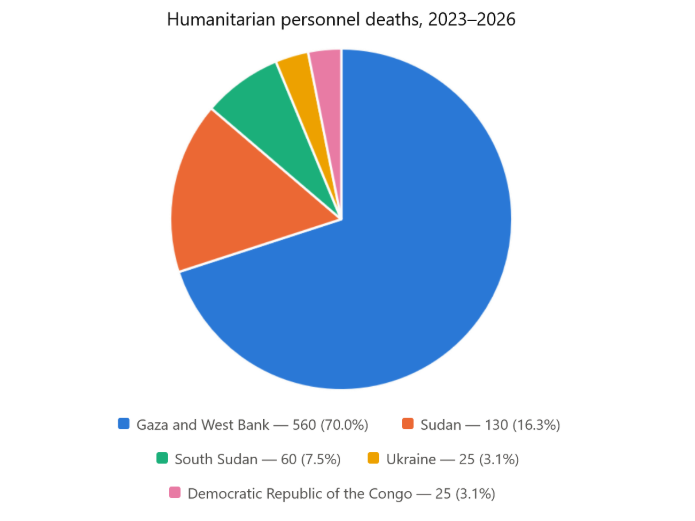
Between 2023 and 2026, the killing of humanitarian personnel has accelerated sharply. The Aid Worker Security Database (AWSD) recorded 117 humanitarian deaths in 2020, 141 in 2021, and 199 in 2022. According to Tom Fletcher, United Nations under-secretary-general for humanitarian affairs, humanitarian mortality figures for 2023 to 2026 sum to more than 1,000.
Fletcher has outlined how in the past three years, there have been 560 reported humanitarian personnel deaths in Gaza and West Bank, 130 in Sudan, 60 in South Sudan, 25 in Ukraine and 25 in the Democratic Republic of the Congo.
Speaking to the Security Council in New York on April 8 2026, Fletcher asserted that the actions of humanitarian organisations are “being restricted, penalized [and] delegitimised”4 which he suggests is because international law is no longer convenient for states, and therefore, is no longer viewed as binding. Fletcher warned that humanitarians are increasingly being seen as legitimate targets.
Elyse Mosquini, an official of the International Committee of the Red Cross, echoed Fletcher’s statement by affirming “Every attack on humanitarian personnel that passes without consequence allows this insidious pattern to continue. Each attack signals to others that the lives of aid workers are expendable.” The OCHA’s overview report for 2026 echoed this sentiment stating to be a humanitarian during this period is to experience "brutality, impunity and indifference."5
Behind each of these statistics is an individual who protected life, health, and human dignity, leaving behind futures that cannot be recovered. Humanitarian personnel and civilians are neither collateral damage nor ‘legitimate’ targets of conflict, yet their lives are increasingly lost to conflicts they play no part in. The international community's continued failure to uphold protective international law emboldens violators. Each unpunished attack signals that further violations will carry no consequence.
Bearing the burden
This impunity falls hardest on local humanitarian personnel, who bear the overwhelming majority of casualties among aid workers. The Aid Worker Security Database (AWSD) reports that in 2025, local staff accounted for 99% of humanitarian personnel killed in conflict. The scale of this risk reflects how heavily humanitarian response depends on local actors. As of July 2026, the United Nations Relief and Works Agency for Palestine Refugees in the Near East (UNRWA) employed around 11,000 Palestinian personnel in Gaza and 4,000 in the West Bank. In Ukraine, an estimated 290 local humanitarian groups support evacuation, logistics and data collection efforts. In Sudan, community-led groups have become central to aid delivery, filling gaps left by the withdrawal of international actors. These local responders are not a supplementary workforce, but the frontline of humanitarian action. The international community has a responsibility to protect them, particularly at a moment when humanitarian funding has fallen to critically low levels.
United Nations activity
The 75th anniversary of the 1949 Geneva Conventions fell in 2024. This was acknowledged in the UNSC Resolution 2730 on May 24 2024, which focused heavily on the protection of humanitarian personnel6. It urged all states to ratify the Optional Protocols of 1977 and 2005 to the Geneva Convention, and called for states to consider becoming parties of the Convention of the Safety of United Nations and Associated Personnel and its Optional Protocol. The resolution also required an annual briefing to be held on the topic of humanitarian protection, and the challenges and progress made on this front. The last annual briefing under this mandate took place in April 2026.
In September 2025, the the Declaration for the Protection of Humanitarian Personnel was launched, where 110 signatories have committed "at the highest political level, to take action and uphold the principles"7 of International Humanitarian Law. The group has delivered statements at the 61st and 62nd Human Rights Council, and endeavour to inform policy relating to the protection of humanitarians.
Geneva International Centre for Justice (GICJ), stands with all humanitarian personnel who work towards health and human dignity for vulnerable civilians. We remind states of their international obligation to protect humanitarian personnel, and GICJ joins the OCHA in its concern for the increased killing of humanitarian workers. We are further alarmed by the impunity these crimes are met with. We support the UN’s statement that mere condemnation for the loss of countless lives is not protection, and call for an action orientated approach to justice. GICJ also urges all states who have not already done so to ratify and uphold both Optional Protocols to the Geneva Conventions as well as the Convention on the Safety of United Nations and Associated Personnel.
[1] United Nations General Assembly. (2008, December 11). Strengthening of the coordination of emergency humanitarian assistance of the United Nations (A/RES/63/139). https://digitallibrary.un.org/record/643306
[2] United Nations. World Humanitarian Day. https://www.un.org/en/observances/humanitarian-day
[3] International Criminal Court. (2002, July 1) Rome Statute. (Article 8(2)(b)(iii)). https://www.icc-cpi.int/sites/default/files/2024-05/Rome-Statute-eng.pdf
[4] United Nations. (2026, April 8). Over 1,000 humanitarians have been killed in three years, Security Council hears. UN News. https://news.un.org/en/story/2026/04/1167267
[5] United Nations Office for the Coordination of Humanitarian Affairs. (2026, August). Ukraine (Humanitarian response plan). Humanitarian Action. https://humanitarianaction.info/plan/1515/article/ukraine-4
[6] United Nations Security Council. (2024, May 24). Resolution 2730 (S/RES/2730). https://docs.un.org/en/S/RES/2730(2024)
[7] Declaration for the Protection of Humanitarian Personnel. (2025). About. https://protect-humanitarian-personnel.org/about