


World Day Against Trafficking in Persons
By Melody Ugochi Nnaji /GICJ
“Human trafficking is a heinous violation of fundamental human rights and freedoms. It preys on vulnerability and thrives in times of conflict and instability.
Today, amidst growing inequalities, worsening climate emergencies, and record displacement, more and more people are left vulnerable to traffickers. The majority of detected victims are women and children, many of whom suffer brutal violence, forced labour, and horrific sexual exploitation and abuse.”
— Antonio Guterres
Introduction
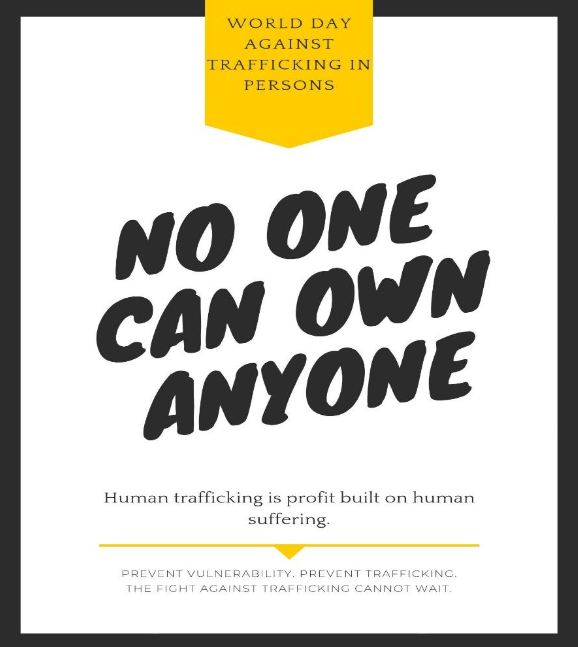
Every year on 30 July, the world observes the World Day Against Trafficking in Persons to raise awareness about one of the gravest human rights violations affecting millions of people globally. Established by the United Nations (UN) in 2013, the day draws attention to the growing scale of trafficking in persons and the urgent need to protect victims, strengthen accountability, and prevent further exploitation.
Trafficking in persons is not merely a criminal offence. It is a grave violation of human dignity and fundamental rights. Victims are often subjected to forced labour, sexual exploitation, domestic servitude, forced marriage, and other forms of abuse carried out through coercion, deception or by taking advantage of their vulnerability. In many situations, trafficking thrives in environments characterised by poverty, displacement, armed conflict, weak institutions and inequality.
The international community formally addressed this issue through the Protocol to Prevent, Suppress and Punish Trafficking in Persons Especially Women and Children, adopted on 13 December, 2000 (hereinafter referred to as “the Palermo Protocol”) as a supplement to the United Nations Convention against Transnational Organized Crime. The Palermo Protocol remains the principal international framework for combating trafficking in persons and it requires States to prevent trafficking, prosecute offenders and protect victims. Article 5 of the Protocol enjoins all countries who are signatory to criminalise all actions and practices that subject human beings to any and all forms of exploitation..
In addition to the Palermo Protocol, several international human rights instruments reinforce protections against trafficking and exploitation. These include the Universal Declaration of Human Rights (UDHR), the Convention on the Elimination of All Forms of Discrimination against Women (CEDAW) and the Convention on the Rights of the Child (CRC). Together, these frameworks affirm that trafficking in persons is not only a matter of organised crime, but also a serious violation of rights related to liberty, dignity, equality, security and freedom from exploitation.
Trapped Behind the Scam
The 2026 theme, "Trapped Behind the Scam", draws attention to the growing link between human trafficking and online scam operations. Across many parts of the world, traffickers increasingly use false job advertisements, fake recruitment opportunities, and deceptive promises of better lives to lure victims into exploitative situations. Many people, particularly young adults seeking employment or economic opportunities, are tricked into travelling or accepting offers that appear legitimate but are actually part of criminal trafficking networks.
The theme highlights the reality that victims are often hidden behind sophisticated scams. Once recruited, they may be forced to participate in online fraud schemes, cybercrime activities, or other forms of exploitation under threats, coercion, or violence. In many cases, victims have their movement restricted, their documents confiscated, and their ability to seek help severely limited.
"Trapped Behind the Scam" also serves as a reminder that human trafficking is evolving alongside technology. Criminal groups are increasingly using digital platforms, social media, and messaging applications to target vulnerable individuals across borders. As a result, combating trafficking now requires greater public awareness, stronger online safety measures, effective law enforcement cooperation, and better protection for victims.
By focusing on the connection between trafficking and online scams, this year's theme calls on governments, organisations, technology companies, and individuals to recognise the warning signs of trafficking and work together to prevent exploitation in both physical and digital spaces.
Forms of Trafficking in Persons
Trafficking in persons takes multiple forms, all of which are rooted in exploitation and the abuse of vulnerability. While methods may differ, the outcome is the same: the denial of freedom, dignity and basic human rights.
One of the most widespread forms is sexual exploitation also known as sex trafficking, where victims are forced, deceived, or coerced into prostitution or other forms of sexual abuse. Persons who are maintained in prostitution through coercion are also victims of sex trafficking. Women and girls are disproportionately affected, although men and boys can also be victims.
Forced labour is another major form of trafficking. Victims are compelled to work under threats, debt bondage or physical coercion, often in sectors such as agriculture, construction, mining, and domestic work. In many cases, they are denied fair wages, rest, freedom and safe working conditions. This form of trafficking is also known as involuntary servitude. Migrants are more vulnerable to labour trafficking and involuntary servitude. Employers or traffickers may confiscate their passports or immigration documents, leaving them unable to leave abusive workplaces. Victims are often forced to work excessive hours for little or no pay under threats, coercion or fear of deportation.
Child trafficking remains a particularly severe concern. Children are exploited for labour, forced begging, armed conflict participation, domestic servitude or sexual exploitation. Their age and dependency make them especially vulnerable to manipulation and abuse. According to the United Nations Children’s Fund (UNICEF) as many as 2 million children are subjected to prostitution in the global commercial sex trade. Victims of child trafficking suffer consequences including lasting physical and psychological trauma, drug addiction, sexually transmitted diseases, unwanted pregnancy, malnutrition and in worst cases, death.
Trafficking for forced marriage also persists in several regions, where individuals, often young girls, are forced into marriages without consent and subjected to domestic and sexual exploitation within those arrangements.
Organ trafficking is trafficking in persons for the purpose of organ removal. It is “a form of trafficking in which an individual is exploited for their organ, including by coercion, deception and abuse of a position of vulnerability.”(2) The crime is sometimes confused with organ trafficking; however, organ trafficking refers more broadly to the illicit trade or exchange of organs for financial or other material gain. In organ trafficking, the focus is on the organ itself; conversely, with trafficking in persons for the purpose of organ removal, the focus is on the individual.(3) Global financial integrity (GFI) estimates that 10% of all organ transplants including lungs, hearts and liver are done via trafficked organs.(4)
Measuring Global Compliance and Accountability
Efforts to combat trafficking in persons are often assessed through the Trafficking in Persons Report, which evaluates how governments respond to trafficking based on internationally recognised standards. The report classifies countries into four categories: Tier 1, Tier 2, Tier 2 Watch List, and Tier 3.
Tier 1 countries fully meet the minimum standards for eliminating trafficking, although this does not mean trafficking no longer exists within their borders.
Tier 2 countries do not fully meet these standards but are making significant efforts to improve their responses. Countries placed on the Tier 2 Watch List face additional concerns, including increasing victim numbers or limited evidence of progress.
Tier 3 countries neither meet the minimum standards nor demonstrate meaningful efforts to do so.
The tier system reflects more than the existence of laws alone. It examines whether governments effectively investigate trafficking cases, prosecute offenders, identify victims, provide protection services and prevent further exploitation. In many instances, countries enact anti-trafficking legislation but fail to enforce it adequately, resulting in weak accountability and continued impunity for traffickers.
The report therefore serves as both a monitoring mechanism and a reminder that combating trafficking requires sustained political commitment, practical enforcement, and accountability at national and international levels.
Victim Protection and Survivor-Centred Responses
Protecting victims must remain at the centre of all anti-trafficking efforts. While prosecution of traffickers is essential, an approach focused solely on criminal punishment often overlooks the long-term needs and rights of survivors. Many victims endure severe physical violence, psychological trauma, social isolation and economic hardship even after escaping exploitation.
International law recognises that trafficked persons should be treated as victims of human rights violations rather than as offenders. This includes protection from detention or punishment for unlawful acts committed as a direct consequence of being trafficked. Victims should also have access to safe shelter, medical care, psychological support, legal assistance and opportunities for education and reintegration into society.
Women and children often face additional barriers when seeking protection or justice. Fear of retaliation, social stigma, language barriers, irregular migration status and lack of trust in authorities often prevent victims from reporting abuse or accessing support services. In some cases, victims are re-trafficked because adequate long-term protection and rehabilitation mechanisms are absent.
A survivor-centred response therefore requires more than emergency intervention. It demands policies and institutions that prioritise dignity, confidentiality, informed consent and long-term recovery. Effective victim protection also depends on cooperation between governments, civil society organisations, healthcare providers, legal institutions and international agencies working to ensure that survivors are not abandoned after rescue.
UN Action Against Human Trafficking
The UN plays a central role in coordinating global efforts to combat trafficking in persons through legal frameworks, technical assistance, data collection, and international cooperation. Various UN agencies work across prevention, prosecution and victim protection to strengthen national responses and address the root causes that increase vulnerability to trafficking.
The United Nations Office on Drugs and Crime (UNODC) remains one of the leading bodies in the global fight against trafficking. Through the Global Report on Trafficking in Persons, the UNODC monitors trafficking patterns, victim demographics and regional trends while supporting governments in implementing the Palermo Protocol and strengthening criminal justice systems.
Other agencies, including the International Organization for Migration and the UNICEF , provide direct support for victims through rehabilitation programmes, child protection initiatives, awareness campaigns and reintegration assistance. The UN has also promoted international cooperation through resolutions, trust funds and global action plans aimed at improving victim identification and disrupting trafficking networks.
Despite these efforts, major gaps remain in implementation and enforcement. In many regions, insufficient funding, weak institutions, conflict and limited cross-border coordination continue to hinder effective responses. The persistence of trafficking therefore demonstrates that international commitments alone are insufficient without sustained political will and concrete action at national levels.
Position of Geneva International Centre for Justice
Geneva International Centre for Justice (GICJ) affirms that trafficking in persons is a grave violation of international human rights law and a direct assault on human dignity, freedom and security. The persistence of trafficking across regions reflects continuing failures by States to fully implement their legal obligations under international anti-trafficking and human rights frameworks.
GICJ maintains that combating trafficking requires more than the adoption of laws or participation in international conventions. Governments must ensure effective enforcement, independent investigations, victim protection and accountability for traffickers and those who facilitate exploitation through corruption, negligence or complicity.
GICJ further stresses that anti-trafficking responses must place survivors at the centre of protection efforts. Victims should not be criminalised, detained or treated solely as instruments of criminal investigations. Access to justice, rehabilitation, psychosocial support and long-term reintegration are essential components of a rights-based response.
We call for stronger international cooperation to address the structural conditions that increase vulnerability to trafficking, including poverty, displacement, gender inequality, armed conflict and weak labour protections. States must move beyond mere commitments and take concrete measures that prevent exploitation, protect victims and ensure accountability in practice.
References
- https://www.un.org/sg/en/content/sg/statements/2023-07-30/secretary-generals-message-the-world-day-against-trafficking-persons-scroll-down-for-french-version
- https://www.unodc.org/unodc/en/human-trafficking/glo-act2/Countries/human-trafficking-for-the-purposes-of-organ-removal_-unodc-regional-consultation-addresses-one-of-the-least-known-but-growing-forms-of-trafficking-worldwide.html
- “Office to Monitor and Combat Trafficking in Persons June 2024” United States Department of States https://www.state.gov/wp-content/uploads/2024/08/24-02934-TIP_Factsheet-Forced-Organ-Removal_Accessible-8.22.20224.pdf
- “Transnational Crime and the Developing World,” Global Financial Integrity, March 2017, /sites/default/files/legacy-acams-today/2017/03/Transnational_Crime-final.pdf
- The Protocol to Prevent, Suppress and Punish Trafficking in Persons Especially Women and Children
- Universal Declaration of Human Rights
- Convention on the Elimination of all forms of Discrimination Against Women
- Convention on the Right of the Child