



Celebrating Human Rights Day - 10 December
By Lorenzo Bersellini / GICJ
Human Rights - Our Everyday Essentials
Children running around in their school’s backyard;
men and women dressing in their traditional attire;
girls and boys playing with one another;
a young woman waving her flag;
a mom receiving a letter from her daughter.
These and other moments were immortalised in the OHCHR’s video for the promotion of the Human Rights Day, celebrated every 10 December in remembrance of the day on which the Universal Declaration of Human Rights was adopted by the UN General Assembly in 1948 [1].
The simple snapshots of normalcy presented in the film underscore the profound meaning of human rights. They are not merely abstract and distant concepts. Rather, they are the very foundation of our shared humanity, the essentials without which there can be no freedom, justice and peace.
At this time of conflicts, diseases, environmental calamities, political turmoil, gender-based and racially motivated violence, widening inequality, job insecurity and beyond, reaffirming the universality and inalienability of human rights stands as the only viable option to secure a bright future for everyone, everywhere.
The Universal Declaration of Human Rights
Although not a legally binding document, the Universal Declaration of Human Rights (UDHR) can be understood as the cornerstone of the whole human rights system.
Born from the ashes of the bloodiest conflict in the world’s history, the Second World War, the declaration represented a new beginning, marked by the repudiation of war and the longing for peace.
In 1946, the Commission on Human Rights was established by the Economic and Social Council with the task of drafting a first declaration. As of 1947, it had already started to work on the project with three of its members, Eleanor Roosevelt (USA), Pen-Chun Chang (China) and Charles Malik (Lebanon). Shortly afterwards, representatives from Australia, Chile, France, the USSR, the United Kingdom and Canada were also added to what was known as the Drafting Sub-committee.
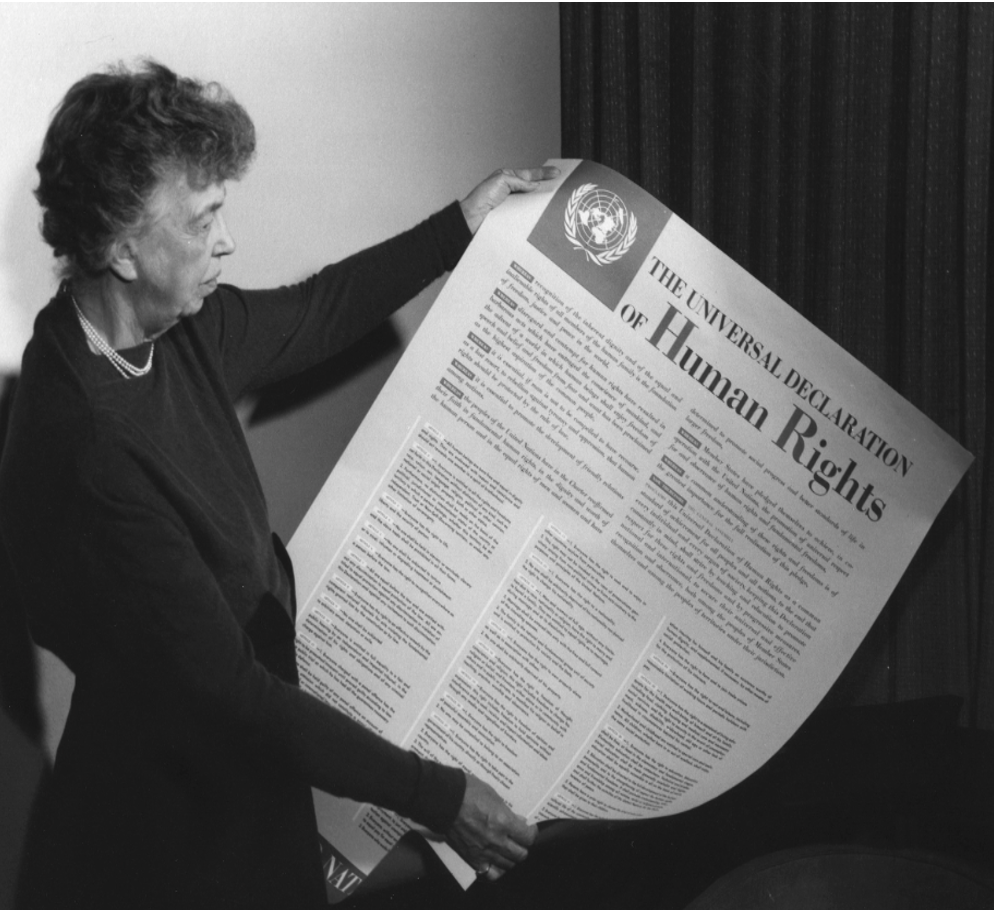
Despite cultural, linguistic, ethnic and religious differences, despite the enormous weight of the recently concluded war and the crippling of a new, cold confrontation, the whole document was redacted in less than two years. In the words of Hernán Santa Cruz, representative of Chile, in the days of the UDHR’s adoption, “there was an atmosphere of genuine solidarity and brotherhood among men and women from all latitudes, the like of which I have not seen again in any international setting”. [2]
The text, which has been untouched since its adoption on 10 December 1948, comprises thirty articles that list fundamental civil, political, economic, social and cultural rights. They include positive rights such as the right to life, to freedom, and to security of person (Art. 3); the right to marry (Art. 16); the right to work (Art. 23); or right to education (Art. 26). They also define some negative rights such as freedom from slavery (Art. 4), from torture (Art. 5), or from arbitrary arrest an detention (Art. 9). [3]
Available in 370 languages and dialects, the UDHR has been converted into the most translated document on earth, spreading its universal message for the last seventy-seven years throughout the globe. [4]
Why Human Rights are Everyday Essentials and why we need to protect them
On 10 December 2025, the UN system will celebrate the 77th Human Rights Day, which coincides with the UDHR’s formal adoption in 1948 in Paris. The selected theme for this year’s celebration is Human Rights - Our Everyday Essentials, underscoring humanity’s vital need for human rights to live peacefully, independently, and with dignity.
Feeling secure, having a roof over your head, speaking without being scared, having access to clean water or to medication, granting education for women and girls, and enjoying a sustainable environment. These examples of “everyday” human rights posted by people from across the world on the OHCHR’s website demonstrate well the essentiality of these rights.
Moreover, not only are human rights indispensable per se, but they are also interconnected with one another. How can somebody feel secure when they do not have access to water? How can women and girls receive education if they do not have a roof over their heads?
Indispensability, universality, and interconnectedness are foundational elements stemming from the UDHR that can help understand the essentiality of the full enjoyment of all human rights. However, they also reveal the fragile nature of these rights when their protection, respect, and fulfilment are not prioritised by individuals and institutions.
In fact, widespread, unprecedented violations of human rights continue to exist and to proliferate in different contexts. Crimes of aggression, war crimes and crimes against humanity are being documented in Palestine, Ukraine, Sudan, Myanmar, Congo, Iran, Haiti and beyond. One in three women experiences physical or sexual violence during their lifetime. [5] Around 700 million people face hunger, and almost the same number of people do not have access to electricity. [6] More than 250 million children do not have access to education. [7] Death penalty, arbitrary detention and torture are still resorted to in countries that supported the creation of the UDHR, such as the United States, Russia and China. These are just some instances in which human rights are violated. To the world’s dismay, the list could be substantially longer.
Nevertheless, commemorating the adoption of the UDHR should not be seen as a pointless, naive routine that drags on every year despite worsening human rights situations. Instead, it should be seen as a call to action for all individuals to uphold their shared rights and advocate for them. Understanding that human rights are not just abstract concepts but everyday essentials also means that their protection, respect, and fulfilment are not unattainable. Therefore, as the UDHR reaches its 77th year of age, it requires the effort of every rights holder to protect its message, by holding accountable those responsible for violations and ensuring that human rights are upheld for everyone, everywhere.
Geneva International Centre for Justice’s position
Geneva International Centre for Justice (GICJ) condemns the egregious violations of human rights happening in Palestine, Ukraine, Congo, Iraq, Iran, Sudan and beyond. Genocide, ethnic cleansing, man-made starvation, attacks against civilians, including children, physical, psychological, and digital violence, unlawful territorial annexation, arbitrary detention, torture, and forced migration are all taking place in utter disregard for the UDHR and its principles. We denounce all these violations and echo the call for accountability and justice of other civil society actors.
We believe that there can be no justice without the full respect of human rights as enshrined in the UDHR and other core treaties. This is why we will continue to act within the framework of the UN Human Rights system to hold perpetrators accountable, report violations, provide training and promote a culture of awareness of human rights.
GICJ calls on every member of the international community, particularly states and businesses, to stop diverting resources away from human rights to fund genocide, rearmament, war fighting and the deepening of injustices. We urge every individual to be aware of their actions’ impact on the lives of others and to act responsibly in the face of violations and abuses of human rights.