



Day of Remembrance for All Victims of Chemical Warfare - 30 November
By Mary Doherty / GICJ
November 30 marks the International Day of Remembrance for all those who have lost their lives to chemical warfare. It is a day to commemorate those who have lost their lives to chemical warfare and to recognise the courage and resilience of all survivors. This day above all is a poignant reminder of the tragic human cost associated with chemical weapons [1].
This year marks the 100th anniversary of the 1925 Geneva Protocol. Since this Protocol, the commitment made in the aftermath of World War 1 (WW1) towards the abolition of chemical warfare has further materialised and can be regarded by many as a success. However, as starkly reminded by the UN Secretary General Antonio Guteress in a recent UN press conference, the work is not finished [2]. One should not forget that the appalling use of chemical weapons continues. According to the Secretary General, this, together with the rapid development in technology, threatens to make the use of such weaponry even easier. It is for this reason that on this day, we must reaffirm our commitment to the Chemical Weapons Convention in order to prevent a repeat and continuation of such atrocities.
Background:
On April 22, 1915, a wave of asphyxiating gas was released from cylinder cans embedded in the ground on the Ypres Front in Belgium. This was the first period in history wherein chemical warfare was used at a large scale. The use of chemical warfare during WW1 resulted in 100,000 fatalities and a million casualties. In the aftermath of WW1, countries soon came to realise that the consequences associated with the use of such weapons far outweighed the benefits . The suffering experienced on the Ypres front and experienced by all victims of chemical warfare as aptly put by H.E. Mr Jan Lucas Van Hoorn (during a commemoration in Ieper for what occurred on the Ypres Front), can only be described as unspeakable. It is near impossible to describe the devastating effects chemical warfare can have on a person [3].
Public dismay in the aftermath of WW1 at the unspeakable horrors of the use of such weaponry culminated in the 1925 Geneva Protocol, a Treaty prohibiting the use of chemical and biological weapons in international armed conflicts. There is no doubt that the preceding decades brought with them remarkable success and consensus among communities in upholding this promise, including the entry into force of a far more stringent, all encompassing Treaty, The Chemical Weapons Convention 1993. The Chemical Weapons Convention opened for signature in Paris in 1993, and was enforced in 1997 [4]. With now near universal adherence, it is clear that there is common agreement among nations towards the abolition of chemical warfare for good. As set out in the Preamble of the Convention, for the sake of mankind, the possibility of the use of chemical weapons should be excluded completely. In order to enforce and ensure compliance with the Convention, The Organisation for the Prohibition of Chemical Weapons (OPCW) was established.
In 2013, the OPCW was awarded the Nobel Peace Prize in recognition of its global efforts in eliminating chemical warfare. Since entry into force, it has been the most successful disarmament treaty. 193 States have committed to the Chemical Weapons Convention. 98% of the global population live under the protection of the Convention. [5] Although the above outlined is a testament to the work done to date in efforts towards eradicating the use of such weaponry, it is imperative that the efforts of OPCW and signatory states to the Convention continue efforts towards the eradication of chemical warfare, particularly in an increasingly dynamic environment.
Syria:
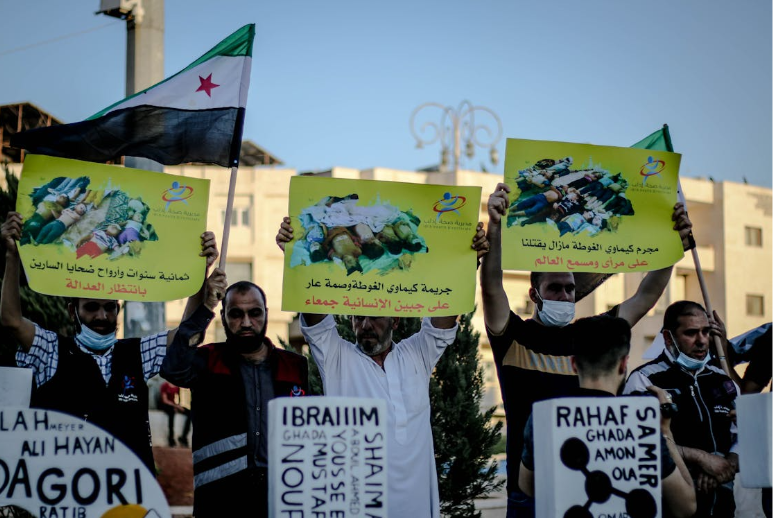
On the 21st August 2013, a coordinated attack was carried out targeting Eastern and Western Ghouta, Syria, in the countryside of Daasuc, a hotly contested area in the Syrian Civil war. The attack involved missiles filled with sarin gas, a nerve agent which essentially suffocates those who breathe it in. The area these missiles targeted was inhabited. It is estimated that 1,514 people suffocated to death in these attacks, a third of those being women and children. Whole families and communities were wiped out in what one could only describe as an unspeakable nightmare. This was an indiscriminate attack targeting civilians, and what has recently come to light, one of several occurrences in Syria. [6] It has been concluded by the UN among other bodies that chemical weapons were in fact used. However, contrary to belief, it has been repeatedly denied by the Assad Regime that they were in fact responsible.
The past 10 years have proven to be a major feat for the OPCW under the Assad Regime in ensuring Syria's compliance with the Chemical Weapons Convention. It is only now, following the fall of the Bashar al - Assad’s regime, that a full investigation could be commenced into the use of chemical weapons in Syria , with results already widening concerns of Syria's chemical weapons use [7]. It is also only now that the voices of those who have suffered most from the use of Chemical Weapons in Syria, particularly Ghouta, are being heard, due to fear of speaking out during the regime. For the first time in 12 years, survivors of these attacks and families of the victims have met with civil society organizations in Syria to cite the depression, displacement, intimidation and devastating loss they have experienced. The effects and their experiences are heart wrenching. Not only have these people lost families, communities, and are themselves suffering consequences, but to also be denied justice and accountability for what had occurred to date. When addressing a meeting of the OPCW in the Hague, Assad al-Shibani promised to “put an end to this painful legacy, to bring justice to victims, and to ensure that the compliance with international law is a solid one.” [8]
It is in these moments when the damage has been done, that the importance of justice and accountability are vital, emphasising the importance of the fact finding mission carried out by the OPCW in Syria. As echoed by Ban Ki Moon on the release of the UN Report on the matter in 2013, then Secretary General, the international community has a moral responsibility to hold those responsible accountable. [9]
On this basis, the continued work of the OPCW’s Fact-Finding Mission into Syria’s use of chemical weapons is paramount in identifying those who are responsible for these reprehensible attacks. [10]
As Mr Jan Lucas Van Hoorn stated during the commemoration, [11], the description and accounts of what happened on the 22nd April 1915 provides a horrifying illustration of what is often referred to as the “scourge of chemical weapons”. This should motivate us, as human beings, to not stand by idly while fellow humans continue to suffer this most horrendous fate today.
Geneva International Centre for Justice (GICJ) stands in solidarity and honours all victims. GICJ calls on all states to implement the convention and ratify the legislation. GICJ urges all parties to abstain from the use of these weapons.GICJ believes this must reinforce our determination to ensure that chemical weapons are banned completely and forever, current breaches are investigated and justice and accountability is brought and ensured for the families of the victims.
One-hundred years on from the Geneva Protocol, people are still falling victim to chemical warfare. The re-emergence of larger scale use of chemical warfare threatened by terrorist organisations, development in technology and most importantly impunity as demonstrated in Syria, are some of the most serious threats to international peace and security today. [12]
#genevainternationalcentreforjustice #gicj #justiceforvictims #geneva4justice
References
[1] (https://www.opcw.org/sites/default/files/documents/2025/11/s-2460-2025%28e%29.pdf
[2] (https://press.un.org/en/2025/sgsm22915.doc.htm )
[3] https://www.opcw.org/sites/default/files/documents/event_photos/2015/Ieper/WEOG_Regional_Group_Statement.pdf)
[4] https://www.opcw.org/about-us/history#:~:text=The%20Geneva%20Protocol,(biological)%20weapons%20in%20war
[5] (https://www.opcw.org/remembrance)
[6] (https://www.opcw.org/remembrance)
[7] https://press.un.org/en/2025/sc16167.doc.htm#:~:text=He%20cited%20the%20%E2%80%9Ctenth%20sad,mines%20and%20remnants%20of%20war.
[8] https://press.un.org/en/2025/sc16167.doc.htm#:~:text=He%20cited%20the%20%E2%80%9Ctenth%20sad,mines%20and%20remnants%20of%20war
[9] https://news.un.org/en/story/2016/08/537352
[10] https://www.opcw.org/fact-finding-mission
[11] https://www.opcw.org/sites/default/files/documents/event_photos/2015/Ieper/WEOG_Regional_Group_Statement.pdf
[12] https://www.eeas.europa.eu/eeas/chemical-weapons-remain-threat-world_en