



Reform or reversal? Latvia's fourth universal periodic review cycle report
By Yassin / GICJ
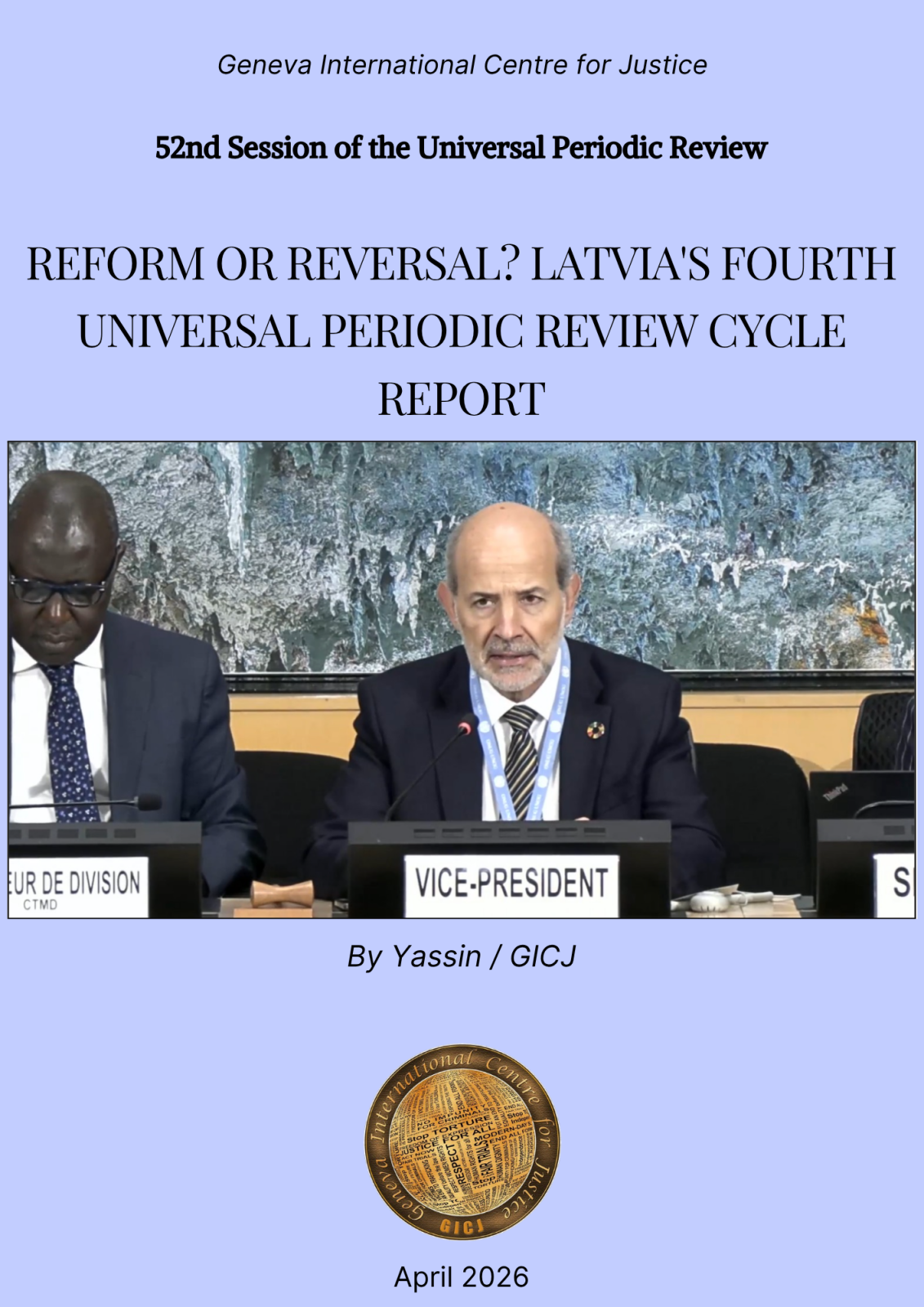
On 11 May 2026, the Working Group of the UN Human Rights Council (HRC) conducted the fourth cycle Universal Periodic Review of Latvia at the Palais des Nations. State Secretary Andžejs Viļumson led the delegation; the troika consisted of the Dominican Republic, France and Pakistan.
The dominant theme by a wide margin was Latvia’s standing under the Istanbul Convention. Latvia ratified it on 30 November 2023 (in force 1 May 2024). In autumn 2025, the Saeima initiated a withdrawal procedure and on 30 October 2025 it adopted the Law on Withdrawal (National Report, paragraph 93); on 3 November 2025 President Edgars Rinkēvičs exercised his suspensive veto, returning the law for a second review with a 1 November 2026 deadline, after the 3 October 2026 parliamentary elections. Sweden, Estonia, the Netherlands, Finland, France, the UK, Brazil, Ireland, Italy, Germany, Austria, Switzerland, Iceland, Belgium and Ukraine, among many others, urged Latvia to remain a State party.
Hate speech and hate crimes were also recurrent themes during the discussion (with the unresolved gap on sexual orientation and gender identity, and Latvia’s non-reporting of hate-crime statistics to OSCE-ODIHR since 2016); the alignment of the national torture definition with Article 1 of the United Nations Convention against Torture and Other Cruel, Inhuman or Degrading Treatment or Punishment (CAT); the 170,463 holders of non-citizen status (as of 1 July 2025); the post-2022 language reforms in education and broadcasting; pushbacks at the Latvia-Belarus border (with thousands of incidents documented in 2024 by civil-society monitoring, and H.M.M. and Others v. Latvia pending before the European Court of Human Rights (ECHR) Grand Chamber); and Latvia’s reported steps to withdraw from the Ottawa Anti-Personnel Mine Ban Convention, on which UN High Commissioner Volker Türk publicly expressed grave alarm on 2 July 2025.
The delegation highlighted Latvia’s 10 December 2021 Optional Protocol on the Convention against Torture and Other Cruel, Inhuman or Degrading Treatment or Punishment (OPCAT) ratification, the 1 July 2024 entry into force of civil partnerships (613 registered including 235 same-sex in the first year), the new Liepāja Prison concluded in 2025 with full operations from 2026, the Roma Strategic Framework 2024-2027, and the Trafficking Plan 2025-2027. It defended the non-citizen regime through the “restored State” doctrine. Formal positions on the recommendations will be set at the HRC plenary in September or October 2026.
Read the full report by clicking on the image below: