




HRC61: Syria After the Fall of the Former Regime
The 61st Session of Human Rights Council
23 February - 31 March 2026
Item 4: Interactive dialogue with the Commission of Inquiry on the Syrian Arab Republic
13 March 2026
By Arwa Akbar/ GICJ
Executive Summary
The Commission of Inquiry on the Syrian Arab Republic focused on the potential for the new Syrian Arab Republic’s government to remedy previous systemic violations under the former Assad regime which fell in December 2024. Recommendations highlighted the need for inclusive and transitional justice mechanisms, to ensure non-recurrence. The Syrian Arab Republic’s statement echoed the Commission’s findings and demonstrated hope for a better future for Syrian civilians; however, concrete actions will be the true indicator as to whether such hopes can come to fruition.
Groups of states commented on the situation, with the EU, Lithuania (on behalf of a group of states) and Bahrain (on behalf of Cooperation Council for the Arab States of the Gulf - GCC), demonstrating support for changes within the country’s political framework. These states called for the institutionalisation of universal human rights protections, with particular respect to the most vulnerable populations, specifically women and children. UN Women further reaffirmed the imperative for women’s participation in the ‘new Syria’.
Geneva International Centre for Justice (GICJ) supports all efforts towards incorporating human rights mechanisms in the ‘new Syria’ to support the flourishing of the Syrian people. We maintain that transitional justice mechanisms must be non-discriminatory and inclusive of all ethnic and religious groups to ensure a stable and just peace.
Background
According to UN News, on 24 December 2024 the former Assad regime fell after fourteen years of sustained conflict in the country which witnessed the displacement of over twelve million Syrians and severe damage to pivotal infrastructure. Tragedy exceeded the political sphere, as Syria was left with the aftermath of the 2023 earthquakes and the accumulated economic turmoil, plunging the country into a deeper humanitarian crisis.
The Commission of Inquiry on the Syrian Arab Republic’s report presented the situation in the country under the nascent new government and its implications for the people of Syria following decades of institutionalised discrimination along sectarian lines, at the hands of the regime. The Commission made reference to the atrocities in the Druze-majority Suwayda and the Alawite-majority Coast, where governmental forces displayed violence against these groups who constitute minorities in the Syrian Arab Republic. This demonstrates the sectarian dimensions of the conflict and the turbulent political transition, as well as, the need for inclusive mechanisms to underpin the state’s political fabric.
Opening Statement
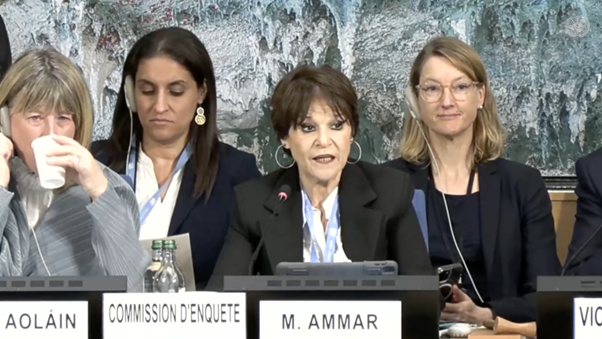
Ms. Monia Ammar, Member of the Independent International Commission of Inquiry on the Syrian Arab Republic
In the words of Commissioner Ms. Monia Ammar, a member of the Independent International Commission of Inquiry on the Syrian Arab Republic, the report sought to cover: ‘the human rights situation in the ‘New Syria’, after decades of authoritarianism’, citing the Commission’s continued reporting in the country, as of 2011, documenting the ‘systematic and widespread violations committed by the former government, as well as, other parties to the conflict’. Commissioner Ms. Ammar affirmed the Commission’s unwavering solidarity with the Syrian people who have been victim to continued violations, as she segued into the contents of this year’s report, which focused on the period between 8 December 2024 to 31 January 2026. She alleged that the newly installed Syrian Government ‘has continued its earnest efforts to ensure a peaceful political transition’. Despite this contention, she noted the waves of ‘deadly violence’ which have ensued since the new government has taken over, citing Syria’s ‘appalling human rights legacy’. She noted that ninety per cent of Syrians live below the poverty line and one and a half million Syrians continue to live in camps.
Despite these stark figures, Commissioner Ms. Ammar chose to emphasise what she deemed to be ‘several positive developments in the field of human rights’, including the implementation of ‘national accountability bodies and national commissions of investigation’. She expressed that media and civil society are able to increasingly consolidate their space in the new domestic sphere. Referencing the violence in Suwayda and the Coast, the Commissioner asserted that ‘all parties have committed serious violations of international law (…) which may amount to war crimes’, and ‘should even amount to crimes against humanity if evidence is established through further investigation’. She emphasises the need for all parties to be held accountable. Despite the transition from the previous government which emphasised factional gains across sectarian lines over the rule of law, there is a continued need for a transformative mechanism within Syria for the newly established government to uphold this rule of law.
The need for an ‘independent’ and ‘developed’ judiciary body was highlighted as a potential remedy, to act as the sought after transformative mechanism that would allow for the integration of the rule of law within the framework of Syria’s new government to catalyse the processes of ‘transitional justice’. Commissioner Ms. Ammar appeared hopeful that the Commission’s recommendations would be taken into consideration by the new government, as she references the Minister of Foreign Affairs whose comments on the Commission’s Report on Coastal Events, described as ‘a roadmap’. Recommendations covered the strengthening of pre-existing justice institutions and the necessity for the implementation of a ‘zero-tolerance’ policy against all violations. She concluded by affirming the significance of the international community and their support in ensuring Syria is able to uphold its commitments to its people, stating ‘Syria needs to intensify efforts to build a new Syria, in this respect, we call upon member states and the international community at large to increase funding for reconstruction and humanitarian response, and help the government find sustainable solutions to the economic and humanitarian crises.’
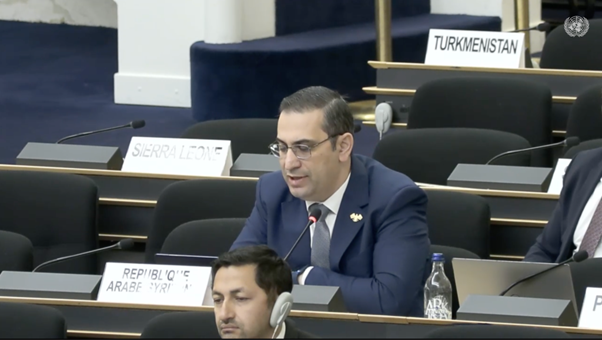
Statement by the Syrian Arab Republic (Country concerned)
The Syrian Arab Republic recalled ‘the systematic and widespread crimes and violations that were continuously perpetuated by the Assad regime’. Syria alleged that: ‘Today, this reality has fundamentally changed thanks to the positions and measures adopted by the new Syrian government’. Echoing the Commission’s recommendations, Syria emphasised the safeguarding of rights, equal citizenship without discrimination, non-recurrence, and upholding the rule of law, as intrinsic principles under which their new government seeks to implement transformative changes. In support of these goals, Syria highlighted several implemented measures, including the inclusion of human rights protections within the Constitution and the issue of a decree respecting ‘the cultural and linguistic rights of the Syrian courts’. Furthermore, Syria noted the adoption of a code of conduct by the Ministry of Defense and Ministry of Interior, as well as its engagement with the human rights mechanisms and the Commission of Inquiry. Syria particularly highlighted the resumed operation of the OHCHR in the country. Regarding the events in Suwayda, Syria claimed that ‘serious investigations’ have taken place, with arrests of involved parties.
Following the Syrian Arab Republic’s statement, the floor was open for questions and comments.
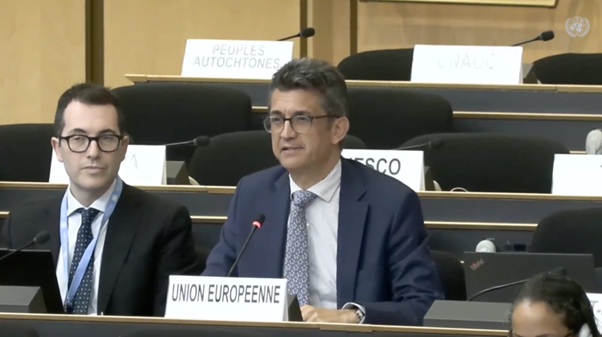
European Union
The EU reaffirmed its support for an autonomous Commission and cited the importance of the mechanism’s independence and the significance for its mandate’s renewal. The EU cited: ‘We urge all actors to uphold international law and universal human rights, with particular attention to women’s and children’s rights’. The EU’s commitment to the rule of law was reinforced through its call for the Syrian Arab Republic to ensure that ‘the rights of all Syrians without distinction of any kind, including those based on gender, ethnicity, or religion; must be respected and protected’. Accountability was highlighted as paramount to Syria’s transition and the EU stated: ‘We support a transition free from foreign interference’.
The EU asked the Commission: ‘How can we best support Syrian capacities to ensure comprehensive transitional justice?’
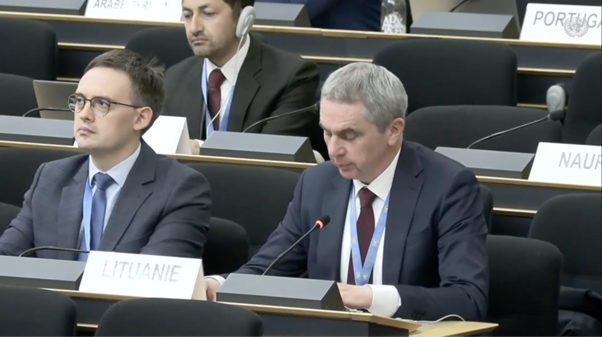
Lithuania (on behalf of a group of countries)
Lithuania spoke ‘on behalf of the Nordic and Baltic states’, recognising that the Syrian Arab Republic ‘stands at a pivotal moment’, following the devastation experienced over the last decade. The significance of protecting human rights, particularly for women and children, and implementing transitional justice was reaffirmed, seen as foundational to building a stable Syria to prosper for generations to come. Lithuania cited the promising developments by the new Syrian government’s installation, towards an ‘inclusive’ and ‘democratic’ Syria. However, sustained ‘grave human rights violations’ throughout 2025 and in early 2026, were raised as legitimate concerns. Lithuania stressed the need for the new government to uphold international law and support the renewed mandate of the independent Commission.
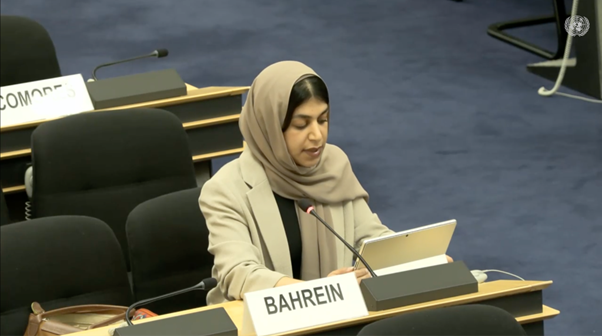
Bahrain (on behalf of Cooperation Council for the Arab States of the Gulf - GCC)
Bahrain reaffirmed ‘the importance of respecting the sovereignty’ of the Syrian Arab Republic, emphasising the rejection of extremism and the protection of civilian rights as essential components to ensure unity within the country and to facilitate the state-building process. Bahrain praised initiatives such as investments and the removal of sanctions which were viewed as supporting the stability for Syria’s future.
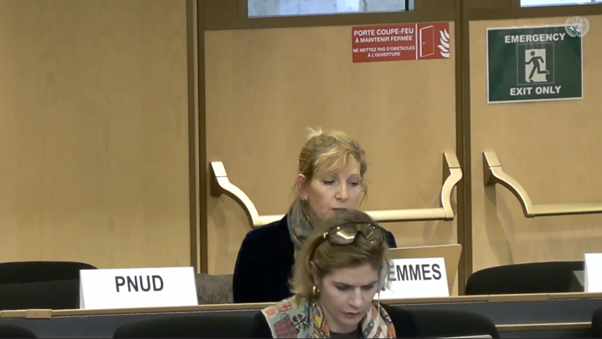
UN Women
The representative of UN Women was hopeful that ‘the transition in Syria represents a defining moment to place women and girls at the center of the country’s recovery and development’. The representative reinforced the need for women ‘from all communities and backgrounds’ in the state-building process. She stated that: ‘Transitional justice processes must be gender-responsive addressing the specific harm suffered by women and girls, including sexual and gender-based violence’. She highlighted how women’s participation is essential to rebuilding Syria’s foundational framework and championing the principles of non-recurrence.
Concluding Remarks
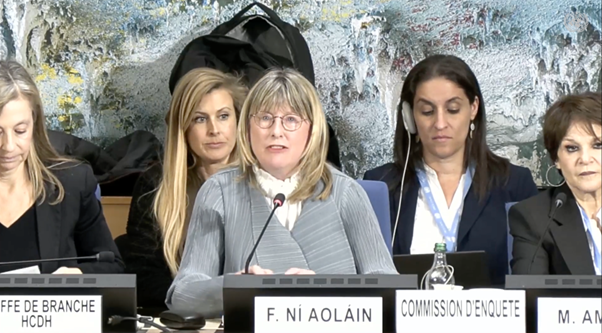
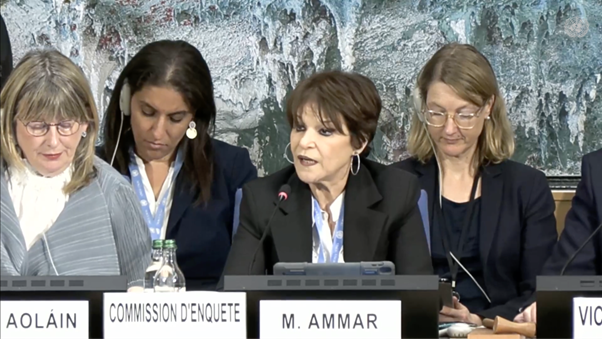
Ms. Fionnuala Ní Aoláin, Mr. Member of the Independent International Commission of Inquiry on the Syrian Arab Republic
The Commission concluded the discussion with positive remarks, stating that the Commission ‘welcomes the positive statement of the Syrian Arab Republic, and particularly its note of the lessons learnt on the events of Suwayda and the Coast’. The Commission highlighted the cooperative and engaging relationship it was able to sustain during its reporting with the Syrian Arab Republic. The Commission ended the discussion with further recommendations for the priorities of state, including: ‘screening and lustration of security forces, conducting effective and independent criminal investigations into violations, rebuilding trust with communities affected by recent violations, and taking preemptive measures to address the dissemination of hate speech’. Commissioner Ms. Ní Aoláin reiterated ‘the importance of women in this process’, referring to Syria’s state-building, citing the ‘resilience and strength of Syrian women’ and how their inclusion is ‘absolutely essential in any new mechanisms, from constitutional to mechanisms of investigations’.
GICJ Position
Geneva International Centre for Justice (GICJ) supports all efforts towards rebuilding Syria’s political landscape under the guidance of international law and the principles of human rights. GICJ welcomes the efforts of the Commission in reporting on the situation and reaffirms the importance of its renewed independent mandate in the region. GICJ recognises the importance of women in Syria’s state-building process. GICJ stands with the Syrian people who have been the victims of continued violence.
GICJ asserts the ‘new Syria’ must be built upon a foundation of equal citizenship that transcends the sectarian divisions. We underscore that there can be no sustainable peace without the provision of reparations to the victims. The resilience of Syrian women must be recognised through effective participation in all constitutional and judicial reform processes. GICJ maintains that women’s rights are the cornerstone to a stable state.
We call upon the international community to increase funding for the reconstruction of the country.
Sources:
