




The Interdependent Struggle for Human Rights and Environmental Protection in Global Business Practices
By Melissa Fuhrer / GICJ
Introduction
The extensive damage brought on by extractive industries and other environmentally detrimental business practices on both ecological systems and human rights is well-documented. Unfortunately, from a purely commercial standpoint, human rights violations - such as exploitative labour or child slavery - and environmental degradation - such as the destruction of biodiversified indigenous flora for monocultural crops - go hand in hand in terms of profit-making.
This raises an important question: how can this cycle be dismantled? While not all corporate leadership is indifferent to human rights, in one way or another, human labour is often viewed as an impediment to maximising profits due to the inherent needs of workers for rest, medical leave, and personal time.
Importance of Human Rights Defenders
Human rights defenders can be defined as individuals or a collective who strive to promote and defend human rights all over the world. The United Nations has repeatedly recognised human rights defenders as essential to ensure corporate accountability and promote sustainability.
Human rights defenders have a tough job. Their job includes the collection of evidence and fact-checking to determine if violations have been committed, ensuring that victims receive the necessary resources to be supported, and pursuing perpetrators in court.
Since the 1970s, environmental defenders have helped to halt 11% of environmentally destructive projects, thereby defending the livelihood and human rights of individuals affected [1].
However, due to the delicate nature of their work, these defenders are constantly under threat [2]. Some defenders are unlawfully detained or even attacked for standing up for human rights. The Business and Human Rights Centre notes that in the past decade, more than 6,400 defenders were attacked, overwhelmingly for speaking out against human rights violations in the business sector. In 2024 only, 89% of these attacks were related to climate, land and environmental defenders [3]. Chris Owalla, a human rights and environmental defender, was beaten for going to court and denouncing human rights violations on behalf of the people affected by the County Government of Siaya.
Indigenous Human Rights Defenders
Indigenous human rights defenders are a key community in the fight for the protection of human rights and the environment. Indigenous populations all over the world have been known to have a profound knowledge of nature and ecosystems, and a deep respect for the environment. As human rights defenders, they use their ancestral knowledge to defend their land. Indigenous communities have played a vital role in providing holistic frameworks to care for the environment.
In Australia, ancient Aboriginal knowledge is being used today to battle wildfires [4]. In Central Africa, Indigenous agricultural communities have implemented traditional agroforestry systems, which reduce soil erosion and mitigate climate change concerns [5].
Indigenous Peoples are the most targeted populations when it comes to the harms perpetrated by business practices, as there is a strong geographical overlap between human rights violations and environmental disasters. For example, they are more likely to live near mining and extractive sites and thus inhale harmful chemicals [6], and often live in poverty, making them vulnerable to exploitation and lower wages [7].
Vulnerable communities such as these better understand the immediate impacts of these violations, positioning them as necessary and their work as imperative. Research indicates that most of the world's natural resources are located within Indigenous territories, which exposes these communities to environmental hazards and human rights risks [8]. These regions face intense pressures from extractive industries, toxic waste dumping, and resource exploitation, systematically endangering Indigenous communities [9],[10].
In July 2010, the United Nations General Assembly recognised the human right to water and sanitation [11]. In 2021, a Human Rights Council resolution declared clean, healthy, and sustainable environments as a universal human right [12]. This includes the right to clean air, which is constantly being violated by corporations.
However well these resolutions were intended, they haven’t led to much change. In Canada, there are 31 long-term drinking water advisories on 29 First Nations reserves [13]. In Australia, Indigenous communities are more likely to be exposed to air pollution and its adverse health outcomes [14]. Indigenous Peoples are still constantly and disproportionately harmed by environmental and thus human rights issues.
Consequently, Indigenous Peoples are consistently a key part of human rights groups.
La Via Campesina is an international movement that consists of peasants, agrarian farmers, and Indigenous Peoples. Its message focuses on food sovereignty. The group advocates for human rights, especially those of peasants and Indigenous Peoples, their right to seeds, land, and dignified livelihood.
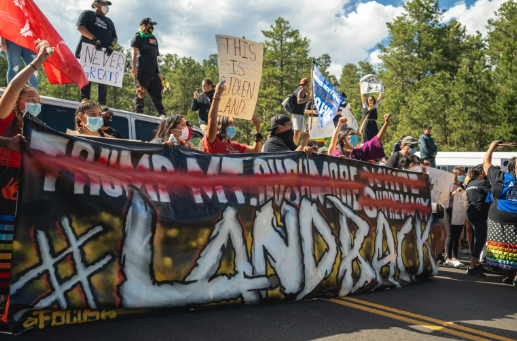
Land Back is an indigenous-led movement that emerged in the 21st century in Australia and Canada, seeking to ensure that stolen land is restored to its people and their authority.
Indigenous rights and their violation
Historically, the seizure of Indigenous land - now more commonly framed as land grabbing or resource extraction - has been a central strategy used by colonial empires to establish and maintain control over Indigenous Peoples, their communities, and their territories.
In the 19th century, the United States military killed thousands of bison, the Plains Native Americans’ primary food source, in order to force them off their lands and onto reservations.1
Such a stark and prompt change in the Bison population has caused an environmental disaster. In 20 years, the population dropped from 8 million to just under 500 [15]. Before European settlement, this number was estimated to be 30 to 60 million [16],[17]. Ecosystems are very fragile and work in complicated but extremely interconnected ways, where even one small change could disturb and collapse a system engineered perfectly thousands of years ago. Indeed, the decline of the buffalo has led to a near extirpation of the Plains Grizzly Bear and the Great Plains Wolf.
Land offers vital space and resources for businesses to carry out developments and industrial projects. Throughout this process, Indigenous Rights and voices are often ignored and forgotten. Indigenous Sámi lands in Norway, Sweden, and Finland are increasingly being used for mining, forestry, and wind farm projects [18].
The principle of Free, Prior and Informed Consent (FPIC) has been recognised as part of the UN Declaration on the Rights of Indigenous Peoples. This principle allows them to give or withhold consent to projects affecting their lands, territories, or resources [19]. As signatory members of the UN, Sweden, Norway, and Finland are failing to respect this critical Indigenous Right.
On a national scale, countries often have legislation aimed at protecting Indigenous Rights, but such frameworks are frequently weakly implemented or inconsistently enforced. For example, Canada has multiple legislatures and treaties in place to recognise and uphold Indigenous Rights, such as Section 35 of the Constitution Act, the Peace and Friendship Treaties, the Numbered Treaties, and the Williams Treaties of 1923. Despite these treaties, Indigenous Rights are sometimes not recognised. For example, during proposed development projects on a protected landmass (the Greenbelt), the province of Ontario failed to have sufficient communication and consultation with Indigenous communities in the region, which is a breach of Section 35; “duty to consult and accommodate” [20],[21]. Furthermore, most of the parcels removed from the Greenbelt were lands protected by the 1923 Williams Treaties, and rights to harvesting (such as hunting and fishing) would be completely eradicated if these parcels had ended up being developed. Other Indigenous Peoples, such as the Anishinaabe community in the Grassy Narrows, have also been fighting to protect their treaty-guaranteed land rights.
On an international scale, frameworks such as the United Nations Declaration on the Rights of Indigenous Peoples (UNDRIP) and the International Labour Organisation (ILO) Convention No. 196 (the Indigenous and Tribal Peoples’ Convention of 1989) have been put in place in order to ensure respect for Indigenous Rights across UN member states.
International treaties are fundamental to a healthy basis of lawfulness and making sure the global society not only agrees on what it means to be treated fairly and to treat each other fairly, but most importantly on what is allowed, what is prohibited, and what the consequences are for such breaches. However, non-compliance regarding treaties on the protection of human rights is unfortunately quite common; on both the national and international level, rights and treaties are either not recognised properly or poorly implemented, leaving a lot of room for infringement [22].
The lack of recognition of Indigenous Rights doesn’t just impact the individuals; it impacts the community, and consequently, the environment.
Burden
Although Indigenous Peoples are critical to the fight for environmental protection and human rights, they should not bear the sole responsibility for addressing global environmental challenges. Contributions come at a significant cost. Indigenous communities face disproportionate environmental burdens, including displacement, human rights violations, and increased vulnerability to climate impacts. While Indigenous Peoples are crucial environmental defenders, the global community must provide substantive support and reduce the systemic pressures placed on these communities.
Solutions
In order to share and reduce the burden that Indigenous human rights defenders carry, various communities such as international bodies, researchers, local communities, policy makers and governments can play a pivotal role.
Policy makers, researchers, and governments can work together to create, ratify, and implement legislation that ensures the protection of Indigenous human rights defenders, as well as the recognition and implementation of Indigenous Rights. In order to compile a relevant and conducive list of solutions, I have drawn insights from a 2025 UNBHR Forum session on the critical role of human rights defenders, including the sensible opinions of multiple panellists: Monica Ndoen, Chris Owalla, Carlos Ernesto Choc, Rebecka Gylfe, and Rémy Friedmann [23].
As Ms Ndoen and countless voices before her have suggested, mandatory human rights due diligence for financiers, corporations and business policies, such as the application of grievance mechanisms on multiple levels throughout the supply chain, is not only critical to the protection of human rights defenders, but will also significantly alleviate their workload by ensuring that systems are put in place to detect human rights violations earlier on.
Unannounced social compliance audits and labour inspections can also be helpful in monitoring and reducing human rights violations in workplaces, and hence lessen the burden on human rights defenders. Other innovative responses to prevent corporate human rights violations include worker-driven monitoring, such as the Bangladesh Accord on Fire and Building Safety [24].
Unfortunately, research shows that current due diligence models are akin to “shooting blanks”; they are essentially ineffective at preventing corporate human rights violations [25]. Consequently, it is important to create such models with rigidity, as current human rights disclosure and due diligence laws are inefficient without enhanced state regulatory oversight [26]. Furthermore, truly successful processes would require binding legal mechanisms with robust oversight.
Another member of the session, Rebecka Gylfe, noted the importance of annual assessments, such as a worker survey, to ensure that violations are properly uncovered.
An additional solution to alleviate this burden included the establishment of trade unions for every worker, and to combat key obstacles of joining unions, such as anti-union worker culture, by building trust, maintaining open communication, and establishing effective safety measures, among others [27].
As noted by Mr Friedmann, a Senior Advisor on business and human rights with the Swiss Federal Department of Foreign Affairs and a panellist of the aforementioned session, protection and respect are imperative in the domain of human rights protection. Nonetheless, he asserted that these principles only work when civic spaces thrive. Thus, human rights due diligence must include supporting civic spaces. He also mentioned that states must become a safe and enabling environment for human rights defenders, which includes ensuring that freedom of association is recognised on a more concrete level. Creating safe communities is conducive to a more transparent and accountable society, which ultimately alleviates the burden on human rights defenders.
In order to alleviate the burden that Indigenous human rights defenders are carrying, it is important to concretise their work. Two means to do this are by changing their depiction in the media and by offering them more concrete special legal protection.
As Mr Choc and many other speakers outlined, human rights defenders are often criminalised and depicted as terrorists.
By actively changing their depiction in the media, we will be able to change the narrative and ensure their role is seen as positive. This will lead to actors whose decisions and opinions are respected and valued, thus leading to lasting, positive change for the protection of human rights and the environment. In fact, research shows that narrative persuasion can influence behaviours and drive positive social change, thus inspiring actions on human rights and environmental issues [28],[29].
More than socially, this can be done legally, for example, by offering special protection to those undertaking the work of human rights defenders. Although the UN Declaration on Human Rights Defenders (1998) already recognises the importance and legitimacy of human rights defenders on an international level, a declaration can only go so far, as it isn’t legally binding. It is only a statement of principle, and hence has no legal basis and offers no protections whatsoever. Human rights defenders must be recognised on a legal basis at the international and national level as a distinct legal class under binding legislation as a way to increase their protection and ensure that corporations and other actors have a harder time threatening, harassing, and assaulting them.
Although these solutions are by far perfect, a holistic and comprehensive approach to the protection of human rights and environmental disasters is the best way to ensure the relief of the burden that Indigenous human rights defenders carry. One study estimates that combining strategies increases human rights defenders’ success rate from 11% to 27%, a significant increase [1].
In any case, it is imperative to address the root causes of human rights violations and environmental degradation in order to protect Indigenous human rights defenders. Capitalism and consumerism push for the infinite and continuous production of goods and money, which leads employees and corporations to decrease salaries, ignore safety regulations and decent work environments for higher profits.
Corruption
Major issues faced by human rights defenders when trying to denounce human rights violations are rampant corruption, impunity, and intimidation.
Chris Owalla, the executive director for the Community Initiative Action Group Kenya and a panellist of the aforementioned session, denounced East African countries as complicit in coordinated repression, especially the abductions and enforced disappearance of individuals, including human rights defenders. Related to this matter, he warned that money from election financing comes from extractive industries, which are reluctant to practice human rights, as they see the extraction of various resources as a necessary evil for “development”2. He criticised the lack of viable channels to denounce human rights violations, as the police, courts and companies are used against you. Consequently, human rights defenders not only suffer discrimination but also mental health issues.
Election financing points to a broader systemic problem: the interconnectedness of corporations and the government. In order for governments, more specifically public servants, to effectively govern and address public interest diligently without being biased, a separation between the state and private corporations is required.
For example, when a government's financing partially comes from a private corporation, they are more likely to dismiss cases of human rights violations caused by that same corporation, leading to a corrupt government that citizens can no longer rely on. In the United States, private contractors work to keep their secrets buried, and Supreme Court rulings have made it harder to expose abuses when governments use private contractors [30].
More commonly, members of government, specifically in a US context, will tend to have stocks in a certain company and thus act in favour of said company, sometimes to the detriment of citizens. A New York Times investigation found that, from 2019 to 2021, 18 per cent of members of Congress traded stocks in sectors related to the work of their congressional committees [31]. This also creates valid concern about the harm and erosion of public trust.
This interconnection also falls on an international scale: note Donald Trump’s “World Class Resorts” project in Gaza, considering his major involvement in pioneering the 20-point peace plan, as well as his role as Chair of the Board on the Board of Peace. His position means that, on top of having major financial projects in Gaza, he also exercises “virtually complete control over the composition of the Board and its decision-making structures, control that would continue even after the end of his term as U.S. President” [32].
So what can we do about this? E-government and technological transparency seem to be some of the most promising methods for eradicating government corruption, and multiple studies provide strong evidence for this approach [33],[34]. E-government - the use of technology services such as the internet to deliver administrative services, making it more efficient and transparent - can significantly reduce corruption, as e-government initiatives in emerging economies enhance transparency and accountability, directly impacting corruption reduction. This is because e-governments allow for an increase in public monitoring capabilities, it creates transparent online application processes, and enable real-time tracking of government transactions. The main limitation of these initiatives is that the wider community needs to have working electricity and internet.
Eradicating government and corporate corruption is an essential step to ensure that people can safely report human rights violations, therefore alleviating the burden that human rights defenders are carrying.
Conclusion
In conclusion, the protection of the environment and the preservation of human rights are inextricably linked within the sphere of global business activities. Indigenous human rights defenders, while serving as the frontline defenders to combat environmental destruction and human rights violations, continue to face disproportionate burdens of exploitation, displacement, and violence. Addressing these concerns demands various solutions, such as concretising the works of human rights defenders, implementing mandatory human rights due diligence, recognising Indigenous Rights, eradicating government corruption, and more.
Ultimately, a holistic approach is required to address the root causes of these violations. Only by fostering safe, transparent, and accountable civic spaces can the global community ensure that the rights of both people and the planet are truly secured.
GICJ position
Geneva International Centre for Justice (GICJ) strongly advocates for the protection of human rights defenders and Inidigenous Peoples who stand at the frontlines of environmental and human rights protection against exploitative business practices. We recognise that human rights defenders play an indispensable role in exposing corporate violations, advocating for affected communities, and promoting sustainable development, and we urge the international community as well as the business community to support and protect this work, rather than criminalise and suppress it.
GICJ expresses grave concern over the systematic targeting, intimidation, and violence faced by human rights defenders, particularly Indigenous defenders who protect their ancestral lands from extractive industries and environmentally destructive projects. The ongoing attacks against these defenders, including arbitraty detention, harassment, and evven killings, represent not only violations of individual rights but also an assault on the collective pursuit of environmental justice and sustainable development.
----------------
1 Indeed, hunger has been weaponised as a tool for genocide and colonisation throughout history, and this practice continues today. For example, Prime Minister Benjamin Netanyahu blocked all aid to Gaza in March 2024. In July 2025 alone, the World Health Organisation reported 63 malnutrition-related deaths in Gaza.
2 Election financing in East Africa is common. According to some sources, the average cost to get elected to the National Assembly is US$182,000 [35].
References
[1] https://www.sciencedirect.com/science/article/pii/S0959378020301424#ab010
[2] https://www.ohchr.org/en/special-procedures/wg-business/human-rights-defenders-business-and-human-rights
[3] https://www.business-humanrights.org/en/from-us/press-releases/landmark-research-more-than-6400-attacks-on-human-rights-defenders-protecting-communities-and-environments-from-corporate-abuses-in-past-decade/#:~:text=Climate%2C%20land%2C%20and%20environmental%20defenders,most%20frequently%20associated%20with%20attacks
[4] https://www.teaonews.co.nz/2024/03/15/aboriginal-australians-teach-iwi-how-to-battle-wildfires/
[5] https://link.springer.com/article/10.1007/s44415-025-00050-z
[6] https://doi.org/10.5040/9798400669729
[7] https://doi.org/10.1163/187197308X356930
[8]https://papers.ssrn.com/sol3/papers.cfm?abstract_id=3849099
[9] https://doi.org/10.4324/9781315094427-1
[10] https://doi.org/10.1097/01.ee9.0000609632.34852.db
[11] https://www.un.org/en/global-issues/water#:~:text=The%20right%20to%20water&text=The%20Assembly%20recognized%20the%20right,per%20cent%20of%20household%20income
[12] https://news.un.org/en/story/2021/10/1102582
[13] https://canadians.org/fn-water/
[14] https://healthbulletin.org.au/articles/environmental-health-challenges-in-remote-aboriginal-australian-communities-clean-air-clean-water-and-safe-housing/#:~:text=PM%20specifically%20from%20mineral%20dusts,international%20studies%20of%20urban%20particulates
[15] https://www.nathab.com/blog/american-bison-their-ecological-economic-and-emotional-impacts
[16] https://fasterplease.substack.com/p/-what-the-bison-shock-of-the-1800s
[17] https://waapihk.com/2025/06/28/bison-loss-and-restoration-on-the-great-plains/
[18] https://www.fern.org/de/publications-insight/critical-raw-materials-mining-on-sami-land-without-their-consent-1/
[19] https://openknowledge.fao.org/server/api/core/bitstreams/8a4bc655-3cf6-44b5-b6bb-ad2aeede5863/content
[20] https://s3.documentcloud.org/documents/23904133/greenbelt_en.pdf
[21] https://laws-lois.justice.gc.ca/eng/const/page-12.html
[22] https://doi.org/10.2307/797642
[23] https://forumbhr2025.sched.com/event/27VPU/the-critical-role-of-human-rights-defenders-in-seeking-solutions-to-environmental-and-social-harms-in-the-context-of-business-activities
[24] https://doi.org/10.4324/9780203125618
[25] https://doi.org/10.2139/ssrn.3849978
[26] https://doi.org/10.2139/SSRN.3497421
[27] https://www.connmaciel.com/union-avoidance-strategies-for-employers#:~:text=Open%20communication%20is%20the%20foundation,a%20timely%20and%20visible%20way
[28] https://doi.org/10.1002/pan3.10259
[29]https://doi.org/10.1007/s10584-019-02403-y
[30]https://ccrjustice.org/home/press-center/press-releases/supreme-court-rules-against-government-transparency-contracts
[31] https://www.brennancenter.org/our-work/research-reports/congressional-stock-trading-explained
[32] https://www.justsecurity.org/130867/board-of-peace-key-questions/
[33] https://doi.org/10.1080/01900692.2022.2076695
[34] https://doi.org/10.3390/su15032694
[35] https://costofpolitics.net/east-and-southern-africa/kenya
