



June 19 - International Day for the Elimination of Sexual Violence in Conflict
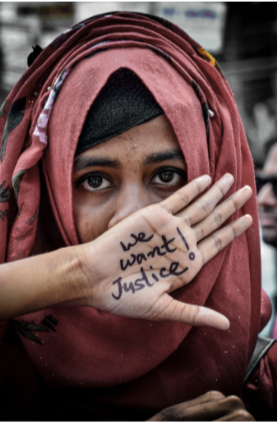 Ferdous. (2018, August 2). Woman in red hijab holding palm with "We Want Justice" written on it [Photograph]. Pexels. https://www.pexels.com/photo/5150610
By Khouloud Alouini / GICJ
The Core Imperative of June 19
Conflict-related sexual violence (CRSV), contrary to popular belief, is not an uncontrollable event that comes as a chaotic side effect of the battlefield. These acts often serve a broader strategic purpose: to undermine a targeted community by destroying its social cohesion. On 19 June 2015, the United Nations General Assembly adopted Resolution A/RES/69/293, establishing the International Day for the Elimination of Sexual Violence in Conflict. This date was chosen to commemorate the landmark UN Security Council Resolution 1820 (2008) (United Nations Security Council, 2008). This historic resolution recognised sexual violence as a tactic of war and a threat to international peace and security, demanding an "immediate and complete halt to acts of sexual violence against civilians in conflict zones" and calling on states to prosecute perpetrators.
The Legal Definitions and the Invisible Statistics
Under Article 7 and Article 8 of the Rome Statute of the International Criminal Court, acts of CRSV may constitute war crimes, crimes against humanity, or, under certain circumstances, acts underlying genocide. To fully encompass its scope , the United Nations Handbook on CRSV defines the terms as covering seven distinct recognised forms: (a) rape, (b) sexual slavery, (c) forced prostitution, (d) forced pregnancy, (e) forced sterilization/abortion, (f) sexual mutilation, and (g) sexual torture. Crucially, the UN definition also encompasses trafficking in persons for the purpose of sexual violence or exploitation when committed in situations of conflict. Although CRSV often involves overt physical violence and coercion, it is frequently described as a "hidden crime" because the vast majority of cases go unreported.
Some estimates suggest that for every reported case of CRSV, between ten and twenty cases remain undocumented. Consequently, while the United Nations verified 3,293 cases in 2021, that number has escalated drastically in recent years, a total of 9,788 cases of conflict-related sexual violence were officially documented globally in 2025, more than doubling the 4,617 cases verified in 2024. Even this shocking increase likely represents only a fraction of the true scale of the problem due to systemic barriers to reporting.
A Frontal Attack on Societal Cohesion
CRSV is often mistakenly perceived as an unfortunate by-product of war driven by individual impulses. However, it is much more tactical and intentional than that; it's a frontal attack on the cohesion of society. It is a planned attack to destroy societal cohesion from the inside out, and it is used deliberately to achieve military objectives. Bushrat Jahan , an academic researcher and legal scholar, describes it as "a military strategy used to deny and destroy the identity of a targeted community," aimed at "humiliation, torture, demoralisation, and individual or collective shaming," and serves to weaken the opponent by terrorising civilians and hurting the most vulnerable. In Russia’s war of agression against Ukraine, CRSV is documented as a method of torture and intimidation, including against men in detention . Acts such as forced sterilisation and sexual mutilation may be used as tools of persecution or ethnic cleansing by targeting the reproductive capacity and identity of an entire community.
The Second Wound: Silence and Structural Exclusion
CRSV brings profound suffering for the survivors. Indeed, not only does it leave deep psychological scars, but also, in most cases, severe physical ones. Victims are left with unwanted pregnancies, severe physical injuries, and deadly STIs (sexually transmitted infections) such as HIV . Consequently, CRSV doesn't just affect the victim, it can have a lasting impact that can cascade down family lines for generations; children conceived through conflict-related sexual violence may become enduring reminders of the conflict within affected communities , while relatives experience debilitating guilt and indignity over their inability to protect their family members .
Tracking the Contemporary Battlefield : Global Case Studies
While conflict-related sexual violence is a devastating global reality, its scale has surged drastically in recent years. The United Nations has documented severe escalation of sexual violence used as a weapon of war, torture, and political repression within the ongoing conflicts in Sudan and the Democratic Republic of the Congo, as well as in detention setting across Israel and the State of Palestine. Examining specific case studies provides a vital window into how these acts of brutalities operate today , across geopolitical landscapes.
Case study : The Modern Reality in Ukraine
In Russia’s war of aggression against Ukraine, CRSV has emerged as a highly documented modern blueprint for this act of violence. Here, monstrosities are frequently deployed on the open battlefield and in occupied territories as a method of torture and intimidation agasint civilians and individuals in detention.
Documented accounts reveal gruesome instances of civilians , such as a 59-year-old widow living in the area around Kyiv in Ukraine, who was forced to undress at gunpoint. A soldier poked her with a rifle, placed it on her legs and buttocks while his colleagues laughed, then knocked her onto a sofa with the gun and raped her twice. Elsewhere in the region, men in Kyiv were forced to watch their wives being raped and were then ordered to perform sexual acts on their spouses, sometimes in front of their own children. To protect themselves , perpetrators systematically attempt to preserve their impunity by destroying crime scenes , threatening single witnesses or actively silencing victims with death threats.
Case study : Detention Settings in Occupied Palestinian Territory by the Israeli Occupying Power
In contrast to frontline battlefield deployments, official United Nations documentation highlights a deeply concerning surge in conflict-related sexual violence weaponised within institutional containment environments, specifically targeting Palestinian individuals held in state custody. Across state-controlled military facilities and camps, most notably the Sde Teiman, Naqab, Ofer and Etzion detention centres, as well as the “Majnunah camp ”, acts of sexual violence, forced public nudity, and targeted genital abuse are systematically deployed by security forces during detention and interrogation.
These violations reflect systemic patterns of abuse documented across broader Israeli - Palestinian interactions. Indeed, a landmark investigation by the UN Independent International Commission of Inquiry concluded that specific forms of gender-based violence, including forced public stripping, sexual harassment, and threats of rape, are not isolated instances of misconduct, but comprise part of the standard operating procedures of the Israeli Security Forces toward Palestinians.
The closed landscape of military confinement makes identifying the true scale of this crisis uniquely challenging. The United Nations has officially verified incidents of CRSV inflicted against 14 men, 7 women, 9 boys and a girl from Gaza Strip and the West Bank across recent reporting periods. However, the UN explicitly cautions that these figures represent a severe undercount rather than a comprehensive total. This tracking deficit is driven by severe access barriers , state authorities systematically deny independent UN inspectors access to detention facilities, while explicit threats of retaliation from security forces actively coerce detainees into silence. Consequently, human right groups must rely primarily on highly restricted lawyer visits and post-release interviews to piece together patterns of ongoing institutional abuse .
The Stigma and The Struggle for Justice
Regardless of geographic location, what unifies global survivors is the profound social exclusion, shame, and silence that followed afterward. Most survivors suffer enormously from physical and psychological after-effects, yet most of them do not talk about their experiences and struggles because many societies still tend to regard them as "dirt" and "spoils of war." Consequently, many women will neither report nor discuss the sexual violence that has been perpetrated against them. Research explains that victims live with a deep feeling of shame because their societies still look down on them, a violation that strips away not just their bodily integrity but their standing in the community. This environment of stigma crushes them into silence out of fear of judgment or revenge, turning CRSV into a heavily underreported "hidden crime or crime of shame."
Furthermore, victims are actively silenced, killed, or threatened for speaking out. One Ukrainian rape survivor, after she told her perpetrator that he was the age of her grandson was met with the threat: "keep quiet, otherwise I will kill you." Aggressors systematically destroy crime scenes, kill their victims, and threaten single witnesses to protect themselves .
Beyond external threats and social stigma, the internal psychological toll creates massive structural barriers to justice. The extreme trauma endured leaves many survivors physically or emotionally incapable of speaking about the events, while in other cases, the human brain copes with overwhelming horror by completely shutting off or suppressing the memories. These biological responses often make it impossible for victims to testify under traditional legal frameworks.
To add , survivors of CRSV frequently suffer from severe , chronic Post-Traumatic Stress Disorder (PTSD) that persists throughout their lives. This severe PTSD drastically reduces life expectancy and devastatingly impacts long-term health, leading to exceptionally high rates of depression, substance abuse and suicide.
Therefore, survivors who attempt to seek justice often face severe re-traumatisation. As one victim noted when describing the experience of testifying in court, they had to talk about the most intimate things they hadn't shared with anyone except a police officer, being forced to live through all those moments again. Because these traumatic memories never truly leave a survivor’s mind , international, regional and domestic judicial processes must shift to become entirely survivor-centred. Judicial proceedings must actively accommodate these profound psychological challenges, including PTSD, trauma-induced amnesia and emotional mutism, while establishing robust adequate witness protection systems to safeguard survivors both inside and outside the courtroom.
The United Nations Response
The United Nations has established a structured framework to combat conflict-related sexual violence. Led by Pramila Patten, the Special Representative of the Secretary-General (SRSG) on Sexual Violence in Conflict, this mandate focuses on prevention, survivor advocacy, and perpetrator accountability. Supported by UN Action Against Sexual Violence in Conflict, an inter-agency network of over 24 UN entities, the mandate coordinates system-wide strategies for survivor care and monitoring.
The operational realities of this work are detailed in annual thematic reports, which highlight a catastrophic global trajectory; verified cases of CRSV have recently more than doubled worldwide, escalating to nearly 10,000 officially recorded violations. These reports emphasize that CRSV is systematically weaponized as a deliberate tactic of war, torture, and political repression, primarily targeting women and girls while tracking severe patterns against men and boys in detention . Crucially, these findings inform a formal UN annex that lists parties credibly suspected of committing or being responsible for patterns of sexual violence, enabling targeted sanctions consideration by UN committees and restricting parties from participating in peacekeeping operations.
Complementing these mandates are UN General Assembly (UNGA) frameworks, such as Resolution 69/293, which establish normative grounds for eliminating CRSV in conflict and post-conflict zones. UNGA discussions emphasize that these violations stem from deep-seated, pre-existing gender discrimination and structural inequalities. Consequently, resolutions continuously urge Member States to strengthen domestic legal systems, dismantle cultures of impunity, and expand access to comprehensive medical, psychological, and legal remedies. Yet, without genuine political will from Member States to enforce these provisions, international mechanisms risk remaining nothing more than words on paper.
Conflict-Related Sexual Violence Against Children
A critical priority within contemporary international monitoring is the alarming rise of CRSV done against children. Within active conflict zones and heavily securitised containment settings, child populations are exceptionally vulnerable to grave violations that threaten their immediate survival and disrupt their long-term developmental trajectories. Official documentation indicates that children are frequently targeted by armed parties, enduring horrific patterns of rape, gang rape, forced marriage and abductions used deliberately to terrorize civilian population and fracture family structures.
The environmental and gendered dynamics of contemporary conflicts subject children to distinct, localized risks. In displacement settings where formal protection networks have collapsed, young girls face an exponentially heightened threat of sexual slavery and trafficking for the purpose of sexual exploitation. Concurrently, in militarised institutional environments and active combat zones, young boys are systematically subjected to targeted genital violence and forced public nudity as severe forms of torture and collective intimidation.
The psychological and physiological trauma inflicted upon child survivors is profoundly devastating, frequently resulting in lifelong psychological scars, severe physical injuries, and the enduring social stigma of community rejection. To address this crisis , the UN continues to advocate for specialised child protection mechanisms, demanding unhindered humanitarian access and urging the international community to prioritize child-centric , trauma-informed psychosocial and medical rehabilitation within all global response frameworks.
Moving From Accountability to Support
To truly support survivors, the global community must ensure comprehensive access to healthcare, legal support, and long-term rehabilitation in a transformative manner. Following the guidelines of The Hague Principles on Sexual Violence, justice processes must become entirely victim-centered, taking into account survivors' individuality, autonomy, goals, and safety while respecting their self-identity. Importantly, achieving true justice requires applying a distinct gendered lens across all legal frameworks. Because the vast majority of CRSV victims are women and girls, accountability mechanisms must actively dismantle the patriarchal biases, structural inequalities, and domestic stigma that uniquely compound their suffering and restrict their access to legal remedies.
Furthermore, we must heavily support local NGOs and amicus curiae structures that provide direct aid to victims and advocate for accountability. States must push for formal reparations under the UN's Basic Principles on the Right to a Remedy and Reparation for Victims of CRSV, while continuously using community outreach and education to dismantle the social stigma that fuels this hidden crime. Finally, justice must be served, for there needs to be real consequences to ensure that, even though we are in times of war, humanity and dignity must still be upheld. Real accountability must exist to prove that no matter the borders, background, or gender, the fundamental rights of human beings remain non-negotiable.
Position of the Geneva International Centre for Justice (GICJ)
Geneva International Centre for Justice (GICJ) stands firmly in solidarity with survivors of CRSV worldwide. GICJ reiterates that sexual violence is a grave violation of international humanitarian and international human rights law that can amount to war crimes, crimes against humanity, or constituent acts of genocide. GICJ calls upon the international community to move past rhetorical declarations and implement concrete legal mechanisms to end impunity for perpetrators, regardless of their status or affiliation. We emphasise that sustainable peace remains unattainable without comprehensive, survivor-centric justice, the total eradication of systemic stigma, and guaranteed access to medical, legal, and psychosocial rehabilitation for all victims.
Furthermore, GICJ argues that existing international laws, including the Rome Statute and the Geneva Conventions, are often ineffective in practice. Although these frameworks require the prosecution of conflict-related sexual violence, enforcement is weak because they depend on the political will of individual states. As a result, some perpetrators, particularly state actors, are able to avoid accountability through political protection. To address this problem, the international community must adopt stronger and more binding obligations. This includes applying universal jurisdiction to CRSV cases so that perpetrators cannot find safe havens in other countries, as well as requiring states to provide immediate financial and medical support to victims, regardless of whether a criminal conviction has been secured.