




International Day for Disarmament and Non-Proliferation Awareness: 5 March
Tanushree Ghosh / GICJ
“Disarmament is not the reward for peace – it is the foundation of peace” – United Nations Secretary-General António Guterres [1].
Contextualising Disarmament and Non-Proliferation Awareness in an Increasingly Volatile World.
In recent years, armed conflicts and geopolitical tensions have been intensifying across the globe. The international order is in a state of flux, and calls for peace and stability are echoing louder. Now more than ever, constructive engagement on disarmament and non-proliferation must gain momentum to prevent further erosion of international norms that protect territorial integrity and sovereignty of States.
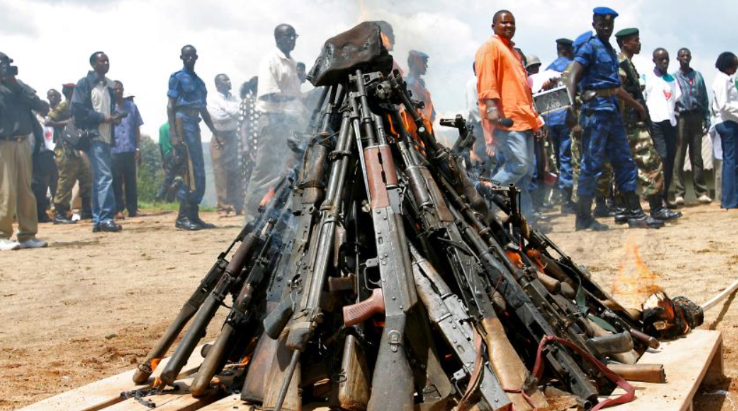
In 2022, the United Nations General Assembly adopted a resolution to observe 5 March as the International Day for Disarmament and Non-Proliferation Awareness [2]. Educational and public events are organised every year to raise awareness about the need to ensure global peace and security. The focus lies on renewing the commitment to eliminate weapons of mass destruction, particularly nuclear weapons. It also serves as a reminder that our “common future” cannot be secured without ensuring respect for norms against chemical and biological weapons [3]. States, organisations of the United Nations system, civil society and other relevant stakeholders advocate for the mitigation of humanitarian risks posed by protracted armed conflicts. Public campaigns and youth-led initiatives are organised to draw much needed attention to the humanitarian costs associated with the rapid accumulation of conventional arms and the illicit trade in such weapons.
Re-Drawing Battle Lines and Reaffirming International Obligations
International instruments imposing obligations on States to either prohibit or restrict the use of the aforementioned categories of weapons remain in force [4]. Yet, States continue to exploit legal lacunae by employing modern means and methods of warfare, thereby thwarting disarmament and non-proliferation efforts. As new frontiers of war open, States contest the applicability of existing legal obligations in an attempt to expand operational latitude.
In this context, the weaponisation of outer space is a cause of concern for the international community. States have publicly declared outer space as an extra-terrestrial battlefield by establishing command capabilities, deploying combat systems and investing in space weapons, including directed energy weapons [5]. The excessive militarisation of space could result in an arms race threatening international peace and security. As battle lines are redrawn, the obligations of States in outer space need to be reassessed.
The Treaty on Principles Governing the Activities of States in the Exploration and Use of Outer Space, including the Moon and Other Celestial Bodies, 1967 (“Outer Space Treaty”) is the fundamental international instrument governing outer space exploration activities. It clearly mentions that States Parties are under an obligation to conduct space exploration activities in the interest of maintaining international peace and security [6].
To ensure compliance with the obligations stated in the Outer Space Treaty, the General Assembly has deliberated on the risks associated with excessive militarisation of outer space. The General Assembly, in its resolution, emphasised that States are bound by disarmament obligations as mentioned in the Outer Space Treaty. It noted that the prevention of an arms race in the outer space continues to be a priority task for the Conference on Disarmament [7]. Most recently, the General Assembly reiterated that States are prohibited from placing any object carrying nuclear weapons or weapons of mass destruction around the Earth’s orbit or in the outer space [8]. At the Conference on Disarmament, deliberations pertaining to space weaponisation, transparency and capacity-building measures by space faring nations have been ongoing for over forty years. However, States have not been able to arrive at a consensus due to competing political interests. As a result, a legally binding international instrument specifically preventing an arms race in the outer space is yet to see the light of the day [9].
Responding to Technological Advancements in the Face of Regulatory Lag
With the rapid advancement of technology, States are increasingly engaging in remote warfare. The traditional deployment of troops and tanks has been supplanted by the use of Lethal Autonomous Weapon Systems (“LAWS”). In the absence of a universally accepted definition of LAWS, the non-exhaustive compilation of definitions provided by the Group of Governmental Experts on LAWS can be referenced [10]. LAWS are weapon systems that can identify, select and engage targets with lethal force. A human input may be required to activate such weapon systems. However, sequential operations are undertaken autonomously. The incorporation of artificial intelligence could further exploit the autonomous nature of these weapon systems [11].
Since LAWS are not specifically regulated under any international instrument, the General Assembly flagged concerns regarding the risks of an emerging arms race and the proliferation of these weapon systems [12]. The use of emerging technologies in the military domain continues to be governed by international humanitarian law until States build consensus around regulating LAWS. The United Nations Secretary-General, António Guterres recommended that a legally binding instrument prohibiting the use of LAWS that operate without human control or oversight, and that cannot be used in compliance with international humanitarian law, be finalised by the end of 2026. He also added that there is a pressing need to regulate LAWS that do not fall within the above-mentioned criteria [13].
Shaping a Secured Future through Public Participation: The Role of the United Nations
As challenges compound, the support extended by the United Nations Office on Disarmament Affairs (“UNODA”) in enabling inclusive, participatory and responsible decision-making merits consideration. UNODA offers resources, conducts events and imparts training to raise awareness about disarmament and non-proliferation. It facilitates public participation to ensure that legal and policy frameworks on arms control incorporate the voices of all stakeholders. Survivors and affected communities, through UNODA-led awareness initiatives, relentlessly sound the alarm on the enduring humanitarian costs of war.
Enumerated below are some of the key thrust areas in which UNODA is actively engaged.
- Youth Engagement and Capacity Building
UNODA routinely administers innovative online learning programmes to ensure that resources on disarmament are easily accessible [14]. The Youth Leader Fund for a World without Nuclear Weapons is its flagship initiative, enabling young change-makers from across the globe to participate in an online learning course. The online course is followed by a visit to Nagasaki and Hiroshima to sensitise participants to the immeasurable human suffering caused by nuclear weapons. The programme is designed to equip students with practical skills in advocacy and policy-making [15]. In addition to the annual initiatives, UNODA also organises side events and exhibition booths to democratise access to information on issues that threaten global peace and security [16].
- Information Sharing on Military Expenditure
In the past few years, global defence spending has shown a consistent upward trend [17]. With increasing budgetary allocations to military expenditure, international commitments to disarmament and non-proliferation risk being rendered largely vacuous. In the interest of transparency and accountability, UNODA encourages States to share information and report statistics related to military expenditures on its website. It has developed a secure MilEx online reporting tool for authorised government officials to submit relevant data [18]. The year-on-year compiled United Nations Report on Military Expenditure is publicly available for assessment [19]. This reporting mechanism is vital, as statistical data often reveal what diplomatic statements may conceal.
- Documentation and Policy Guidance
UNODA has collaborated with Hibakusha Stories to document the testimonies of atomic bomb survivors in Japan [20]. The lived experiences of the horrors of one of the darkest chapters in human history have been recorded for posterity. The testimonies form part of UNODA’s awareness initiatives on nuclear disarmament and non-proliferation. Cognisant of the past, UNODA has undertaken efforts to address contemporary challenges associated with emerging means and methods of warfare. The Secretary-General’s Agenda for Disarmament (2018), most notably, proposes the adoption of voluntary guidelines and best practices in the absence of formal international obligations. The Agenda also outlines the most recent developments in multilateral disarmament negotiations, informing stakeholders of progress towards effective arms control [21]. The wide range of engagement and outreach programmes undertaken by UNODA reflects its unflinching commitment to building sustainable peace.
Geneva International Centre for Justice (GICJ) observes the International Day for Disarmament and Non-Proliferation Awareness, in solidarity with the victims and survivors of armed conflicts, to amplify calls for peace. It recognises the coordinated efforts of States, civil society and other relevant stakeholders in contributing to UNODA’s broader mandate of ensuring “general and complete disarmament under strict and effective international control”. GICJ fervently appeals to States to maintain compliance with established international norms on arms control. Furthermore, it calls on States to constructively engage in multilateral negotiations to bring into effect international instruments regulating emerging means and methods of warfare.
References
[1] United Nations Press Release, “Calling Disarmament ‘Foundation of Peace’, Secretary-General, Marking International Day, Urges Nuclear Weapon States Return to Dialogue”, 26 September, 2025.
[2] A/RES/77/51, 77th Session of the United Nations General Assembly, 13 December, 2022.
[3] Securing our Common Future: An Agenda for Disarmament, United Nations Office for Disarmament Affairs, 2018.
[4] Treaty on the Non-Proliferation of Nuclear Weapons, 1968, Convention on the Prohibition of the Development, Production, Stockpiling, and Use of Chemical Weapons and on their Destruction, 1992, Convention on the Prevention of Development, Production and Stockpiling of Bacteriological (Biological) and Toxin Weapons and on their Destruction, 1972, Convention on the Prohibitions or Restrictions on the Use of Certain Conventional Weapons which may be deemed to be Excessively Injurious or to have Indiscriminate Effects, 1980
[5] A/76/77, 76th Session of the United Nations General Assembly, Report of the Secretary General, “Reducing Space Threats through Norms, Rules and Principles of Responsible Behaviours”, 13 July, 2021.
[6] Article III, The Treaty on Principles Governing the Activities of States in the Exploration and Use of Outer Space, including the Moon and Other Celestial Bodies, 1967.
[7] A/RES/70/26, 70th Session of the United Nations General Assembly, 11 December, 2015.
[8] A/79/406, 79th Session of the United Nations General Assembly, 14 November, 2024.
[9] https://disarmament.unoda.org/en/our-work/emerging-challenges/outer-space.
[10] CCW/GGE.1/2023/CRP.1, Convention on Certain Conventional Weapons (CCW) Group of Governmental Experts (GGE) on Emerging Technologies in the Area of Lethal Autonomous Weapons System (LAWS), “Non-exhaustive Compilation of Definitions and Characterisations”, 10 March, 2023.
[11] https://disarmament.unoda.org/en/our-work/emerging-challenges/lethal-autonomous-weapon-systems
[12] A/RES/79/62, 79th Session of the United Nations General Assembly, 10 December, 2024.
[13] Our Common Agenda Policy Brief 9, A New Agenda for Peace, July, 2023.
[14] https://education.unoda.org/
[15] https://unric.org/en/fsg-youth-leader-fund-for-a-world-without-nuclear-weapons-ylf/
[16] https://youth4disarmament.org/events
[17] https://www.un.org/en/observances/disarmament-non-proliferation-awareness-day
[18] https://milex-reporting.unoda.org/en/reporting-tool
[19] https://milex-reporting.unoda.org/en/states
[20] https://education.unoda.org/presentations/hibakusha.html
[21] Securing our Common Future: An Agenda for Disarmament, United Nations Office for Disarmament Affairs, 2018.