



HRC 63: None of Our Business? Addressing Modern Slavery and Human Trafficking
The 63rd session of the Human Rights Council
7 September - 7 October 2026
Item 3: Interactive Dialogue with the Special Rapporteur on contemporary forms of slavery and trafficking in persons
11 September 2026
Interactive Dialogue Addressing Contemporary Forms of Slavery and Trafficking in Persons through an Intersectional and Human Rights-Based Approach
By Tanushree Ghosh / GICJ
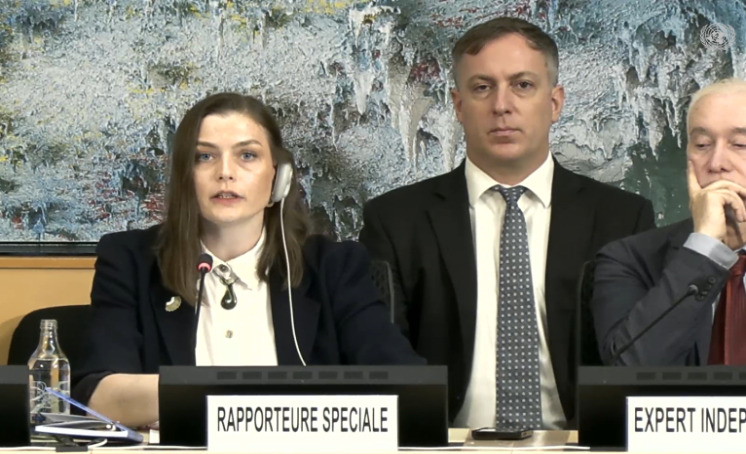
In her report, Ms Katarina Schwarz, the UN Special Rapporteur on contemporary forms of slavery and trafficking in persons, noted that “[t]he manifestations of slavery and trafficking today reflect a tapestry of intersecting forces, including the structural conditions and architecture of societies, economies and polities shaped by long records”. On 11 September 2026, at the 63rd session of the Human Rights Council, the Special Rapporteur presented her report on the challenges of addressing modern slavery and human trafficking (A/HRC/63/36), alongside her findings from her official visit to Brazil (A/HRC/63/36/Add.1).
The interactive dialogue that followed the presentation of the report enabled States and non-governmental organisations to assess how the intersecting crises of climate change, migration, displacement and poverty have exacerbated vulnerabilities among at-risk groups. Amid such volatility, businesses have been exploiting the compounded vulnerabilities faced by migrant workers and workers in precarious or informal employment, prioritising profit maximisation over the protection of human rights.
Exploitative business practices that discriminate against, exclude or marginalise vulnerable individuals are structural drivers of modern slavery and human trafficking that must be addressed through a coordinated response involving both State and non-State actors. Accordingly, the Special Rapporteur recommended that States enact and enforce robust legislative frameworks to ensure corporate accountability. Additionally, she emphasised that policy measures informed by the lived experiences of survivors could help close accountability gaps. To build greater resilience into these systems, she further recommended that technology companies partner with governments to collect evidence of human rights abuses, identify sites or practices of exploitation and undertake necessary due diligence before human rights violations occur.
Geneva International Centre for Justice (GICJ) expresses concern over the increasing use of exploitative practices by corporations and business entities prioritising profit maximisation over the protection of human rights. It asserts that the human rights of all workers are inviolable and any business or private-sector entity that fails to respect and protect these rights must be held accountable. GICJ acknowledges that the compounded vulnerabilities faced by workers, particularly migrants, women and racial or ethnic minorities, render them more susceptible to discrimination, marginalisation and exclusion. It further urges both State and non-State actors to adopt measures to prevent and address human rights abuses in business operations, supply chains and corporate practices.