



The 62nd Session of the Human Rights Council
15 June - 7 July 2026
Item 10: ID on OHCHR Report on Technical Assistance in South Sudan
3 July 2026
A Paralysed Judiciary, Unchecked Armed Groups, A Powerless International System, People Who Alone Pay the Price For Everyone's Crimes.
By Mohammed Hindawi / GICJ
Executive Summary
The report of the Office of the United Nations High Commissioner for Human Rights (A/HRC/62/57) and the interactive dialogue held by the Human Rights Council at its sixty-second session on 3 July 2026 reveal a sharp and continuous deterioration in the human rights situation in the Republic of South Sudan during 2025, despite the significant technical efforts undertaken by the United Nations, represented by the Human Rights Division of its mission in the country, to support the Transitional Government in addressing these challenges.
The Human Rights Division documented 1,158 conflict-related violations affecting 5,108 victims during the year, a 40% increase over the previous year. Civilians continued to be targeted indiscriminately and deliberately amidst escalating political and military tensions. Conflict-related sexual violence remained widespread and increasingly severe, although the number of documented cases decreased, with a notable rise in related abductions. Access to justice remains severely limited due to a profound structural weakness in the formal court system. This leaves vast areas under the jurisdiction of customary courts, which lack fair trial guarantees. Impunity for security forces also remains a major obstacle to achieving justice.
While legislative progress has been made in the transitional justice process, with the enactment of the Commission for Truth, Reconciliation and Healing and the Compensation and Reparation Authority laws, the establishment of the hybrid court for South Sudan remains stalled due to the lack of finalised legal arrangements with the African Union. This threatens to undermine the credibility of the entire transitional justice process. Civil society space also remains severely restricted through the persecution of journalists and human rights defenders. The announcement of general elections scheduled for December 22, 2026, represents a significant political milestone that requires a secure and inclusive environment to ensure their credibility.
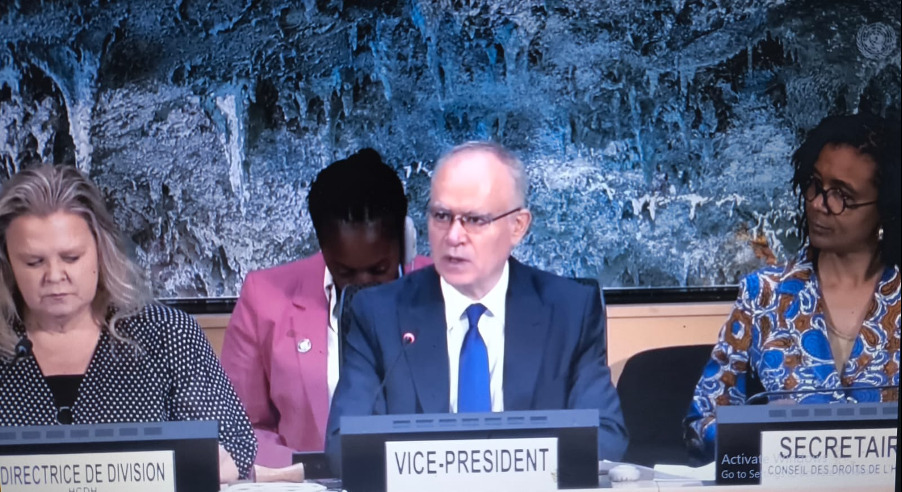
During the interactive dialogue, the majority of member states agreed on the importance of continued technical assistance and capacity building, although their approaches varied. Some emphasised linking support to accountability and political will, while others called for respect for national sovereignty and government priorities. Human rights organisations and civil society institutions have also expressed shared concern that technology alone is insufficient to address the root causes of the crisis, calling for the strengthening of independent international monitoring mechanisms alongside technical support.
Geneva International Centre for Justice (GICJ) expresses its deep concern regarding the continued impunity and escalating suffering of civilians, emphasising that the technological progress achieved remains inadequate in the absence of genuine political will among the parties to the conflict. GICJ called for the immediate establishment of the hybrid court, linking international support to tangible progress indicators in the areas of accountability and the protection of civilians, and ensuring effective protection for journalists and human rights defenders. GICJ stressed that the path to sustainable peace in South Sudan inevitably leads through justice, not through any alternative.
To read the full report, click on the image below: