



HRC61: Trapped in an Ever-Shrinking Gaza
The 61st session of the human rights council
23 February–2 April 2026
Item 2: ID on HC report on OPT
26-27 february
By Rocío Gómez Rodriguez / GICJ
Executive summary
At its 61st session (23 February–2 April 2026), the Human Rights Council held an Interactive Dialogue under Item 2 on the report of the High Commissioner for Human Rights concerning the situation in the Occupied Palestinian Territory, covering the period from 1 November 2024 to 31 October 2025. The report documents a severe and rapidly deteriorating human rights and humanitarian crisis in Gaza and the West Bank, including East Jerusalem. It highlights mass displacement, widespread destruction of civilian infrastructure, famine, civilian casualties, arbitrary detention, torture, and attacks on journalists and medical personnel, all within a context of entrenched impunity.
During the interactive dialogue, many States strongly condemned violations attributed to Israeli forces, including settlement expansion, forcible displacement, and the disproportionate use of force. Others also drew attention to violations committed by Hamas and other Palestinian armed groups, including attacks against civilians and hostage-taking. Despite differences in emphasis, the majority of delegations expressed deep concern over the scale of human suffering and the erosion of international legal norms.
The Geneva International Centre for Justice (GICJ) shares the grave concern voiced during the session. GICJ calls for the immediate protection of civilians, unhindered humanitarian access, and independent, impartial investigations into all alleged violations by all parties. Accountability must be non-selective and firmly grounded in international law, including through universal jurisdiction and cooperation with international courts. GICJ further stresses that sustainable peace requires addressing the root causes of the conflict, including the prolonged occupation and the denial of the Palestinian people’s right to self-determination. Only through justice, accountability, and respect for international law can the cycle of violence and impunity be broken.
Background
The present report, submitted in accordance with the Human Rights Council resolution 58/2, aims to provide an understanding of the human rights situation in the Occupied Palestinian Territory, covering the period from 1 November 2024 to 31 October 2025.
The occupation of the Palestinian Territory by Israeli forces started 58 years ago, and has continued to this day through institutionalizing long-standing patterns of systematic discrimination, segregation, oppression, domination, violence and other inhumane acts against the Palestinian people. The situation worsened 18 years ago, and since then, Gaza has been subjected to blockades and closures amounting to collective punishment that continues to this day.
To fully understand the current human rights situation in the Occupied Palestinian Territory, it is necessary to situate it within its broader historical context. In 1922, Palestine was placed under the administration of the United Kingdom by the League of Nations. While under British mandate, the “Balfour Declaration” of 1917 was issued, supporting the establishment of a national home for the Jewish people in Palestine. This triggered a large-scale Jewish immigration that augmented with the Nazi persecution.
In response, demands for independence and resistance to immigration spread through Palestinian territory, leading to a rebellion in 1937, followed by violence and terrorism on both sides. The situation compelled the British mandate authorities to turn the Palestine problem over to the United Nations, leading to the termination of the mandate and the partition of Palestine into two independent territories, one Palestinian Arab and the other Jewish, with Jerusalem remaining in between them.
The Jewish side proclaimed its independence as the state of Israel in 1948. On 5 June 1967, Israel started war against the United Arab Republic, Syria and Jordan; occupying the Gaza Strip and the West Bank, including East Jerusalem, forcing Palestinians to flee. The Security Council ordered the Israeli withdrawal from the territories occupied during conflict. Further hostilities followed in subsequent years, leading to similar resolutions from the Security Council.
In 1974, the General Assembly reaffirmed the rights of the Palestinian people to self determination, national independence and sovereignty, created the Committee on the Exercise of the Inalienable Rights of the Palestinian People and conferred on the Palestine Liberation Organization (hereinafter PLO) the status of observer in the Assembly and in United Nations conferences.
Less than ten years later, in 1982, Israel invaded Beirut, where the PLO headquarters were located, with the declared intention of dismantling the organization. To prevent this, a ceasefire was arranged, and PLO troops were dispersed towards neighboring countries. After the incident, a massacre took place in the Sabra and Shatila camps. In this climate, nearly 20 years of occupation in Gaza and the West Bank had created widespread frustration among the population, culminating in the First Intifada (1987). The response of Israeli forces resulted in mass injuries and a heavy loss of life among the civilian Palestinian population, leading the Palestinian leadership to be reconfigured, and the consequent 1988 proclamation of the State of Palestine. With a view to achieving a peaceful resolution, the 1993 Oslo Accords were signed, consolidating the mutual recognition between the Government of Israel and the PLO, the representative of the Palestinian people.
However, on September 28, 2000, Ariel Sharon, the leader of the Likud Party in Israel, made an unprecedented and controversial visit to the Temple Mount in Jerusalem. This act was widely perceived as defiant and a direct challenge to Palestinian control, evoking further fights between the Israelis and the Palestinians, known as the Second Intifada.
The escalating tensions led Hamas to take control over Gaza in 2007, after which Israel implemented an unprecedented blockade. The insecurity and detrimental conditions that arose from the blockade promoted inner confrontations between Palestinian fractions, whilst Palestinian armed groups continued launching rockets and mortars toward southern Israel, threatening nearly one million Israelis. This culminated with the Israeli ground operation “Cast Lead” in Gaza.
In November 2012 another cycle of violence between Israel and Gaza concluded with an Egyptian-brokered cease-fire. In October 2023, a major escalation between Gaza and Israel began, leading South Africa to file an International Court of Justice case against Israel alleging genocide. The court ordered Israel to prevent genocide, enable provision of basic services and aid in Gaza, and curb incitement to genocide, and later on declared Israeli presence in the occupied Palestinian territories unlawful. The General Assembly then demanded Israel to cease its occupation in 12 months.
It is in this context of prolonged occupation and conflict that, on 5 April 2024, the Human Rights Council requested the Independent International Commission of Inquiry on the Occupied Palestinian Territory, including East Jerusalem, to conduct an investigation regarding the conditions on the territory. In its resolution 58/2 of 2 April 2025, the Council reaffirmed this request, calling on the Commission to present its report during the 61st session.
Summary of the expert’s report
The data collected during the monitoring period indicates that Israel pursued a policy aimed at systematically displacing the Palestinian population. Between the 1st of November 2024 and 31st of October 2025, 121 displacement orders were issued, pushing Palestinians into an “ever-shrinking area”. By the end of this period, approximately 90 per cent of the Palestinian population had been displaced, many, several times. This situation forced Palestinians into severely overcrowded areas, such as Al Mawasi, which Israeli forces unilaterally designated as a 'humanitarian area’, despite the lack of guaranteed living conditions.
In other occasions, Palestinians have been led out of their homes and towns by Israeli security forces under the threat of lethal force. Those towns were then demolished to prevent Palestinians from returning, amounting to the destruction of approximately 1,400 homes. To further prevent families from returning, Israeli forces shot and killed those who attempted to do so.
Among these efforts, the Israeli forces have carried out mass forcible transfers through additional means, highlighting the wide scale destruction of civilian infrastructure necessary to support Palestinian life. This encompassed the demolition of sites such as residential buildings, hospitals, schools, food related facilities, and tents for the internally displaced. As a result, 81 per cent of all structures in Gaza were either damaged or destroyed. Among these attacks, it is worth noting the 1,993 offensives towards residential buildings during the reporting period, resulting in 4,528 fatalities; as well as the 642 attacks on makeshift tents accommodating , accounting for 1,677 deaths. These strikes, that cumulatively killed thousands, have raised some concerns about the intentional targeting of civilians and civilian objects, which would constitute war crimes.
Simultaneously, the continuous use of explosive weapons with wide area effects by Israeli forces in these attacks had indirect negative effects in the habitability. By the end of 2024, nearly all cattle and poultry had been killed, and by August 2025, 98.5 per cent of Gaza’s cropland was assessed as either damaged, inaccessible, or both, with no cropland in Rafah or North Gaza accessible. The environmental impact was not far behind, including unprecedented contamination of soil, water and air.
Moreover, the discriminatory water resource allocation that arose after the destruction of the wells of local civilians, roof water tanks and other water and irrigation facilities under military and settler operation since 1967, did not contribute to the crisis. In fact, the destruction of vehicles and machinery essential for food distribution and critical services, combined with the dismantling of the United Nations’ aid delivery system, has raised concerns that these attacks are intended to produce permanent demographic changes, effectively rendering Gaza largely uninhabitable for Palestinians.
These conditions triggered a malnutrition crisis. By august 2025 famine was confirmed in Gaza Governorate and was projected to expand to Deir al-Balah and Khan Younis by the end of September 2025. During the covered period, at least 463 Palestinians starved to death. This situation worsened with Israeli action, as 2,435 Palestinians were killed by the Israeli military while trying to access food. As the report states, “Palestinians faced the inhumane choice of either starving to death or risking being killed while trying to get food”. It must be highlighted that any use of starvation of the civilian population as a method of war constitutes a war crime, and can account for a crime against humanity if committed as part of a widespread or systematic attack. Such acts can also amount to genocide if carried out with the intent to destroy, in whole or in part, a national, ethnic, racial, or religious group.
Moreover, military forces began targeting and killing security personnel responsible for securing the distribution of aid, contributing to the famine. Medical personnel were also targeted, being arbitrarily detained and killed, accounting for 1,722 deaths in Gaza territory. The strikes also extended to civilians gathering outside of clinics to receive essential care, as well as to civilians during ceasefire, reporting 1,819 killings.
The total deaths during the reporting period amounted to 25,594, with 68,837 injured. However, the total is likely to be much higher as the report does not account for those buried under rubble. According to the Palestinian Ministry of Health 20,179 children have been killed as a result of Israeli action in the last 2 years, which accounts for a classroom of children killed every day. Additionally, due to the artillery used in the attacks, limited medical access, and the harsh living conditions, Gaza now has the highest number of child amputees per capita in the world.
In the context of law enforcement, the killing of Palestinians by Israeli security forces has dramatically increased, amounting to 255 deaths solely in the reported period. Most of the killings happened during raids in Palestinian cities and refugee camps, where the victims posed no threat whatsoever.
Once again, the means employed by Israeli forces were disproportionate, being intended for warfare, in a context where there were no hostilities. The use of weapons, such as air-to-ground missiles, constitute a violation of humanitarian law if used in a non hostile situation, and even within a hostile context less harmful means should be proven ineffective first.
Moreover, the disproportionate use of force was noted in situations such as the shooting and killing of a 10-year-old unarmed boy, a two-year-old Palestinian girl or an eight-month pregnant woman in a refugee camp. Additionally, some extrajudicial executions have also been reported, which can amount to war crimes.
Israel’s attacks against civilians have also dismantled and destroyed Gaza’s governance and law enforcement structures. In this context, intra-Palestinian violence involving armed elements affiliated with Hamas and groups opposing Hamas’ rule increased during the reporting period. Some of these groups further destabilized communities where law enforcement and judicial systems had already been largely destroyed by Israeli attacks, contributing to serious abuses of Palestinians’ human rights, including violations of the right to life, liberty, and security of person. Of particular concern was the unlawful use of force by what remained of the de facto authorities’ law enforcement capacities, including groups such as the “Saheem” Unit, which carried out arbitrary detention, torture, and the extrajudicial execution of a young Palestinian man in March 2025.
Furthermore, the report shows a high number of detained Palestinian people by Israeli forces. In total 9,204 Palestinians were being held in Israel, from which 3,368 are in administrative detention without charge or trial, 175 being children. From the people detained, only one in four were identified as belonging to the armed wings of Hamas or Palestinian Islamic Jihad, with the rest being civilians who did not belong to either. This reflects a pattern of arbitrary detention, as reported by the Office of the United Nations High Commissioner for Human Rights (hereinafter OHCHR).
The detainees face conditions of severe overcrowding, with limited access to hygiene and sanitation, outdoor time, and contact with family members. Moreover, they are subject to inhumane treatment consisting of sexual and gender-based violence, repeated beatings (with electric wires and other tools), waterboarding, stress positions, starvation and medical negligence. Torture was applied as a widespread method to elicit confessions.
It is especially concerning the situation of women, facing physical assault during arrest; unnecessary, repeated and abusive strip searches; the presence of cameras directed toward the toilets in cells; beatings in detention; verbal abuse, including sexual slurs and threats of rape.
In addition, these detainees were reportedly used by Israeli forces as human shields during operations and house searches, amounting to war crimes.
Simultaneously, Israeli authorities continued to withhold the bodies of Palestinians as a bargaining tool or for collective punishment. By comparison, 476 Palestinian bodies were withheld, including those of women and children, while Hamas and other Palestinian armed groups retained the bodies of 11 adult Israeli and foreign men.
In the meantime Gaza remained the deadliest place in the world for journalists, accounting 289 deaths since the 7th of October 2023. The report showed an unprecedented multi-faceted attack on Palestinian journalists that encompassed the killing, censoring and arbitrary detaining of journalists. This raised serious concerns regarding the deliberate targeting of journalists by Israeli forces, aiming to obstruct media coverage of the international humanitarian law violations occurring in the territory.
As well as other detainees, journalists being held under Israeli forces face torture and other ill-treatment, including rape and other forms of sexual violence.
During the reporting period, OHCHR was not aware of any steps taken through the Israeli justice system to ensure accountability for violations of international humanitarian law, including alleged war crimes in Gaza, reflecting long-standing patterns of impunity. In relation to the 1,521 killings recorded in the reporting period, only 112 of these deaths have been or are under criminal investigation, with only one leading to conviction. Simultaneously, regarding the ill treatment of detainees there was also only one conviction during the reporting period.
International courts remained an important avenue for accountability. The International Criminal Court issued arrest warrants for Israeli and Palestinian officials for war crimes and crimes against humanity, though execution of these warrants remained pending. Similarly, the International Court of Justice continued proceedings on the application of the Genocide Convention in Gaza and issued advisory opinions on Israel’s obligations as an occupying power to uphold international humanitarian and human rights law.
Israeli forces, Hamas, and other Palestinian armed groups have continued to commit serious violations of international humanitarian law in Gaza, gross violations and abuses of international human rights law, and atrocity crimes. The simultaneous deepening of the man-made crisis has contributed to the spread of famine, starvation and malnutrition, and the critical lack of healthcare and other basic necessities across Gaza.
These actions, combined with long-standing practices such as the blockade of Gaza and settler violence in the West Bank, raise serious concerns of ethnic cleansing and attempts to alter the demographic composition of Palestinian territories.
The High Commissioner and international law bodies emphasize the urgent need for accountability, protection of civilians, cooperation with international justice mechanisms, cessation of arms transfers that facilitate violations, and meaningful inclusion of Palestinians in governance and reconstruction efforts to ensure human rights, self-determination, and the possibility of lasting peace.
Summary of the interactive dialogue
Opening statement / high commissioner
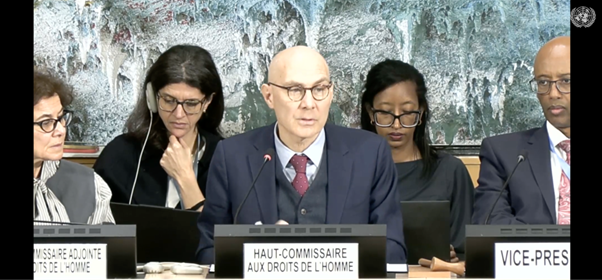
“Anywhere else this would be considered a major crisis”, stated the High Commissioner on Human Rights, Volker Türk, on the Palestine human rights situation. More than 25,500 Palestinians killed, 463 dead from starvation, over 300 arbitrarily detained and ill treated, 11 children dead from hypothermia; the conditions in the occupied Palestinian territory are nothing but alarming, and rapidly deteriorating.
During his statement, the High Commissioner brought attention to the concerning data portrayed in the report. He reminded people that, despite the ceasefire of 11 October 2025, “people are still dying in Gaza from Israeli fire, cold, hunger, and treatable diseases”. In order to revert this “human-made disaster”, the High Commissioner on Human Rights highlighted 5 necessary elements.
Firstly, meaningful steps towards accountability are required to end the cycle of unpunished crossed violations highlighted throughout the reporting period. All human rights violations and abuses must be subject to independent investigation and judicial scrutiny. In this regard, the High Commissioner reaffirmed his Office’s commitment to continue monitoring and reporting on the situation in the Occupied Palestinian Territory.
Secondly, the full realization of Palestinians’ right to self-determination is essential. This includes full responsibility for their own governance, as well as control over their land and natural resources. “Palestinians must be able to shape their own future and lead reconstruction efforts in Gaza”.
Thirdly, security must be understood as extending beyond weapons and walls. He calls for the dismantling of all measures that resemble the apartheid system as “people can only feel safe when they have faith in equal justice and the rule of law”.
Fourthly, the role of Palestinian and Israeli civil society organisations that are trusted by their communities is crucial when it comes to safeguarding human rights. These organizations must receive ongoing support and safeguards from the international community to ensure they can operate effectively and independently.
Finally, the underlying causes of the conflict must be addressed to guarantee lasting peace. This entails undoing the dehumanization that has fueled this decades long conflict, fostering healing and reconciliation between Palestinian communities and Palestinians and Israelis.
State of Palestine
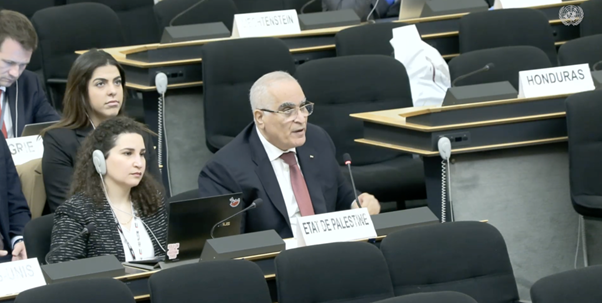
The representative of the State of Palestine reminded that the occupying power continues to commit human rights violations, ignoring the international community even after the announcement of the cease fire in Sharm El Sheikh. The targeting of civilians by Israel, he stated, has led to 250,000 people dead or injured, including more than 20,000 children, 14,000 women, and medical workers.
Moreover, he highlighted the attacks against protected infrastructure that have resulted in the destruction of 95% of health facilities and hospitals. Combined with the forced displacement and the prevention of the flow of aid and relief materials, exacerbated the suffering of people in Gaza.
“Our people want an end to their suffering after seventy-five years of displacement and fifty-six years of occupation,” he stated, emphasizing that this requires a reconsideration of diplomatic, trade, and security relations, and the prohibition of hate speech, particularly when propagated by officials of the occupying government.
He concluded by demanding full implementation of the conclusions and recommendations contained in the High Commissioner’s report.
Pakistan on behalf of the organization of Islamic Cooperation
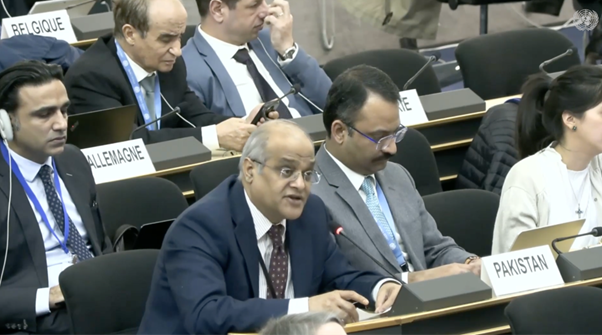
The Organization for Islamic Cooperation Group echoed the concerns raised by the State of Palestine and condemned “in the strongest terms” the escalating crimes of the illegal occupying power in the West Bank, including East Jerusalem, and the Gaza Strip.
They demanded accountability for Israel’s action as the evidence detailing the occupying power’s violations of international law before, during, and since the reporting period continues to grow. The Organization of Islamic Cooperation (OIC) Group emphasized that the intent behind these actions, aimed at destroying the Palestinian people, “leaves no room for equivocation,” and characterized the situation as genocide.
European Union
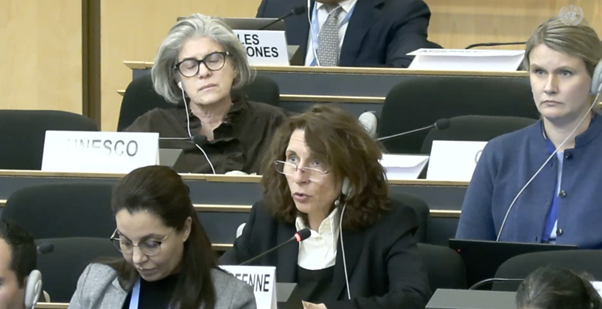
The representative of the European Union reminded the international community that they remain “firmly committed to peace”. For this reason, they condemned all violations of international human rights law and international humanitarian law in the whole occupied Palestinian territory, and called for the full implementation of the International Court of Justice orders.
Moreover, the European Union continues to call on all parties to facilitate full and unimpeded humanitarian access to Gaza, urging that aid be effectively and fairly distributed in accordance with international law. The EU also urges Israel to reverse the expansion of settlements and to hold perpetrators of settler violence accountable.
Saudi Arabia on behalf of A group of Arab states
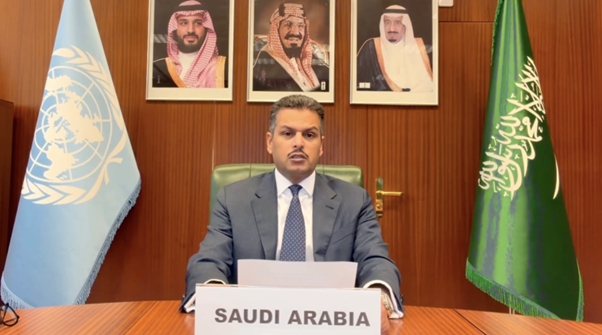
Saudi Arabia, speaking on behalf of a group of Arab States, expressed full solidarity with the statements made by the Representative of the State of Palestine. The group noted that events before, during, and after the reporting period demonstrate a total disregard for international law. They warned against any attempts to create a false equivalence between the occupying power and the occupied population.
The group condemned in the strongest terms the crimes committed in the Occupied Palestinian Territory, including acts amounting to genocide, and reaffirmed that any forced displacement of Palestinians, whether inside or outside their land, is unacceptable. They emphasized that the suffering of the Palestinian people can never be justified.
Finally, the group reaffirmed the importance of accountability and the role of international tribunals and courts, stressing the need to take immediate measures to preserve evidence and hold perpetrators responsible.
Kenya on behalf of group of African states

Kenya, speaking on behalf of the African Group, expressed concern over the ongoing violations against the Palestinian people, including repeated breaches of the ceasefire that have resulted in civilian casualties and widespread destruction. Based on their shared values opposing colonialism, occupation, and apartheid, the African Group reaffirmed the Palestinian people’s right to self-determination and their pursuit of an independent state.
While condemning the colonial policies manifested by Israel, welcomes the Gaza peace agreement and calls for its full implementation in all its phases, including the consideration of the ceasefire. With this, the African Group aims for the protection of civilians, the urgent and unhindered delivery of humanitarian assistance, and the lifting of the blockade on Gaza. All necessary for the advancement of recovery and reconstruction and the preservation of unity.
Australia
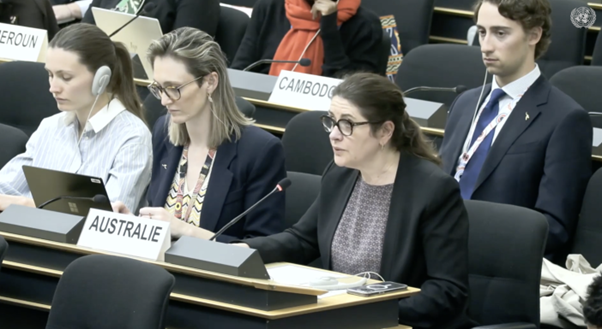
The representative of Australia reminded that all civilians, humanitarian workers and United Nations staff must be protected, condemning the ongoing abuses and acts of terror. Australia supports the Two State Solution in which Hamas must play no role.
Moreover, sustained and unimpeded humanitarian assistance needs to be allowed into Gaza, and called on Israel to cease settlement expansions in the West Bank, strongly opposing any form of annexation.
Jordan

The representative of Jordan opened its statement by declaring that “being lax in supporting the law and its respect […] only exacerbates violations”. Through its intervention, Jordan reminded the international community that this attitude towards human right violations, without prevention and accountability, only undermines rights and weakens the prospect of peace.
Now in order for peace to last, it calls for the ending of occupation and the establishment of a Palestinian state through the right of self determination. A right that, Jordan stated, was “embedded in the universal declaration of Human Rights”, that we must not fail to implement.
Ireland

Ireland aligns with the statement of the European Union, condemning the widespread and systematic human rights abuses in the occupied Palestinian territory, as well as the decisions taken by the Israeli security to expand control over the occupied West Bank. Ireland understands this activity to be part of a pattern to “create a new status quo in the occupied Palestinian territory”, contravening international law.
Moreover, Ireland brings attention to the fact that Gaza is now home to the highest number of child amputees per capita in the world, further denouncing the obstruction of the entry of humanitarian aid into Gaza, that prevents from bringing in wheelchairs, crutches, walkers, and other essential assistive devices arbitrarily.
Egypt
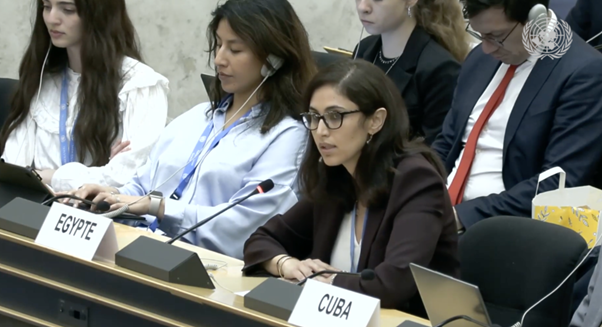
Egypt commences the statement by denouncing the lack of accountability for human rights violations happening in the occupied Palestinian territories, as well as the breach of the cease fire agreement. In this situation, Egypt understands that reconstruction and recovery are only possible with the withdrawal of Israel from Gaza, ending the occupation.
Moreover, this reconstruction must be based on accountability, and focused on addressing the root causes of the conflict. All this to ensure the right to self determination and to an independent state for the Palestinian people.
South Africa
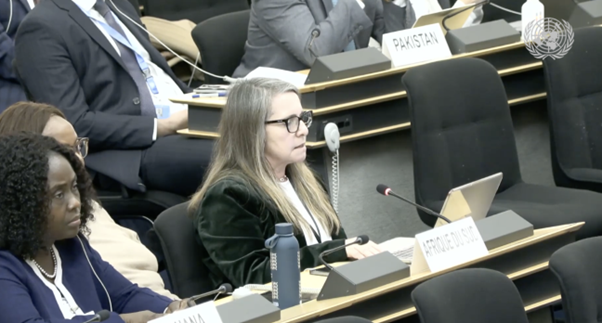
South Africa strongly condemns the permanent displacement of Palestinians through the weaponization of humanitarian assistance, the destruction of neighborhoods and the violation of the ceasefire. Moreover, South Africa further denounces Israel's decision to resume land registration procedures as part of its illegal occupation. These actions raise concerns about the ethnic cleansing being undertaken by Israel.
South Africa understands that the actions described in the report amount to genocide as they are aimed to the destruction of the Palestinian people as a group. Accordingly, they call for calling Israel accountable, highlighting the crucial role of the Human Rights Council’s mechanisms, and urging states to join in taking effective measures to that end.
Conclusion
Throughout the interactive dialogue, three main themes consistently emerged. Firstly, delegations emphasized the urgent need for accountability for violations of international human rights law and international humanitarian law as a prerequisite for achieving lasting peace. This requires independent and impartial investigations into alleged violations that may amount to breaches of international law, including war crimes, crimes against humanity, or genocide, as well as concrete measures to end the longstanding cycle of impunity. In this context, the High Commissioner reaffirmed his Office’s commitment to continue monitoring and reporting on the situation in the Occupied Palestinian Territory.
In order to advance this objective, the High Commissioner’s report calls upon States to pursue accountability through the exercise of universal jurisdiction to prosecute crimes under international law in national courts, in accordance with international standards. It further urges cooperation with the International Criminal Court pursuant to the Rome Statute, and encourages Israel to cooperate in good faith with the United Nations, including the Office of the High Commissioner for Human Rights, in line with the ruling of the International Court of Justice of 22 October 2025.
Secondly, both the interactive dialogue and the report underscored the importance of protecting civilian lives and ensuring full, safe, and unhindered humanitarian access. Delegations stressed that the delivery of humanitarian assistance is essential to alleviating the severe humanitarian crisis and restoring conditions necessary for dignified living. Ensuring sustained access to food, medical supplies, and essential services is critical to preventing further loss of life and reversing the famine conditions affecting Gaza.
Finally, the third main point of the discussion centered on the right of the Palestinian people to self-determination, considered essential for achieving lasting and sustainable peace. Several delegations emphasized that this right, “enshrined in the Universal Declaration of Human Rights,” as highlighted by Jordan, must be fully realized. In this regard, many reaffirmed their support for the establishment of an independent Palestinian State within the framework of the two-State solution. Delegations also stressed that ending the illegal occupation is a necessary condition for the realization of this right and for securing a just and durable peace.
GICJ position
The Geneva International Centre for Justice (GICJ) expresses its deep concern over the grave human rights and humanitarian law violations documented during the reporting period in the Occupied Palestinian Territory, particularly in Gaza. The scale of civilian casualties, widespread destruction of infrastructure, forced displacement, famine conditions, arbitrary detention, torture, and attacks against journalists and humanitarian personnel reflects a man-made crisis of unprecedented magnitude.
GICJ reiterates that all parties to the conflict are bound by international humanitarian law and international human rights law. Violations committed by Israeli forces, including indiscriminate and disproportionate attacks, collective punishment, settlement expansion, and policies that may amount to forcible transfer, must be independently and impartially investigated. At the same time, violations committed by Hamas and other Palestinian armed groups, including the killing of civilians, hostage-taking, and reported executions, must also be unequivocally condemned and investigated. Accountability must be universal and non-selective.
GICJ stresses that the protection of civilians must be the immediate priority. The continued obstruction or limitation of humanitarian access, as well as the use of starvation as a method of warfare, constitute serious violations of international law. Full, safe, and unhindered humanitarian access must be guaranteed, and attacks against medical personnel, humanitarian workers, and journalists must cease immediately.
Furthermore, GICJ underscores that lasting peace cannot be achieved without addressing the root causes of the conflict. The prolonged occupation, expansion of settlements, and systemic discrimination undermine the Palestinian people’s right to self-determination. The realization of this right, including the establishment of an independent Palestinian State within the framework of international law and relevant UN resolutions, is essential for sustainable peace and security for both Palestinians and Israelis.
GICJ calls upon States to fulfill their obligations under international law, including through the exercise of universal jurisdiction where appropriate, cooperation with the International Criminal Court, and full implementation of the rulings and provisional measures of the International Court of Justice. States must also refrain from transferring arms where there is a clear risk that they may be used to commit or facilitate serious violations of international law.
Finally, GICJ urges the international community to prioritize accountability, civilian protection, humanitarian relief, and meaningful political dialogue grounded in international law. Only through justice, equality before the law, and respect for human dignity can the cycle of violence and impunity be broken and a just and durable peace be achieved.
