




Gender Based Violence (GBV) in South Africa: A National Disaster!
By Teboho Mosebo/ GICJ
On 20 November 2025, President Cyril Ramaphosa of the Republic of South Africa officially declared gender-based violence a national disaster at the G20 social summit held in South Africa. He underscored the extraordinary and concerted action that will be required to end it. The move came after a wave of protests that began weeks earlier online, where activists flooded social media with the colour purple – the symbol of the #G20WomenShutdown campaign – urging people to withdraw from all economic activities for one day and to lie down in silence for 15 minutes at noon in honour of the 15 women murdered each day in the country.
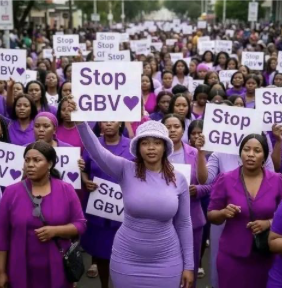
On 21 November 2025, the online call turned into a nationwide street action. Women, men, universities,civil society organisations and allies took to the streets across the country, wearing either purple or black as a visual representation of mourning and solidarity, demanding urgent government action.
Background
South Africa faces a shocking and persistent epidemic of GBV. Although this is a universal phenomenon, South Africa experiences some of the world’s highest levels of GBV, particularly against women and children, with the rate at which women are killed being five times higher than the global average, according to UN Women.
The Human Sciences Research Council’s (HSRC) 2024 national GBV survey paints a grim backdrop: one‑third of women over 18 have experienced physical violence, one‑quarter have endured emotional abuse, and one‑eighth have suffered financial abuse. Sexual violence is reported by 9.8 % of women, and over a third have faced either physical or sexual violence. These figures are not evenly spread – black African women, women with disabilities, older women and LGBTQIA+ women bear the brunt of this violence[1].
Causes
Gender-based violence (GBV) in South Africa is deeply rooted in patriarchal societal structures, cultural traditions, and power imbalances. The way males are raised to exert power and control over women contributes significantly to the prevalence of GBV. Harmful cultural practices, such as lobola, can perpetuate the notion that women are possessions, blurring the lines of consent. The media's focus on victim-blaming rather than perpetrator accountability further entrenches GBV. Additionally, limited access to support services, inadequate law enforcement, and societal attitudes that normalise violence against women exacerbate the problem. [2]
The 16 Days of Activism (25 Nov – 10 Dec 2025)
From 25 November to 10 December 2025 South Africa will observe the 16 Days of Activism for No Violence Against Women and Children under the theme “Letsema: Men, Women, Boys and Girls working together to end GBVF.” Launched by the Department of Women, Youth and Persons with Disabilities, the campaign marks the 27th anniversary of the UN‑led initiative and ties into the Positive Masculinity Dialogue on the margins of the G20 ministerial meeting.
During the 16‑day window, government, civil‑society and the private sector will host community dialogues, awareness drives and a pledge‑signing campaign aimed at challenging cultural norms, reporting abuse and supporting survivors. The period also encompasses World AIDS Day (1 Dec) and the International Day of Persons with Disabilities (3 Dec), underscoring the intersecting vulnerabilities that the broader GBV response must address.
Why does the timing matter?
In the past years, reported incidents of gender‑based violence have risen sharply during the very same 16‑day window. This troubling pattern has become an embarrassing “shadow” of the activism itself, highlighting the need for the current mobilisation to be matched by sustained implementation rather than symbolic gestures. [3]
Vulnerable groups
Women with disabilities: higher rates of physical (29.3 % vs 21.7 %), sexual (14.6 % vs 7.2 %) and economic abuse.
Older women (60+): Financial and physical abuse are most common; substance abuse in families is a key risk factor.
-LGBTQIA+ women: face rejection, homelessness and discrimination in services, despite constitutional protections.
Government response
The declaration of GBV as a national disaster allows departments to redirect allocated budgets to implement the Emergency Response Action Plan on GBV and Femicide, first announced in 2019. The 16 Days campaign sits at the centre of the broader 365‑Day Activism strategy.
Civil society and community action
NGOs such as Mosaic, Ikamva Labantu and Pride Shelter Trust are running parallel programmes, offering shelters, legal assistance and awareness workshops. Grassroots “lie‑down” protests and the online #G20WomenShutdown campaign have generated over one million signatures. [4]
Conclusion
South Africa’s declaration of GBV as a national disaster and the upcoming 16 Days of Activism signal heightened political will, but the recurring surge in violence during the campaign period reminds us that awareness alone is insufficient. Sustained funding, rigorous implementation of the Emergency Response Action Plan and targeted interventions for the most vulnerable groups are essential if the country is to move from rhetoric to real reduction in gender‑based violence.
Sources:
[1]. https://www.bbc.com/news/articles/cn979g302l9o
[2] https://safpj.co.za/index.php/safpj/article/view/5729/7927
[3] https://www.gov.za/16DaysOfActivism2025
[4] https://hsrc.ac.za/news/review/violence-against-women-in-south-africa-intersecting-vulnerabilities/
