



𝐵𝑦 𝑁𝑎𝑦𝑖𝑟𝑎 𝐻𝑖𝑚𝑝𝑒 / 𝐺𝐼𝐶𝐽
On 16 December 1966, the United Nations General Assembly adopted two landmark human rights treaties: the International Covenant on Civil and Political Rights (ICCPR) and the International Covenant on Economic, Social and Cultural Rights (ICESCR). Commonly referred to as the International Covenants, they were developed to give binding legal force to the human rights principles proclaimed in the Universal Declaration of Human Rights (UDHR). Together, the three instruments form the International Bill of Human Rights.
Sixty years later, the Covenants remain fundamental instruments in the international protection of human rights. On 6 November 2026, the United Nations Office at Geneva marks this anniversary with a joint commemoration under the theme “Sixty years of the Covenants: progress, challenges and a roadmap for the future”.
The Two Covenants
The ICCPR and the ICESCR establish a comprehensive framework of civil, political, economic, social and cultural rights to which every individual is entitled. Although they address different categories of rights, both are essential to ensuring human dignity and the effective enjoyment of human rights.
Adopted on 16 December 1966, the ICCPR entered into force on 23 March 1976, following the required 35 ratifications. It seeks to protect individuals against violations of their civil and political rights. Among the rights it guarantees are the right to self-determination (Article 1), equality and non-discrimination (Articles 2 and 3), the right to life (Article 6), freedom from torture and cruel, inhuman or degrading treatment (Article 7), and freedom from slavery (Article 8).
The ICCPR is complemented by two Optional Protocols. The First Optional Protocol, which entered into force on 23 March 1976, establishes a procedure through which individuals can submit complaints to the Human Rights Committee alleging violations of their rights under the Covenant. This procedure applies to individuals under the jurisdiction of States that have ratified or acceded to the Protocol, subject to its admissibility requirements.
The Second Optional Protocol, which entered into force on 11 July 1991, aims to abolish the death penalty. States parties agree not to execute anyone within their jurisdiction and to take the necessary measures to abolish capital punishment, subject to the limited reservation permitted under the Protocol.
Similarly, the ICESCR was adopted on 16 December 1966 and entered into force on 3 January 1976, after the required 35 ratifications. It protects economic, social and cultural rights, including the right to work (Article 6), the right to just and favourable conditions of work (Article 7), the right to form and join trade unions (Article 8), the right to social security (Article 9), the protection of mothers and children (Article 10), the right to an adequate standard of living, including adequate food and housing (Article 11), the right to health (Article 12), and the right to education (Article 13).
The ICESCR is supplemented by its Optional Protocol, which entered into force on 5 May 2013. It allows individuals and groups to submit communications to the Committee on Economic, Social and Cultural Rights (CESCR) concerning alleged violations of their rights under the Covenant. It also establishes procedures through which the Committee may investigate grave or systematic violations and consider inter-State communications, subject to the relevant conditions and acceptance of competence by States.
Monitoring the Covenants
The implementation of the two Covenants is overseen by separate treaty-monitoring bodies: the Human Rights Committee and the Committee on Economic, Social and Cultural Rights. Both consist of 18 independent experts who monitor States' compliance with their respective treaty obligations.
The Human Rights Committee supervises the implementation of the ICCPR. One of its principal responsibilities is to examine periodic reports submitted by States parties on the measures they have taken to give effect to the rights protected under the Covenant. Following these examinations, the Committee issues concluding observations identifying areas of progress, concerns and recommendations for further action.
It also considers individual communications submitted under the First Optional Protocol and, where the relevant conditions are met, inter-State communications under Article 41 of the Covenant. Furthermore, the Committee develops general comments, providing authoritative interpretations of the provisions of the ICCPR and guidance on specific human rights issues.
Through these different procedures, the Committee seeks not only to identify violations but also to encourage States to strengthen their domestic legal frameworks and policies. Its recommendations can help preserve existing protections, address shortcomings in national legislation and prevent measures that could undermine the enjoyment of civil and political rights.
Over the years, the Committee's work has contributed to meaningful changes in States' laws, policies and practices. In several instances, individual complaints have resulted in remedies for victims, including compensation, the commutation of death sentences, retrials and investigations into alleged violations. Although it is difficult to establish a direct causal relationship in every case, these outcomes demonstrate the practical importance of the Committee's monitoring mechanisms.
The CESCR performs a similar monitoring role with regard to the ICESCR. It examines periodic reports submitted by States parties and issues concluding observations assessing their implementation of economic, social and cultural rights. Through this process, it identifies shortcomings and provides recommendations aimed at improving the protection and enjoyment of these rights.
The Committee also adopts general comments to clarify the scope and content of the rights enshrined in the Covenant. In addition, the Optional Protocol gives it the competence to examine individual communications and, under specific conditions, conduct inquiries into grave or systematic violations. Its work seeks to promote constructive dialogue with States and assist them in fulfilling their obligations through legislative, policy and other recommendations.
Ratification Status
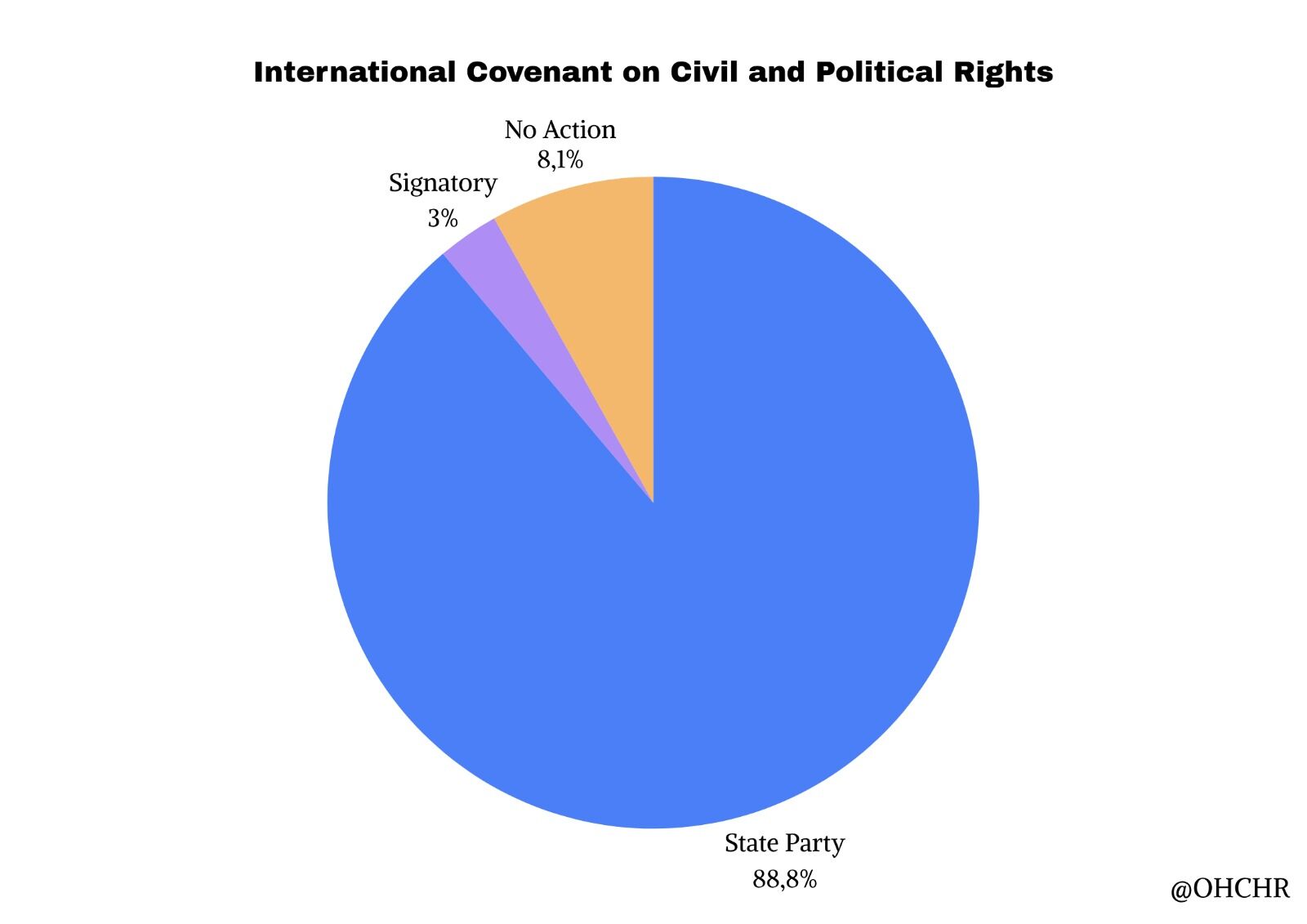


Despite their widespread acceptance, the Covenants and their Optional Protocols have yet to achieve universal ratification. According to the OHCHR Status of Ratification Dashboard, out of 197 countries, 175 are States parties to the ICCPR, six have signed it but not ratified it, and 16 have taken no action.
Regarding its First Optional Protocol, 119 States are parties, four are signatories and 74 have taken no action. The Second Optional Protocol has 92 States parties, while 105 States have taken no action.
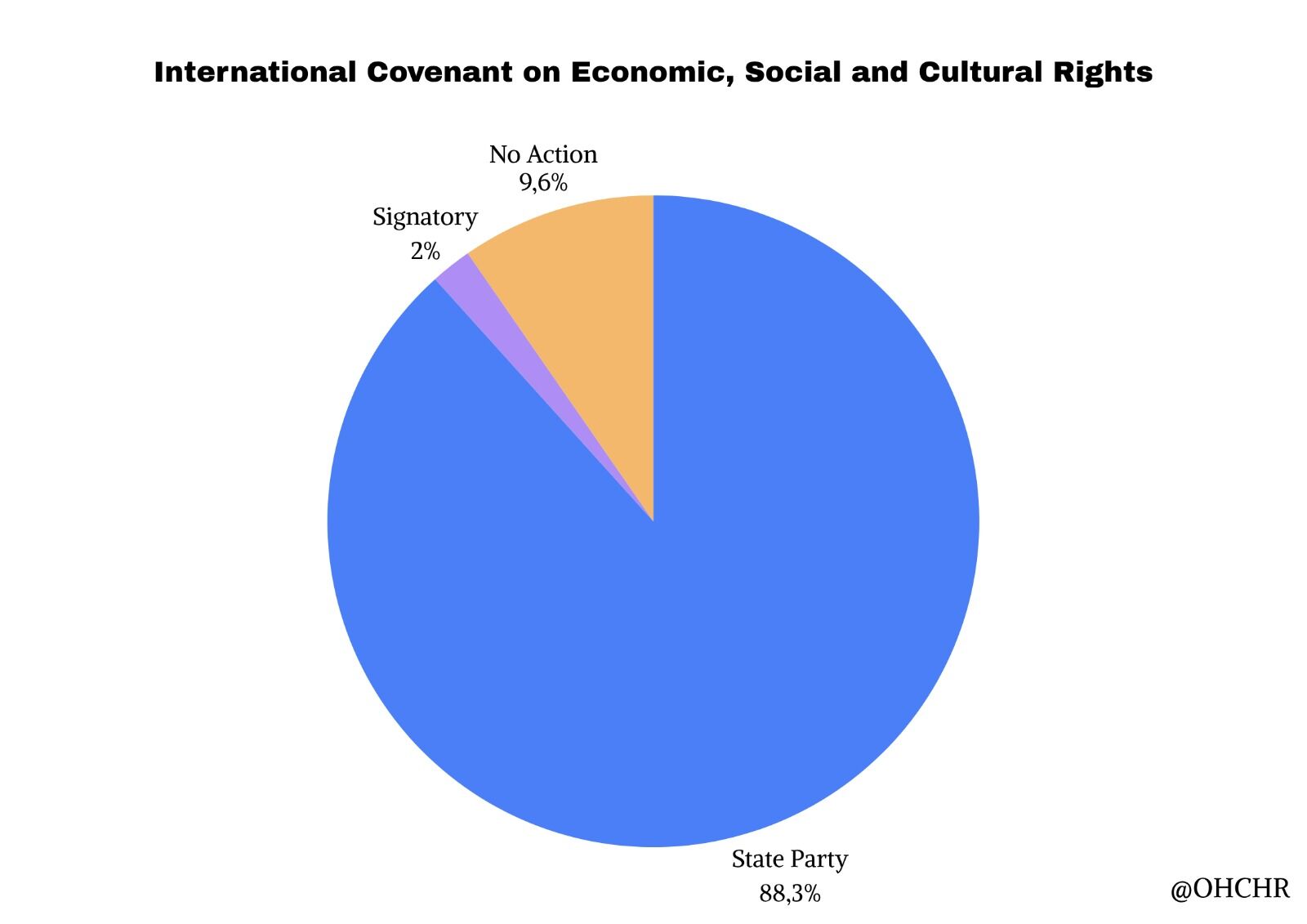
Similarly, the ICESCR has 174 States parties, four signatories and 19 States that have taken no action. Its Optional Protocol has received considerably fewer accessions, with 31 States parties, 24 signatories and 143 States having taken no action.
These figures illustrate that, although the two Covenants enjoy broad international acceptance, participation in their Optional Protocols remains considerably more limited. This is particularly significant given the role of these instruments in strengthening the international mechanisms available for the protection of the rights enshrined in the Covenants.
Remaining Challenges
Six decades after their adoption, the Covenants remain highly relevant in a world facing increasingly complex human rights challenges. Armed conflicts, humanitarian emergencies, inequality, climate change and rapid technological developments continue to place pressure on the enjoyment and protection of fundamental rights.
In particular, armed conflicts have devastating consequences extending far beyond immediate threats to life and physical security. They destroy homes and livelihoods, disrupt access to food and clean water, damage healthcare infrastructure and interrupt education. Consequently, they affect the full range of civil, political, economic, social and cultural rights, often with particularly severe consequences for already vulnerable populations.
Technological developments, especially artificial intelligence (AI), also raise new questions regarding the protection of human rights. The growing use of surveillance systems and biometric technologies creates concerns regarding the right to privacy, while AI-generated disinformation can undermine freedom of expression and political participation. Furthermore, the increasing integration of AI into workplaces and public services may affect employment security, equality and access to essential services.
Both Committees are working to clarify how the Covenants apply to these contemporary challenges. The CESCR is preparing a general comment on the application of the ICESCR in situations of armed conflict, while the Human Rights Committee is developing a general comment on the right to freedom of association under Article 22 of the ICCPR, addressing issues including emerging challenges associated with new technologies.
These initiatives demonstrate the continued importance of the Covenants in adapting international human rights standards to evolving circumstances and ensuring that existing protections remain effective.
Commemorating 60 Years at the United Nations
Under the theme “Sixty years of the Covenants: progress, challenges and a roadmap for the future”, the joint commemoration in Geneva will bring together members of the two Committees, States parties, United Nations agencies, international organisations, civil society organisations and other stakeholders.
The event will provide an opportunity to assess the achievements made over the past six decades, examine the continued relevance of the Covenants in addressing contemporary human rights crises and consider the challenges that lie ahead.
The programme will be structured around three discussions. The first will look back at the sixty years since the adoption of the Covenants. The second will examine their role in addressing present-day crises, while the third will focus on future challenges and possible ways forward.
By bringing together different actors in the international human rights system, the commemoration seeks to reaffirm the shared and complementary nature of the two Covenants and their continued importance in protecting human dignity.
Geneva International Centre for Justice’s Position
Geneva International Centre for Justice (GICJ) supports the work of both the Human Rights Committee and the Committee on Economic, Social, and Cultural Rights. Through its participation in the treaty-body process and the submission of parallel reports, GICJ contributes to the monitoring of States' human rights obligations. Among its recent contributions are parallel reports concerning Austria and Pakistan.
On the occasion of the Covenants' 60th anniversary, GICJ calls upon States that have not yet done so to ratify the ICCPR and its Optional Protocols, as well as the ICESCR and its Optional Protocol. It further urges States parties to cooperate fully and in good faith with the respective Committees and to implement their recommendations effectively.
Sixty years after their adoption, the Covenants remain essential pillars of international human rights law. Their continued relevance, however, depends on States' willingness to uphold their obligations and ensure that the rights they guarantee are effectively enjoyed by everyone. Protecting human rights is not only an individual State responsibility but also a collective commitment of the international community.
[1] OHCHR. (n.d.). 60Th anniversary of the covenants: 60 Years of commitment to human dignity. Ohchr. Retrieved November 5, 2026, from https://www.ohchr.org/en/what-are-human-rights/international-bill-human-rights/60th-anniversary-covenants-60-years-commitment-human-dignity
[2] United Nations. (2025). Background to the international Covenant on civil and political rights and optional protocols. Ohchr. https://www.ohchr.org/en/treaty-bodies/ccpr/background-international-covenant-civil-and-political-rights-and-optional-protocols
[3] United Nations. (2025). Background to the international Covenant on civil and political rights and optional protocols. Ohchr. https://www.ohchr.org/en/treaty-bodies/ccpr/background-international-covenant-civil-and-political-rights-and-optional-protocols
[4] United Nations. (2025). OHCHR | background to the Covenant. Ohchr. https://www.ohchr.org/en/treaty-bodies/cescr/background-covenant
[5] United Nations. (2025). OHCHR | background to the Covenant. Ohchr. https://www.ohchr.org/en/treaty-bodies/cescr/background-covenant
[6] United Nations. (2025). OHCHR | Introduction to the Committee. Ohchr. https://www.ohchr.org/en/treaty-bodies/ccpr/introduction-committee
[7] OHCHR | introduction to the committee. (n.d.). Ohchr. Retrieved November 5, 2026, from https://www.ohchr.org/en/treaty-bodies/cescr/introduction-committee
[8] OHCHR. (2014). Status of ratification interactive dashboard. Ohchr.Org. https://indicators.ohchr.org/
[9] OHCHR. (2026, November 2). Keystone Covenants at 60: uN Committees to reflect on progress, emerging challenges and the way forward. Ohchr. https://www.ohchr.org/en/press-releases/2026/11/keystone-covenants-60-un-committees-reflect-progress-emerging-challenges-and
[10] Human Rights Committee, Committee on Economic, Social and Cultural Rights. (2026, November 6). Joint commemoration marking the 60th anniversary of the international Covenant on economic, social and cultural rights and the international Covenant on civil and political rights. Ohchr https://www.ohchr.org/en/events/events/2026/joint-commemoration-marking-60th-anniversary-international-covenant-economic
