



Out of Sight, Out of Mind - The lived reality of afghani women
By Lenja Probst / GICJ
People holding on to airplanes taking off, falling from nauseating height in a desperate attempt to get to be one of the few to leave the country. Those are the pictures that went around the world from 15 August 2021, the day the Taliban took back Kabul. Now it is approaching for the fifth time and the world, it seems, has moved on from them, as diplomatic connections to the Taliban's de facto regime are quietly expanded and countries are deporting to Afghanistan again. However, moving on and turning a blind eye to the developments in the country is a luxury, Afghan women don’t have. While the initial decree “on the rights of women”, issued by the Taliban after the Kabul takeover, might have sparked hope, the lived reality of women has primarily changed with each of the decrees, orders by the Taliban leader and oral statements, that followed after. So let’s have a look at the impact of the complicated web of restrictions on women’s rights.
One of the Taliban’s first measures after returning to power in 2021, was to restrict women’s access to education. In 2024, the De-facto authorities enacted the “morality law”. Within three months of its adoption, the ban on girls' education rose to affect ninety-seven per cent of girls.1 Today, girls and women are excluded from any sort of formal education after grade six, so around age twelve.2 Meaning, in the years to come, zero per cent of women are expected to receive a secondary education.3By targeting education at such an early stage, the Taliban are not only depriving women of knowledge, but also of the opportunity to develop individuality, aspirations, and personal autonomy. By denying women access to it, the de-facto authorities systematically undermine their ability to achieve independence, participate in public life, let alone advocate for their rights. Therefore, in the long term, these measures appear aimed at shaping a generation of women with limited opportunities to self-rely, question authority and resist or challenge suppression.
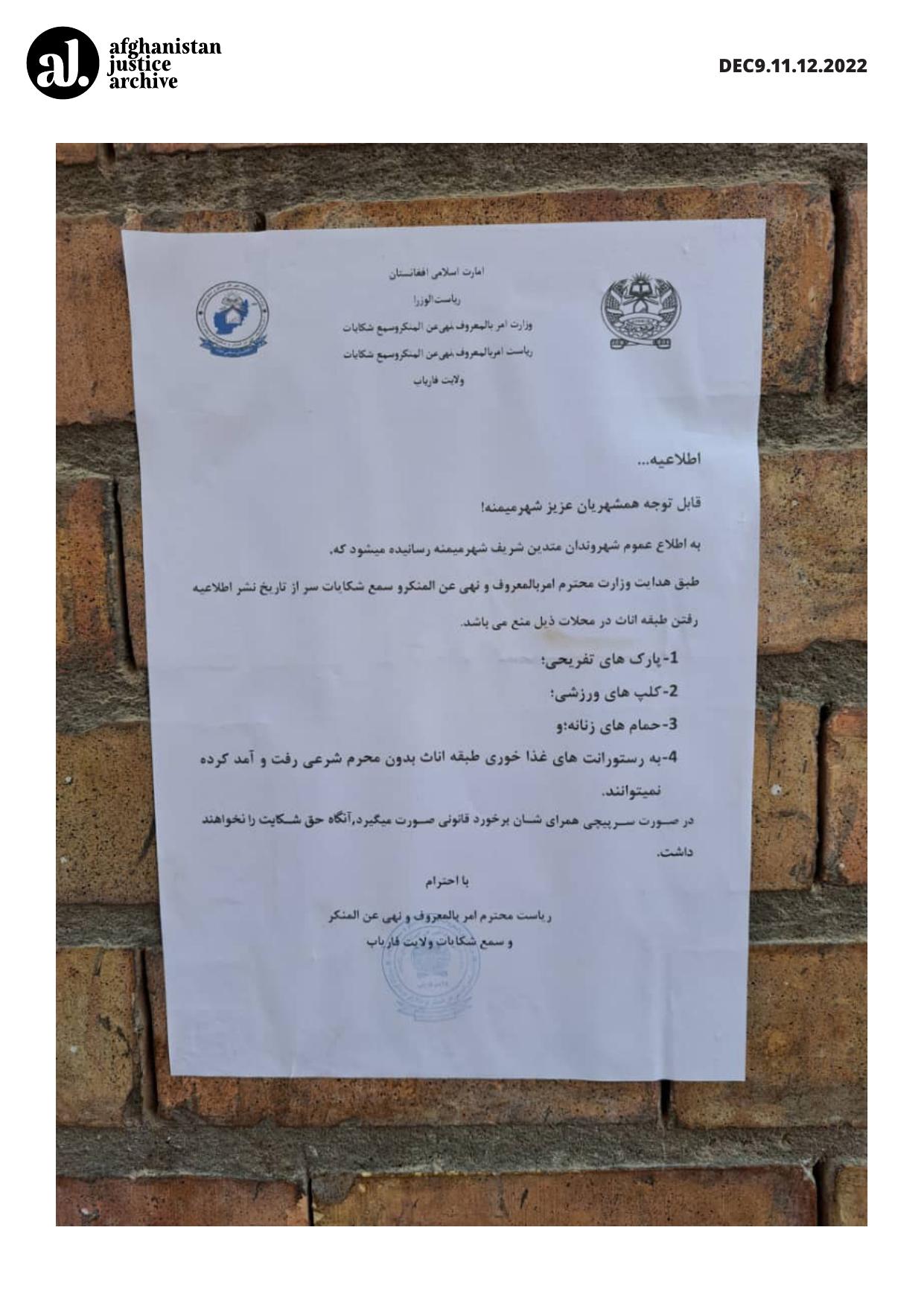
By oral decree on 19 December 2021, the Taliban required women leaving their homes without a male guardian (mahram) to wear a full-body hijab covering, with only one eye permitted to remain visible. In 2024, women’s voices were classified as awrah, to be concealed and not be heard in public. These inflictions, combined with other restrictions on women's movement,4 imposed extensive limitations on women's ability to travel independently and conditioned their presence in public spaces on both strict dress requirements and male guardianship.5
These measures reshape the conditions under which women may participate in public life. By requiring extensive concealment and, in many circumstances, the presence of a mahram, the decrees reduce women's autonomy over their movement and how they appear in public. This even stretches to the health care sector. In 2024, eighty per cent of women reported being denied access to health care centres without a mahram.6 Additionally, male health care professionals are prohibited from treating female patients while female health care professionals are restricted access or entirely expelled from their place of work.7 Thus, limiting women’s access to health care further.
The Taliban's initial decree on "women's rights," issued in December 2021, appeared to recognise one significant protection: adult women were granted the right to consent to marriage, and the decree stated that women should not be forced into marriage. Suggesting a commitment to addressing forced marriage. However, in practice, human rights organisations have continued to document reports of women and girls being coerced into marriages involving Taliban members and officials, highlighting a gap between the decree's stated protections and its implementation.8 In 2023, around twenty-nine per cent of girls under the age of eighteen were married, as well as around ten per cent of those under the age of fifteen.9
Decrees that were later issued, have further weakened women's legal position within a marriage. Most notably, recent Decree No. 18 on spousal rights, which grants men unilateral right to initiate divorce, while placing women at a legal disadvantage when seeking to dissolve a marriage.10 Rather than expanding women's legal autonomy, these measures reinforce unequal power relations within the family.
The limitation on justice for women is increased by a number of decrees that are limiting women's ability to access courts unless they comply with strict dress requirements, or in some places even women's ability to pursue legal claims against their husbands entirely.11 As legal remedies become increasingly inaccessible, the ability of women to challenge abuse or seek remedy by enforcing their rights is substantially reduced, putting women further at risk.
Taken together, these and the many more policies contribute to a broader process of social exclusion. Women's visibility in public spaces is reduced, while their access to education, employment, and civic participation is increasingly conditioned on compliance with restrictive rules. The cumulative effect is not simply the regulation of women's dress or movement, but a legal framework in which women's presence in public is treated as something requiring constant control and justification. Under isolated consideration, these orders can seem scattered and impulsive. However, in context, they create a concerning net of suppression for women. A net that seems aimed at redefining womanhood as a whole. Orders about clothing, leisure, movement and education are targeting a woman’s will and right to define herself by being prescribed a role so restricting, there’s no space for individual identity.12 A woman under Taliban rule is not to be considered just a woman. According to these rules, her value stems from her association to a man in the role of a mother, wife or daughter. Instead of her own person, she is required to be his accessory.
So how have five years of Taliban Rule affected women’s daily lives? The decrease in girls' education, economic factors, limited health care, cultural pressure and the fear of a forced marriage to Taliban officials are major drivers for adolescent child bearing, with the effect that sixty-two out of a thousand girls are having children before they turned eighteen.13 A number that is expected to rise a further twenty-five per cent in 2026 under the rule.14 Furthermore, due to missing regulation, as well as an increasing number of child and forced marriages, intimate partner violence is expected to rise further.15
Additionally, seventy-nine per cent of women state that they have been denied access to public spaces such as parks and recreational centres even when accompanied by a mahram. Sixty-nine per cent of women report feeling unsafe leaving their homes. Fifty-seven per cent report a decline in financials and only around six per cent having a joint or personal bank account.16
Women have been erased from public life and leadership positions. Their autonomy and sense of self has been stripped from them by the entirely male Taliban de facto authorities who are making even the most basic decisions for them. In 2025, eighty-one per cent of women judged their mental health to be “bad” or “very bad” and every year since the takeover, more women are suffering from mental health issues due to cultural isolation and the lack of future prospects.17
Therefore, Geneva International Centre for Justice (GICJ) believes that although Afghanistan might not be an active warzone any longer, the war on women is raging on, under the eyes of the international community. For women’s protection, GICJ condemns the crimes committed against Afghan women and their identities. At the same time, it calls on the international community not to normalise the danger, the suppression of women and violation of their human rights under the Taliban rule, and instead to only entertain diplomatic relations to the de-facto regime as is necessary for the Afghan people, especially its minorities, its women and its girls.
GICJ calls on all countries to stop deportation to Afghanistan and to increase funding for aid through local women’s organisations, as they are often the only healthcare, education and support women in Afghanistan may receive. Lastly, GICJ stands with the women and girls affected by the Taliban. It recognises their pain and celebrates Afghan women, their bravery, aspirations, community, humanity, strength and individuality.
1 UNWomen/Summary of Countrywide Consultations with Afghan Women [July 2024], p. 4, (https://asiapacific.unwomen.org/sites/default/files/2024-10/af-c1242-final-consulation-report_july-2024-en-r02.pdfI).
2 UN Women/UNDPD/Twin Paths to Equal – Twin Indices on women’s empowerment and gender equality [2023], p. 28 (https://www.unwomen.org/sites/default/files/2023-07/paths-equal-twin-indices-women-empowerment.pdf).
3 UN Women/Gender Index on Afghanistan [2024], p. 7 (https://www.unwomen.org/sites/default/files/2025-06/gender-index-2024-afghanistan-executive-summary-en.pdf).
4 https://www.jomhornews.com/fa/news/146045/ (Aug. 26); https://afghanistanjustice.org/media/2022/11/AJA_DEC9.11.12.2022.jpg.
5 https://afghanistanjustice.org/decrees/dec5-12192021/ (Aug. 26).
6 Fn. 1, p. 4.
7 UN Women/State of women’s rights in Afghanistan [August 2025], (https://www.unwomen.org/en/articles/in-focus/afghanistan).
8 https://paigah-news.com/یک-دختر-در-ازای-آزادی-برادرش-از-زندان-به/ (Aug. 26).
9 Fn. 3, p. 25.
10 Statement by UN Women Special Representative in Afghanistan, Susan Ferguson (https://www.unwomen.org/en/news-stories/statement/2026/05/un-women-afghanistan-statement-on-decree-no-18-issued-by-the-de-facto-authorities).
11 https://afghanistanjustice.org/decrees/dec3-06162022/ (Aug. 26).
12 https://paigah-news.com/از-منع-موسیقی-تا-حذف-آرایش-عروس؛-طالبان/ (Aug 26).
13 Fn. 3, pp. 25.
14 Fn. 3, pp. 25 f. ; Fn. 1, p. 6.
15 Fn. 1, p. 7.
16 Fn. 3, p. 34.
17 Fn. 1, p. 7.