





The United Nations Permanent Memorial to Honour the Victims of Slavery and the Transatlantic Slave Trade. Credit: UN Photo/Devra Berkowitz
International Day of Remembrance of the Victims of Slavery and the Transatlantic Slave Trade – 25 March
Tamira Gibbs Chumillas and Delfina Fiammenghi/ GICJ
The transatlantic slave trade remains one of the darkest chapters in Western history, marked by the enslavement and deprivation of freedom of more than 15 million people over four centuries.
On 25 March 1807, the United Kingdom passed the Abolition of the Slave Trade Act, becoming the first country to outlaw the Atlantic slave trade. However, this is only the final part of the story we commemorate on this date.
Each year on 25 March, we honour the resilience of those who endured enslavement, pay tribute to those who lost their lives, and remember all those who fought for freedom and for the equality of every human being. As UNESCO’s former Director-General Kōichirō Matsuura noted, abolition was not a benevolent concession: the resistance and uprisings of enslaved people profoundly and irreversibly shook the slave system and helped set in motion the process that led to the abolition of the transatlantic slave trade.
Historical Context
The Transatlantic slave trade is the largest instance of forced migration in human history. UNESCO estimates that 15 to 20 million African were kidnapped and forcefully transported to the Americas, the Caribbean and Europe to serve as slave labour. The Atlantic slave trade began with the Portuguese in the 1440s. Spain, the Netherlands, England and France followed and became the main countries active in the perpetuation of the slave trade.
People were abducted from villages or captured in wars , forced onto ships in appalling conditions, and set off on the “Middle Passage” to the United States and to European colonies in the Caribbean and South America. Nearly 2 million of the people captured and enslaved during the transatlantic slave trade died on the journey due to overcrowding, disease, violence and minimal food.
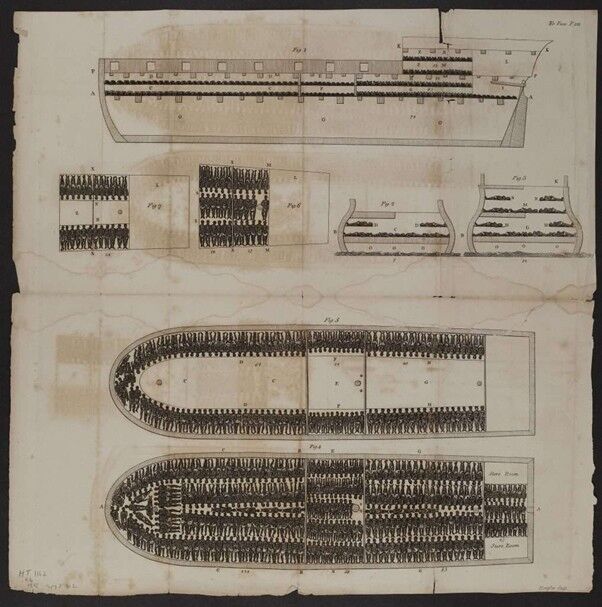
Diagram of Ship Transporting Enslaved People (original author Thomas Clarkson, 1808)
Enslaved people were sold as commodities to work for free on plantations, mines and rice fields. They were considered and treated as property. By the end of the 18th century, moral and political opposition to the slave trade starting taking place in Britain and Europe more broadly. Through a concerted campaign of public petitions, boycott campaigns and the publication of the conditions of ships carrying enslaved people, the slave trade was abolished over the course of the early 19th century.
2026 Theme: “Acknowledge the past. Repair the present. Build a future of dignity and justice.”
Some may ask why a practice abolished long ago still matters today. It matters because the ideology that sustained the slave system has not disappeared: in the past, the idea of race became firmly embedded in a social hierarchy used to justify the exploitation of some for the economic benefit of others. Today, those same prejudices and cultural (when not explicitly racial) hierarchies continue to shape the divide between those who produce and those who consume, between those who are exploited and those who exploit.
The legacy of the systematic dehumanisation of African peoples over generations can still be recognised in the unequal access by people of African descent nowadays to quality education and to medical treatment. In the United States, African American women are 243% more likely than white women to die from pregnancy and childbirth-related issues [1]. This phenomenon is far from normal, and it stands as a testament to the suffering still being inflicted because of deep-rooted racist prejudice.
To repair the present, it is important to question whether we are indeed living in a “post-colonial” world. Many of the countries who were deeply affected by the enslavement of their people during the Slave Trade remain at the mercy of Western countries through exploitation and inability to harness their own natural resources. Through a series of neo-colonial mechanisms, including the control of mining by foreign firms, African nations are forced into extracting raw materials which in turn get exported to Europe and sold for exorbitant amounts of profit. This is particularly notable in the Democratic Republic of Congo (DRC), a country which supplies over 60% of global cobalt used in electronics and lithium-ion batteries (a crucial component in electric cars). Congolese miners work in sub-human conditions where no regard is given to their health and safety. Often times, this leads to tragedy, as evidenced by the landslide that took place on March 2026 where 200 workers were killed, including 70 children who had also been working at the mines. This is modern day slavery parading as liberation.
Geneva International Centre for Justice (GICJ), calls on the international community to confront this enduring legacy of exploitation and structural inequality, and to dismantle the continuing oppression of the Global South by the Global North, and of the poor by the wealthy, through the effective implementation of strong laws and policies.
Bibliography:
[1] Invisible Women: Exposing Data Bias in a World Designed For Men by Caroline Criado-Perez (pg. 548).
[2] Witteveen, Ieteke Inchi, and Teresa Leslie. “On Slavery Remembrance Day, UN Chief Shines a Light on African Diaspora’s Legacy.” UN News, March 25, 2025. https://news.un.org/en/story/2025/03/1161481
[3] United Nations. “International Day of Remembrance of the Victims of Slavery and the Transatlantic Slave Trade.” https://news.un.org/en/story/2025/03/1161481