




62nd Session of the Human Rights Council
15 June -7 July 2026
Item 3: Interactive Dialogue with the Special Rapporteur on the Human Rights of Migrants
22 June 2026
Externalisation of Migration Governance and the Human Rights of Migrants: An Interactive Dialogue with Special Rapporteur Gehad Madi
By Danila Pulinets / GICJ
Executive Summary
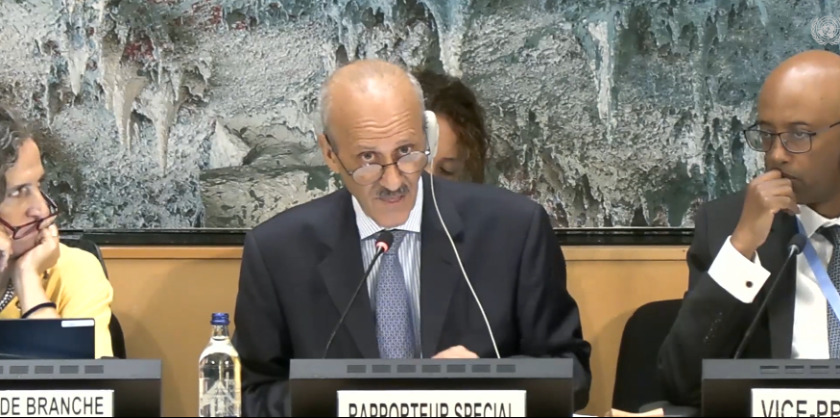
On 22 June 2026, the Human Rights Council held an Interactive Dialogue with Mr Gehad Madi, Special Rapporteur on the Human Rights of Migrants, as part of the Council's 62nd Session. The dialogue centred on two reports: the special rapporteur 's thematic report on the externalisation of migration governance (A/HRC/62/35) and his country visit report on Mauritania (A/HRC/62/35/Add.1), based on a visit conducted from 2 to 12 September 2025.
Mr Madi presented an alarming global picture. States across all regions have been accelerating the practice of shifting migration and asylum responsibilities to third countries, resulting in serious and wide-ranging human rights violations. He identified three principal forms of externalisation: measures preventing arrival, extraterritorial asylum processing, and removal to third states. He raised particular concern over the European Union's rapid legislative expansion of safe country concepts and new return hub regulations, as well as the United States' bilateral agreements with more than 20 countries. Three additional areas of risk were highlighted beyond his previous findings: forced labour, family separation, and the growing use of digital surveillance tools.
Regarding Mauritania, the Special Rapporteur acknowledged the country's constructive engagement with his mandate and its openness to refugees, hosting hundreds of thousands of displaced persons, most of whom are from Mali. However, he identified serious concerns, including mass expulsions without individualised assessment, arbitrary detention, confiscation of documentation issued by the United Nations High Commissioner for Refugees (UNHCR), discrimination against sub-Saharan African migrants, and a legal framework that has shifted decisively towards a security-oriented enforcement model, partly in response to pressure from European partners.
A broad range of delegations participated in the dialogue. The African Group, Mexico, Venezuela, Nepal, Bangladesh, and others expressed deep concern over the proliferation of externalisation policies and their incompatibility with international human rights and refugee law. The European Union and Italy offered a more qualified position, framing cooperation agreements as consistent with legal obligations when accompanied by appropriate safeguards.
The special rapporteur concluded by reaffirming that states cannot evade their human rights obligations by outsourcing migration control and called for enforceable human rights guarantees, independent monitoring, and a renewed commitment to fair, rights-based migration systems.
Read the full report by clicking on the image below: