



By Marcela Miteva
Executive summary
Recently Ceuta, one of the two Spanish enclaves in the African continent, faced one of the biggest waves of immigration it has ever had.
What started as a mere disinformation online campaign turned abruptly into a worrisome humanitarian crisis creating a public and political turmoil on national and European level. European leaders once being formally “excluded” from the ruling majority for their far-right values are starting to gain popularity and support whilst the ones that laid the grounds to more moderate EU-values oriented immigration policies are now being condemned for their inaction to protect the public safety. Immigration handling practices once called radical are now serving as a policy model. The changing political landscape on EU level seems to be a natural response to the outburst of immigrants “flooding” Europe and the respective consequences faced.
This paper presents the events that led up to what happened in Ceuta with the ultimate goal to explore the ever-existing yet neglected two sides of the same story by dissecting the complex legal framework and its procedural gaps.
The Immigration Wave towards Ceuta
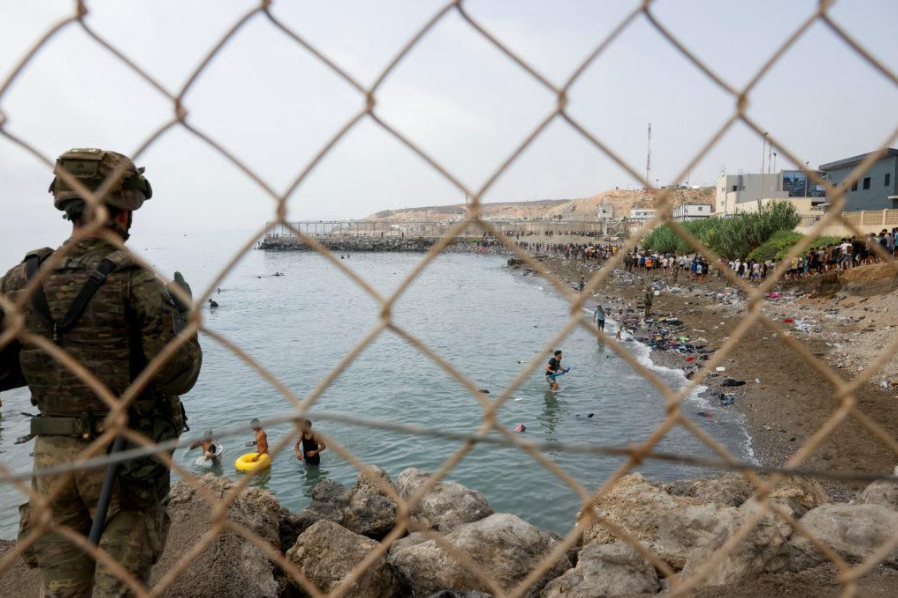
Between the 30th and 31st of July 2026, more than seventy-two thousand of migrants crossed the border, entering one of the two Spanish enclaves on the African continent, Ceuta. Almost ninety people, numbers which vary among the different sources, lost their lives in the attempt to reach the Spanish border by sea or on foot.
Most of the people who crossed the border subsequently returned back to Morocco. A big part of the asylum seekers, including nationals of Sub-Saharan Africa and Algeria, remained in the enclave “living in makeshift camps, on the streets or on the beaches”, causing a humanitarian crisis. All of this occurred despite the existence of an agreement between the two countries which imposed the duty of Morocco to readmit back its illegal immigrants.
Historical Background
To understand the complexity and sensitivity of the situation, it is crucial to discuss the historical background around it.
Historically, the two Spanish enclaves were never recognised by the Moroccan government, yet those two cities came into Spanish possession at the end of the Reconquista (the period marked by the series of political campaigns undertaken by Christian Spain and Portugal to take territories from the Muslims, also known as the Moors) and the beginning of the Age of Discovery. Initially Ceuta was first captured in 1415 by Portugal. Portugal saw Ceuta as a strategic bridge for trading routes between the Mediterranean Sea and the Atlantic Ocean. Furthermore, Portugal aimed to take back its control over its trading with Asia which was previously dominated by Muslim powers. Melilla, on the other hand, came under Spanish control in 1497 in an attempt to secure its recently conquered Granada by setting a foothold in the territory where the Muslim Nasrid dynasty of Granada resorted. With the union of Portugal and Spain in 1580, Spain gained ultimate control of Ceuta, a fact which remains disputed up to this day by one single country, Morocco1.
Procedural Explanation of EU Immigration Handling
So how exactly does this work? An immigrant enters a certain country which under EU law is obliged to handle their case individually. The first seven days after arrival are a period for identification and health and security controls, during which the immigrant can request asylum. If the person does not do so, that person receives a deportation order and the return procedure is triggered. If however asylum is claimed, the 12-week asylum border procedure is triggered which allows for a more in-depth evaluation of the individual case and a final decision for admission or rejection. If in that period the asylum-seeker does not receive a verdict, he is authorised to enter the receiving member state with the status of an applicant for international protection with his case redirected for further examination. The root of the conflict is rejection accompanied by deportation for asylum-seekers. In fact the legal gaps start to emerge when the country of nationality of the immigrant refuses to readmit its citizen, causing a legal limbo where the person can neither be admitted to the new country, nor be sent back. That uncertain legal status of mere “tolerance” inevitably contributes to pushing those groups into the margins of society with almost no options for work and integration.
A similar situation can also be observed in current Ceuta where those awaiting the decision are living in very inhuman conditions.
International Legal Framework
To understand the causes of the influx towards Ceuta and connect all these events, it is crucial to delve into the legal framework.
The foreign policy with regards to immigration is a shared competence of the EU members derived from Article 4 (j) of the Treaty of the Founding of the European Union, “Shared competence between the Union and the Member States applies in the following principal areas: (...) area of freedom, security and justice” and article 79, “The Union shall develop a common immigration policy aimed at ensuring, at all stages, the efficient management of migration flows, fair treatment of third-country nationals residing legally in Member States, and the prevention of, and enhanced measures to combat, illegal immigration and trafficking in human beings.”
Nonetheless member states retain a certain degree of legislative autonomy in that domain, not only a quantitatively measured power granted from art. 79 TFEU (5), “5. This Article shall not affect the right of Member States to determine volumes of admission of third-country nationals coming from third countries to their territory in order to seek work, whether employed or self-employed” but also a substantive one2. The lack of legislative initiative on behalf of the EU in that domain leaves a broader space for member states to conclude for example bilateral agreements with third-countries regarding deportations, detention centres and other intermediary facilities aimed at preventing illegal immigration.
Such an agreement has been negotiated by numerous European countries like the government of Italy’s Prime Minister Giorgia Meloni and Albania and an ex-member state of the EU - the UK with Rwanda.
Most of these agreements expose migrants to higher risks for their safety due to their nature. The UK, for instance, faced judicial condemnations regarding the breach of the non-refoulement principle where migrants were unjustly and repeatedly sent to Rwanda without proving actual connections with the country. The deportation centers in Albania have faced multiple warnings for severe violations of human rights and inhumane conditions.
Not only do these practices prove to be inefficient in fulfilling their main function in deterring migration by creating undesirable post-migration conditions that a migrant would want to avoid, evident from the huge ongoing influxes throughout Europe, but they also worsen the legal safeguards of migrants making them even more vulnerable. The evolution from condemning those agreements and practices to their growing tolerance at the European level, raises the concern of whether they will one day become the model for handling migration issues. This concern is not unfounded which is evident from the newly enacted Pact of Migration and Asylum which introduced the idea of the “return hubs” essentially replicating the practice of Italy. These hubs will be facilities outside of the EU in countries with which the EU concluded an agreement where people with rejected asylum claims will be sent, in case the home country denies their readmission, in case of non-existing diplomatic relations between the home country and the receiving country or in case of failed identification. The migrant may not have any connections with the country to which he is deported with the only requirement being that there is an agreement between the EU and that country. Furthermore detention periods are extended for up to 24 months3.
These offshore facilities have been declared in an opinion by the European Court of Human Rights as legal and non-violating of EU law if they ensure access to a lawyer and language support, and allow detainees to contact relatives, and relevant officials.
National Legal Framework
A crucial part of this case was a recently ruled decision by the Spanish Supreme Court which resulted in a big disinformation campaign promising open borders to those crossing it by sea. This ruling confirmed a previously established unjust deprivation of the procedural rights of a Moroccan migrant who attempted to reach Ceuta by sea but was intercepted and returned back to Morocco using the “hot returns” track. The Moroccan citizen appealed this decision which later reached also the Spanish Supreme Court stating that since the crossing was by sea, the requirement for that procedure could not have been applied as there was no physical crossing of a border fence or razor wire4.
The issue is rooted in an interpretation of the “tenth additional provision of the Immigration Law” which enables border rejection in Ceuta and Melilla for those immigrants who are trying to overcome “border containment elements”. It is not a deportation since it is rooted in the idea that those people never set foot on the Spanish territory and face thus fewer legal protections: no individual case files, no provision of lawyers or interpreters and the immediate handover to Moroccan authorities.
With this decision the court reiterated that “summary returns” cannot be applied to migrants entering Spain by maritime means and migrants crossing the border or being intercepted in the sea shall have access to the ordinary return procedure, governed by Spain’s Aliens Act which requires the opening of an individual case file with crucial safeguards such as identification, mandatory legal assistance as well as an interpreter and the possibility to also file an asylum claim. Furthermore the court stressed that if the state was to establish true containment elements in the sea, it could rethink its decision on admitting the summary returns to sea migrants but as of now maritime surveillance cannot amount to the substantive satisfaction of that criterion5.
The Political Outcome
This event triggered national and international discourse on whether this was the ultimate evidence for the collapse of the border security of the EU, necessitating thus tighter control, regulations and screenings to reduce the volumes of migrants towards the union. Despite the fact that these two cities retain a special Schengen status requiring Spain to perform double checks - one on the admission of migrants and one mandatory for everyone upon leaving the enclave, the massive influx of migrants provoked a backlash in which various political actors were jungling and pinpointing responsibilities of the “Ceutan crisis”6. In the heat of the events, the left-wing Spanish Prime Minister Pedro Sánchez faced numerous criticisms for his pro-immigration policies. He was confronted with internal criticism, originating mainly from the People’s Party and Vox party, whose leader publicly called Sánchez a “traitor”7. He was also accused of ignoring multiple warnings of the planned mass crossing by the Spanish National Intelligence Center (CNI), even one received the night before the huge influx, raising questions as to whether this humanitarian crisis could have been timely and properly handled. On the other hand the Moroccan government also faced allegations regarding the alleged politically orchestrated crossing news of which propagated mainly through social media, “for an assault on the fence and by sea tomorrow at 8 p.m.”8 The Moroccan Ministry of the Interior has confirmed that there was indeed an online campaign which promoted that the Spanish border was open to anyone who reached Ceuta and would subsequently be allowed to remain, facing no legal consequences.
However, the Ministry of Foreign Affairs has refused those allegations underlying not only their timely involvement in trying to prevent the crossing with the placement of police patrols9, but also its numerous warnings to both organizers and participants for the legal consequences that would follow and reminded Spain of its obligation under the bilateral agreement under which Morocco is to take back its illegal immigrants10.
While the directly involved national political leaders are losing their credibility over the dispute of fault attribution, other political actors were seen as drawing benefits from the situation, namely Israel which was said to have initiated the mass disinformation campaign for the open borders to undermine the standing of a political opponent in the face of Sánchez who overtly criticized Israel for its actions in the Palestinian territory. Other sources attribute the outcomes of these arrivals to Moroccan clandestine immigration networks trying to undermine the power of their own government.
And while these events unfolded amid an already well-established political bipolarisation on EU level regarding border control and regulation and handling the increase of migrants towards Europe, the right-wing views on the matter seem to have gained the upper hand. The far right parties used the occasion to further push the narrative of the collapsing patrolling system of the EU and the imminent necessity for stricter, more radical policies to preserve the public safety of the union. Politicians once labelled as fascists due to their foreign policy projects and criticized for their anti-EU values such as Italian Prime Minister Giorgia Meloni’s Albanian pact are now gaining popularity among EU politicians. The recent attacks in various European cities connected to undocumented immigrants spark further pushback and reopen discussions about the low level of execution of their deportation orders amounting to only around 28 percent.
The complexity of the issue must be examined from all of its angles to prevent unfounded allegations towards migrants. The two issues of presumed higher crime rates in areas with larger numbers of illegal immigrants and the inefficiency of the execution of deportation orders are not only interconnected but may also prove a certain degree of causality. In fact on one side it’s the inefficiency of the execution of deportation orders of immigrants whose asylum status is later rejected for various reasons one of which is the reluctance of the originating country to readmit its citizen but on the other it’s the prevention of those flagged as “illegal” from leading their lives normally, inevitably pushing them to the edges of society.
Position of Geneva International Centre for Justice
Geneva International Centre for Justice (GICJ) is deeply concerned with how the political debate on EU level on this matter is shifting towards almost complete exclusion of migrants’ rights. In the attempt to reduce and disincentivize migration, the union has turned a blind eye to its fundamental values, namely the right to due process and the respect for human dignity. Many migrants throughout Europe are stripped of their procedural rights to have their case being treated and handled on an individual basis rather than placed in the mass category of “illegal migrants amounting to a threat to public security”.
In that regard to what extent are the values of the EU, serving as the building blocks for all member states, an elastic unit so fragile that it shrinks with every obstacle it faces? And in that case how could an unstable supranational legal framework guarantee the safeguard and durability of values on national level if itself cannot withstand these challenges?
GICJ believes that the ineffectiveness of the current system and the systematic time delays of the administrative tasks related to the admission or rejection of a migrant shall not result in their imminent punishment with harsher conditions. In line with the gridlock with which undocumented immigrants redirected to the standard procedure are faced, GICJ advocates for timely, procedurally just and individually handled inquiries of migrants.
[1] https://www.britannica.com/question/Why-does-Spain-have-enclaves-in-North-Africa
[2] https://eur-lex.europa.eu/LexUriServ/LexUriServ.do?uri=CELEX:12012E/TXT:en:PDF
