



Photo: © PWWSD.
By Beatrice Rattazzi / GICJ
Introduction
In September 2026, the Palestinian Working Woman Society for Development (PWWSD) published Gendered Impacts of Israel's Settlement Regime in the West Bank. The report covers the West Bank, including East Jerusalem, from 2022 to 2026. The main argument of the report is that settlement expansion, settler violence, movement restrictions and the suppression of civic space are not separate phenomena but mutually reinforcing components of one regime producing distinct and compounding harms for Palestinian women and girls1. At a side event organized by several NGOs during the 63rd session of the UN Human Rights Council on 28 September 2026, PWWSD presented some of the report's findings on women's health.
Taking the Land: "State Land" and the Outposts
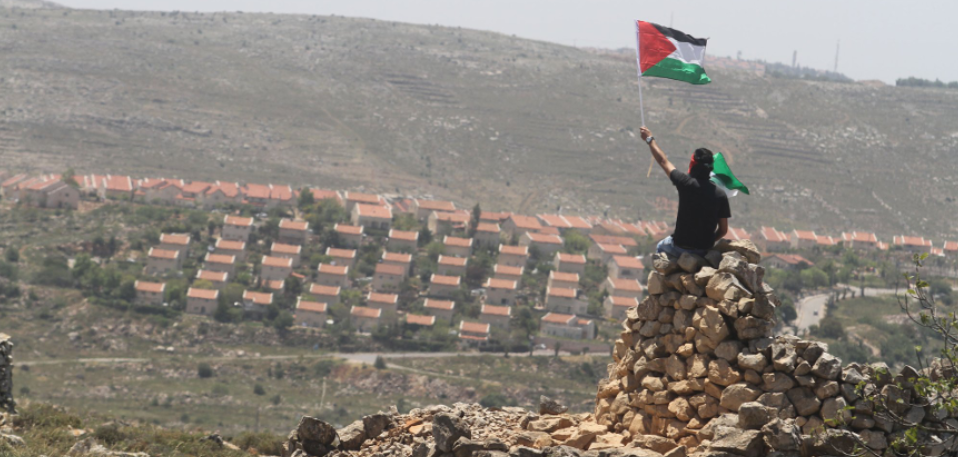
The Israeli Occupying Power no longer treats settlement activity merely as a means of expanding control over Palestinian territory. Settlement has become a systematic settler-colonial project that restructures the territory politically, legally and administratively, consolidating annexation and rendering any reversal difficult2. The Colonization and Wall Resistance Commission (CWRC) describes the first half of 2026 as a qualitative shift in this project, marked by accelerating legislation, structural plans, new outposts and land confiscation. At the centre of settlement activity sits the declaration of "state land": more than 28,000 dunams of Palestinian-owned land have been declared "state land" over the past three years; a policy the CWRC assesses has become the central instrument for reallocating Palestinian land to settlements and imposing de facto annexation3.
The sharpest tool of the takeover is the pastoral and agricultural outpost whose significance lies not in their scale but in their function. Settlers close off grazing routes, restrict access to water and subject residents to a sustained pattern of harassment and attack. Therefore, Palestinian communities are left with no viable option but to leave, effectively forcing their displacement4. This method has outpaced the formal settlement project itself: shepherding outposts have brought at least 786,000 dunams under settlers’ control, roughly 14 per cent of the West Bank, an area larger than all conventional settlements combined5.
Making Leaving the Only Option: Violence That Enters the Home
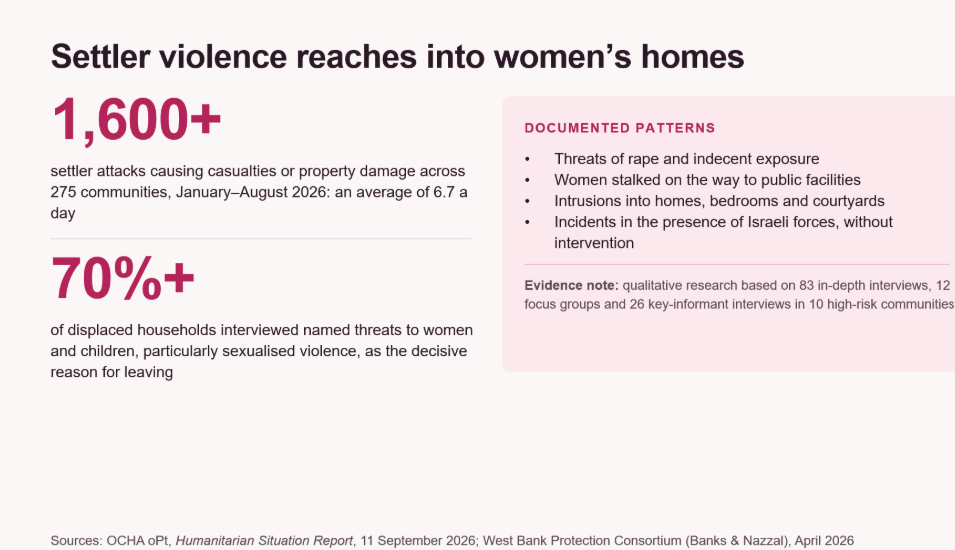
Land is difficult to seize from populations that intend to remain, and the violence documented in the report is best understood in this context. Settlers raid homes and villages, beat residents, issue death threats to force them from their homes and land, destroy homes and other property, seize control of natural resources, and sever water and electricity supplies6. Lethal violence has escalated sharply since 7 October 2023: 61 of the 87 Palestinians killed in settler attacks between January 2019 and August 2026 were killed after that date, just over 70 per cent of the total, and 2026 is already the deadliest year on record7.
The most disturbing pattern of this violence is that it is sexualised, and the report shows it has migrated from public space into intimate domestic space. Women described being harassed metres from their front doors, drones hovering outside bedroom windows, and settlers entering homes at night8. The distinction between private violence and State conduct is frequently blurred since soldiers are repeatedly reported to have stood by during attacks and to have participated in degrading and sexually intrusive searches.
Another concerning trend is that Palestinian women face violence even in what should be the safest of spaces: their own homes. It has been documented that the constant sound of drones raises stress levels within households, contributing to the occupation-related climate of insecurity that United Nations bodies and researchers have found conducive to domestic violence. Women are therefore exposed to intersecting risks of violence from two directions: within the family, where chronic insecurity and tension feed domestic abuse, and from Israeli forces, whose drones have been documented hovering outside bedroom windows and directing cameras into intimate spaces. The psychological toll of drones is particularly severe among children and young people, who report sleep disturbance, fear and difficulty concentrating. Drones are further used as instruments of psychological intimidation and surveillance, including in places where displaced civilians seek refuge.
This violence works precisely because of what it targets. As one woman from a displaced community testified: “They tried to drive us out in every way... In the end, they resorted to targeting women and terrorizing them. This method is what forced us to leave our land in exchange for protecting the women”9. Indeed, more than 70 per cent of displaced households identified threats to women and children as the decisive reason for leaving. Sexualised violence is thus not only a violation, but it also functions as an instrument of displacement10. Even after displacement, the struggle only escalates for Palestinian women and girls. The loss of homes and privacy, overcrowded shelters and inadequate sanitation undermine their dignity, menstrual hygiene and safety, increasing exposure to gender-based violence. Lost livelihoods and financial autonomy deepen dependency, while healthcare costs and barriers to reaching services obstruct access to essential care, including sexual and reproductive healthcare. These conditions intensify unpaid caregiving responsibilities and psychological distress, further eroding their health, autonomy and security.
Making Survival Impossible: Closing Roads
Those who remain, face a slower form of pressure, imposed not by individuals but by the structure of the territory itself. OCHA documented 925 movement obstacles restricting the movement of 3.4 million Palestinians as of December 2025, with checkpoints and iron gates. Aggravating this, since 7 October 2023 most permits have been revoked or suspended, including more than 800 issued to nationally recruited humanitarian workers11.
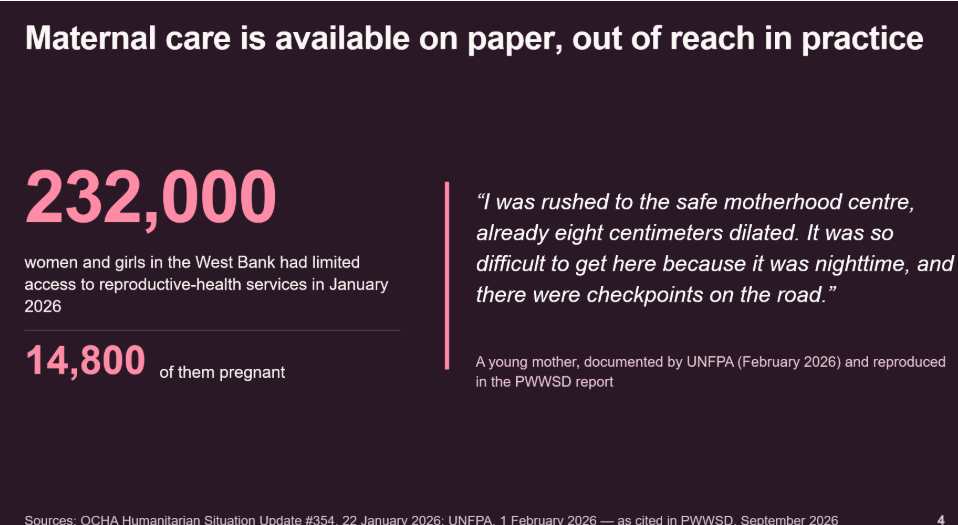
Each closure carries a cost distributed unevenly across the population. Roadblocks and checkpoints can make reaching a hospital nearly impossible, threatening the health and lives of pregnant women. Only 42 per cent of health facilities are fully operational, and more than 230,000 women and girls, including some 14,800 pregnant women, have limited or no access to reproductive health care12. Providers have brought care closer through safe-motherhood centres and mobile clinics, yet the WHO recorded 98 attacks affecting health care in the first seven months of 2026 alone13. The report draws the conclusion that a service that is formally available may remain practically inaccessible.
Education is subject to the same pressure. More than 550 attacks on children travelling to school, on school infrastructure and on teachers were documented in the two years to the end of 2025. Moreover, 85 schools remain under pending demolition or stop-work orders that, if implemented, would affect more than 13,000 students, including 6,557 girls, taught by 1,089 teachers, 649 of whom are women14. As a result of these attacks, families restrict girls' movement to reduce exposure to harassment perpetrated by settlers or soldiers and push them into marriage, to move them somewhere safer. The report notes that early marriage forecloses education, mobility, bodily autonomy and later access to paid work in a way that is difficult to reverse15.
The economic logic is equally gendered. Women's productive work in herding and Bedouin communities is tied to proximity to land, livestock and household space, so the loss of access to land removes women's income: 87 per cent of displaced women reported losing all sources of income, from dairy production to embroidery and beekeeping16. Furthermore, displacement requires women to take up visible public responsibilities, such as documenting violations and engaging directly with humanitarian and diplomatic actors because men face risks of detention. The result is a double bind: women are simultaneously more exposed as documenters and advocates, and less protected in that role.
Silencing Those Who Would Document It
The regime's final instrument removes the people and organisations positioned to respond. Since October 2021, the report notes that six Palestinian organisations, including the Union of Palestinian Women's Committees, have been designated "terrorist organisations" on the basis of material Israeli authorities have refused to disclose17.
External pressure compounds these restrictions, including the United States’ imposition of sanctions on Al-Haq, Al-Mezan and the Palestinian Centre for Human Rights in 2025.
These restrictions take multiple, mutually reinforcing forms: surveillance; searches of phones and work-related materials at checkpoints; online harassment; intimidation; and the arrest and detention of human rights defenders, including women human rights defenders and medical professionals. Doctors and gynaecologists providing free community care also face restrictions on their ability to practise and reach patients. Such measures constrain civil society’s ability to communicate freely, threaten the confidentiality of sensitive information, and impede access to communities requiring urgent support.
The consequences extend beyond restrictions on freedom of expression and association. By targeting those who document violations, support survivors and deliver essential services, these measures undermine protection networks and obstruct access to healthcare, justice and assistance. For Palestinian women and girls, this compounds existing risks and barriers to care, while exposing those who defend their rights to further intimidation and harm.
What the Law Already Requires
The International Court of Justice has already ruled on the framework. Its 2024 Advisory Opinion found Israel's continued presence in the occupied Palestinian territory unlawful, held that Israel must cease all new settlement activity, evacuate all settlers and make full reparation, and that all States are under an obligation not to recognise as legal the situation arising from that unlawful presence and not to render aid or assistance in maintaining it.
Side Event – Presenting the Report at the Human Rights Council
The report Gendered Impacts of Israel's Settlement Regime in the West Bank was presented at a side event entitled "Human Rights in the State of Palestine", held on Monday 28 September 2026 during the 63rd regular session of the Human Rights Council.
The presentation walked the audience through the report's evidence in the same sequence in which the harms reach women's lives: from the taking of the land, through the violence that enters the home and the closures that make survival impossible, to the silencing of those who would document it. The speakers of Palestinian Working Women Society for Development showed how these issues are linked. Land confiscation can force families to leave their homes, while sexualised settler violence adds to the pressure on communities to flee. Furthermore, for displaced families, checkpoints can prevent women from reaching maternal care and children from attending school.
The event closed with the report's recommendations, from implementation of the ICJ Advisory Opinions of 2004 and 2024 and UNSCR 2334, to upholding return under GA Resolution 194 and holding businesses involved in settlement activity accountable, closing the loop between the victims' experiences with which it opened and the obligations those experiences already engage.
GICJ Position
Geneva International Centre for Justice endorses the findings of this report and expresses deep concern for the forcible transfer of Palestinians and the documented pattern of conflict-related sexual violence. Moreover, GICJ is particularly alarmed by the report's finding that settler violence has become sexualised and has entered intimate domestic space; it further acknowledges that the protection of Palestinian women and girls cannot be separated from the restoration of their land, their freedom of movement and the civic space in which their organisations work. GICJ stands in solidarity with them and with all who document these violations at personal risk. GICJ therefore calls on the international community to prioritise the rights and needs of victims by guaranteeing independent investigation of all allegations of conflict-related sexual violence and ensuring humanitarian access and protection for displaced families.
[1] PWWSD 2026 report, page 7
[2] PWWSD 2026 report, page18
[3] Ibid
[4] PWWSD 2026 report, page 25
[5] PWWSD 2026 report, page 24
[6] PWWSD 2026 report, page 21
[7] Ibid
[8] PWWSD 2026 report, page 30
[9] PWWSD 2026 report, page 27
[10] PWWSD 2026 report, page 39
[11] PWWSD 2026 report, page 37
[12] PWWSD 2026 report, page 32
[13] PWWSD 2026 report, page 33
[14] PWWSD 2026 report, page 42
[15] PWWSD 2026 report, page 43
[16] PWWSD 2026 report, page 35
[17] PWWSD 2026 report, page 47
