






By Nayira Himpe / GICJ
In 2026, the International Convention for the Protection of All Persons from Enforced Disappearances celebrates its 20th anniversary. Adopted by the United Nations General Assembly on 20 December 2006, it is the only universal treaty specifically dedicated to preventing and eradicating enforced disappearances, and it places the victims’ right to truth, justice and reparation at its core1. It entered into force four years later.
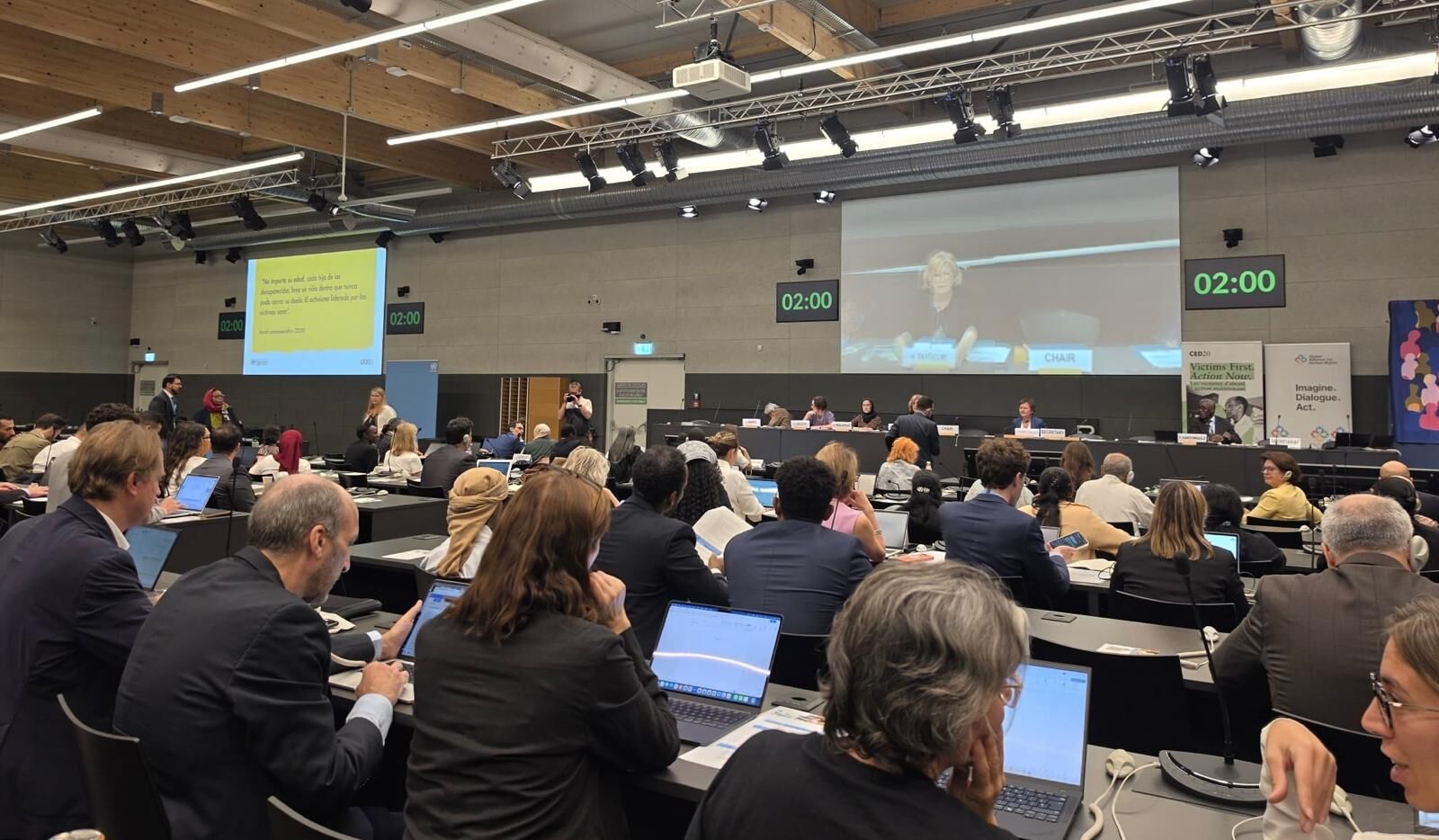
Commemorating CED20 in Geneva
The theme chosen for the commemoration of CED20 is “Victims first. Actions now”. It puts victims at the centre of all efforts and stresses that enforced disappearances are preventable, and that States and other stakeholders have clear responsibilities and tools to act2.
On 24 September 2026, the UN Committee on Enforced Disappearances (CED), the Global Alliance for Human Rights, the Geneva Human Rights Hub and the Permanent Representation of France to the United Nations Office at Geneva celebrate the anniversary. The Global Alliance for Human Rights will launch the initiative: “We Are Still Here: Putting Victims at the Centre of the Human Rights Movement”. Built on lived experiences, this project will bring together networks of victims, civil society, States, cities, the private sector, academia, artists and human rights mechanisms. Together they will co-design, among other things, a practical guide for State authorities, cities and private institutions. The guide will set out concrete measures to address the daily challenges faced by survivors and families of disappeared persons, including in terms of legal status, banking, insurance, education and health. Finally, the drafters of the Convention, victims of enforced disappearance, and members of the CED and of the Working Group on Enforced or Involuntary Disappearances (WGEID) will look back at the Convention's history, achievements and challenges, and discuss the way forward.
The Convention: Defining Enforced Disappearance
Article 2 of the Convention defines enforced disappearance as the arrest, detention, abduction or any other form of deprivation of liberty by agents of the state or by persons or groups of persons acting with the authorisation, support or acquiescence of the State. This must be followed by a refusal to acknowledge the deprivation of liberty or by concealment of the fate or whereabouts of the disappeared person, which places that person outside the protection of the law.
Enforced disappearance is therefore characterised by three cumulative elements (see A/HRC/16/48/Add.3): i) the deprivation of liberty against the will of the person; ii) the involvement of government officials, at least by acquiescence; iii) the refusal to acknowledge the deprivation of liberty or concealment of the fate or whereabouts of the disappeared person3.
Two Complementary Mechanisms: the CED and the WGEID
On the one hand, the implementation of the Convention is monitored by the Committee on Enforced Disappearances (CED), a body of independent experts that oversees how States parties apply the treaty. Its responsibilities include: examining reports from States parties and making recommendations on enforced disappearances in that State (article 29); registering requests for urgent action (article 30); receiving individual complaints from victims of a violation of the Convention by a State party (article 31); and receiving inter-State communications, in which a State party claims that another State party is not fulfilling its obligations under the Convention (article 32)4. The procedures under articles 31 and 32 apply only to States that have recognised the Committee's competence to that effect.
On the other hand, there is the Working Group on Enforced or Involuntary Disappearances (WGEID), whose main function is humanitarian. It assists families in determining the fate or whereabouts of their loved ones who have reportedly been forcibly disappeared, and acts as a channel of communication between relatives (or the organisations supporting them) and the governments concerned. To this end, it receives, examines and transmits to governments the reports of enforced disappearances submitted by relatives or by human rights organisations acting on their behalf. It asks governments to carry out investigations and to share their results, and follows up on these requests periodically. Cases remain open in the WGEID's database until the fate or whereabouts of the person is determined5.
The Committee and the Working Group coexist and cooperate to assist States in their fight against enforced disappearances, taking into account that the Committee can intervene only in States that have ratified the Convention, while the Working Group can consider the situation in all countries. Furthermore, the Committee can only deal with cases of enforced disappearance that occurred after the entry into force of the Convention on 23 December 2010, while the Working Group can examine all situations before that date6.
Twenty Years On, Thousands Remain Unaccounted For
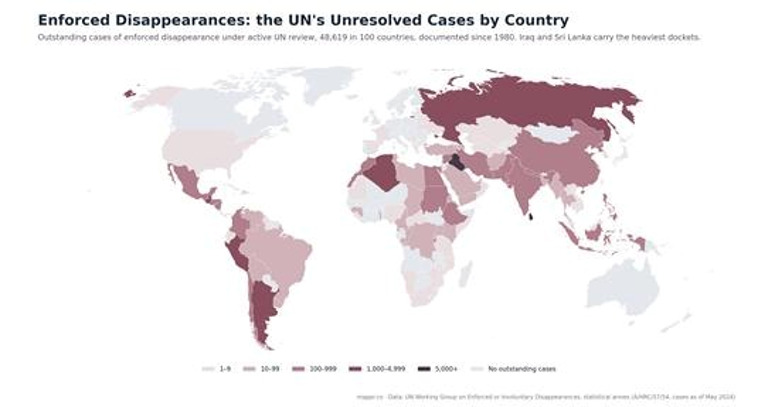
Today, 48 619 people are still unaccounted for. Since 1980, the UN's Working Group on Enforced Disappearances has transmitted 61 626 cases to governments in 115 countries. Nearly 49 000 of them, in 100 countries, have never been clarified: the person was never found, alive or dead. These figures only reflect cases formally documented by the UN, and the real numbers are likely much higher. Syria's true toll is estimated in the tens of thousands, against only 355 cases recorded by the UN, and Mexico's national registry lists more than 100,000 missing persons, against 697 UN cases.
Behind the Numbers: The Suffering of Victims and Their Families
Enforced disappearance has frequently been used as a strategy to spread terror within societies. The insecurity it generates is not limited to the close relatives of the disappeared: it also affects their communities and society as a whole7.
These figures must not hide the suffering of the victim. Article 24(1) of the Convention defines the victim as the disappeared person and any individual who has suffered harm as the direct result of an enforced disappearance. The disappeared person is frequently tortured, and many are killed or live in constant fear of being killed. Globally, the vast majority of victims of enforced disappearance are men, yet it is often women who lead the struggle to find out what happened, putting themselves at risk of intimidation, persecution and violence.
Families, relatives, and any other persons affected also carry the emotional weight and slow anguish of not knowing where their loved one is, or how they are being treated. Psychologically, they live with ambiguous loss, survivor’s guilt, severe depression, loss of trust in institutions, fear, and other forms of psychological distress. They also suffer from financial loss, most notably when the breadwinner disappears. Children may lose access to education, and be pushed to work from an early age as the family loses its income. The search itself is costly, as legal fees, travel and other expenses quickly accumulate, and some relatives cannot keep working because of their distress and their intense focus on the case. Finally, legal procedures can be long (from six months to ten years), complex and, in some institutions, compounded by corruption, and they are often met with a limited response or none at all from the competent authorities.
Ratification Gaps and Remaining Challenges
At the time of publication, 78 countries have ratified the Convention and 39 have signed it, while another 80 have taken no action. Since the Committee can act only in States parties, the Convention's protection is still far from universal, and enforced disappearances remain a global issue8.
GICJ Engagement and Recommendations
Geneva International Centre for Justice (GICJ) actively works with the Committee on Enforced Disappearances. Over the years, it has sent multiple reports, and participated in meetings with the Committee members of the CED, most notably regarding Iraq. GICJ reaffirms its collaboration with the CED in combating these violations.
GICJ emphasises in its activities the suffering of the victims, their families, relatives, and any other persons affected by the disappeared person. A victim is more than a definition or a number on a statistical chart: it is a person suffering in more ways than one. Meanwhile, families and relatives remain in a painful darkness, seeking answers, justice, truth, and the safe return of their loved one. GICJ is grateful for the efforts of the CED, the WGEID, non-governmental organisations, and all other organisations and persons, working to enforce the Convention.
GICJ calls upon the rest of the international community to ratify the Convention, including the individual complaints procedure, the interstate communication, and the inquiry procedure. It urges all states to enforce the convention, and to cease any violations. It also demands the safety and return of the disappeared persons to their families, as well as respect for the victim’s right to truth, justice, and reparation.
[1] OHCHR. “Ohchr.” Ohchr, 2026, https://www.ohchr.org/en/treaty-bodies/ced/20th-anniversary-adoption-international-convention-protection-all-persons-enforced-disappearances. Accessed 23 Sept. 2026.
[2] OHCHR. “Ohchr.” Ohchr, 2026, https://www.ohchr.org/en/treaty-bodies/ced/20th-anniversary-adoption-international-convention-protection-all-persons-enforced-disappearances. Accessed 23 Sept. 2026.
[3] “OHCHR | About Enforced Disappearance.” Ohchr, https://www.ohchr.org/en/special-procedures/wg-disappearances/about-enforced-disappearance. Accessed 23 Sept. 2026.
[4] “OHCHR | About Enforced Disappearance.” Ohchr, https://www.ohchr.org/en/special-procedures/wg-disappearances/about-enforced-disappearance. Accessed 23 Sept. 2026.
[5] “OHCHR | About Enforced Disappearance.” Ohchr, https://www.ohchr.org/en/special-procedures/wg-disappearances/about-enforced-disappearance. Accessed 23 Sept. 2026.
[6] “Introduction.” Ohchr, 2025, https://www.ohchr.org/en/treaty-bodies/ced/introduction. Accessed 23 Sept. 2026.
[7] “OHCHR | About Enforced Disappearance.” Ohchr, https://www.ohchr.org/en/special-procedures/wg-disappearances/about-enforced-disappearance. Accessed 23 Sept. 2026.
[8] OHCHR. “Status of Ratification Interactive Dashboard.” Ohchr.Org, 2014, https://indicators.ohchr.org/. Accessed 23 Sept. 2026.
